
Membership of ESAI is open to all those with a research interest in education, whether they work in universities, in colleges, in schools, in managerial bodies, in administrative or policy-making positions, or as unwaged persons.
A primary aim of the ESAI is to ensure, as far as possible, that educational discourse in Ireland remains grounded in perspectives which are adequately acquainted with the evidence from the various disciplines of educational research and that educational policy-making at all levels remains similarly informed by arguments which are educationally sound.
The well of resilience is running dry, but universities keep drawing from it
Resilience is often praised as a professional virtue, but what happens when it becomes something the job quietly depends on? Research with teacher educators in Ireland and the UK reveals how universities have built working conditions that rely on staff absorbing excessive pressures.
From outsider to researcher: Making the invisible barriers to education progression visible
Research reveals why students from disadvantaged backgrounds in Ireland remain underrepresented in higher education despite policy initiatives. Financial aid isn’t enough – we must address the invisible barriers of social and cultural capital that block educational progression.
Challenging the rise of transactional language in educational policy
Education reform deserves language that reflects its complexity. When policy borrows the vocabulary of markets and business, we risk reducing teaching to a transaction rather than a deeply human, transformative process.

Why teacher educators stay – the power of PERMA in practice
The occupational wellbeing of all involved in education is important; however, the wellbeing of one cohort, higher-education-based Teacher Educators, is often overlooked. We take a closer look at how Seligman’s PERMA model can help – and how institutions can help.
Parental and Family Involvement in Children’s Digital Learning: Bridging Policy and Practice
As education systems adapt to the demands of the digital age, preparing students to live and learn in a technology driven world has become a pressing priority. The successful integration of digital technologies in education is a complex, multi-faceted process that depends on several interrelated factors, including the crucial role of family support and socio-economic conditions.

Fostering Creativity in the Classroom – developing a cross-curricular module in ITE
Dr Tiernan on fostering creativity in the classroom with a multidisplinary approach, including digital learning, drama, and linguistic responsiveness.
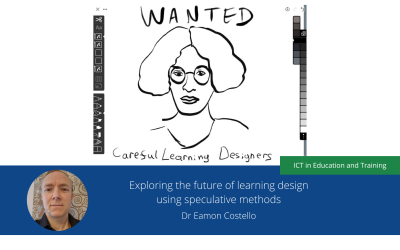
You’ve been hired! Exploring the future of learning design using speculative methods
The latest annual survey from the Association for Learning Technology (ALT) highlights the changes in the profession of those who work in the spaces where technology, teaching, and learning intersect. The brokers who work in these vital in-between places of education...

Gently down the stream(ing): Can digital literacy help turn the tide on the climate crisis?
The ubiquitous availability of digital content and web services has transformed the way we live, work, and learn (List et al., 2020). Technology provides us with tools to manage and accomplish work, content to entertain us, and applications to document, store and...

Results from a Survey on Post-Primary Teachers’ Experiences with Calculated Grading during COVID-19
In May 2020, as a result of Covid-19, the high stakes assessment at the end of post-primary education in Ireland (the Leaving Certificate Examination - LCE) was cancelled replaced by a system of calculated grades. In documentation sent to schools, the Department of...

Caring for Those who Teach Online – Reflections from a Virtual Staffroom
When schools and higher education institutions closed their doors in March 2020, some of the implicit and informal supports for teacher educators disappeared. As teacher educators migrated to new modes of teaching and learning, institutional supports such as IT...