Researchers from the Norwegian University of Science and Technology, (NTNU) presented their INCLUSCHOOLproject, funded by the Research Council of Norway, at ECER 2025. The project’s main objective is to gain new knowledge about inclusion and inclusive practices in schools.
Inclusive education is high on the global agenda and is described by UNESCO (2003) as an ongoing process grounded in the conviction that it is the responsibility of the mainstream school system to educate all children. The UN Sustainable Development Goal on Quality Education (goal no. 4) emphasizes that “Access to inclusive, high-quality education is one of the most important conditions for welfare, health and equality in all societies”.
Although research on inclusive education has intensified in recent decades, the concept continues to be interpreted and implemented in diverse ways (Keles et al., 2024). What inclusive practice actually entails remains unclear(Nilholm, 2021). Accordingly, understanding how inclusion is experienced by those directly affected, particularly students, can offer critical insights into why such gaps persist and how they might be addressed (Chapman and Ainscow, 2021; Messiou, 2024😉
The scope and aims of the INCLUSCHOOL project
By exploring inclusive practices from the bottom up in a super diverse primary school, the INCLUSCHOOL project seeks to contribute new student- and context-sensitive knowledge to the field. The project adopts a user-centered, collaborative approach, in which the students themselves, teachers and other professionals play a key role in shaping both the project design and the research process, step by step. By following their initiative, we explore how they experience, perceive, and practice inclusion in everyday school life.
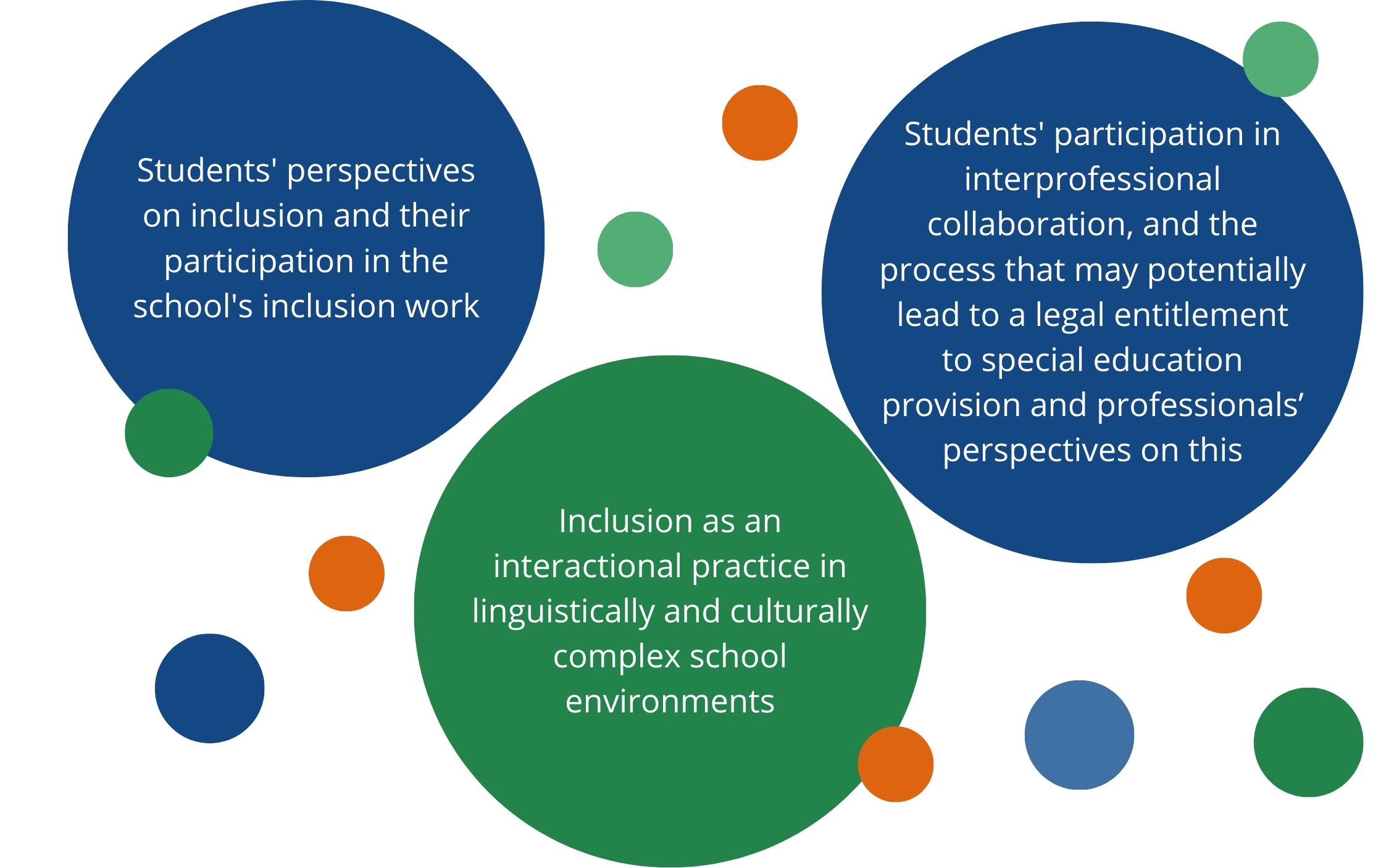
Through three sub-studies, the project will gather knowledge about:
A scoping review on students’ perspectives on inclusion
At this year’s ECER conference, participants learned more about a scoping review carried out as part of the first subproject, which aimed to map existing research on students’ voices on inclusive education.
The scoping review is intended to provide valuable insights into research on inclusive education through the voices of students, contributing to the field globally. It also aims to inspire further research into which students themselves are placed at the center.
Likewise, the study offers meaningful contributions to the INCLUSCHOOL project by raising researchers’ awareness of both the opportunities and the potential challenges involved in student-centered research. In particular, the review of 51 research articles focuses on the samples, research methodologies, and themes explored. The majority of the articles involved diverse student populations in their sample. A wide variety of research methodologies have been used in the articles, with qualitative interviews as the most common one.
The students are able to share their perspectives on many different topics, and the research articles include open-ended questions about students’ school life experiences, their socio-emotional experiences at school, and academic experiences and learning environments. Additionally, some articles included questions about students’ need for resources, access, and adjustments, their self- and other perceptions in diverse learning environments, and their life experiences and prospects of the future.
Presenting our findings from the review
Our takeaways include that student voices on inclusive education are multidimensional and complex. For example, students’ experiences of inclusion do not concern solely social-emotional or academic aspects. When schools remain arenas where the majority of students’ time is occupied by learning, their social inclusion depends on whether they are granted equitable access to shared learning activities in the classroom.
If we interpret the collective ambition of these studies as an effort to understand students inclusion experiences as multidimensional and complex, and to explore what they need to experience inclusion in school, we suggest a holistic approach. This perspective highlights the importance of contextual, processual, and interactional sensitivity in the field of inclusive education. Such an approach may offer new and valuable contributions to the field of inclusive education.
Key Messages
- The INCLUSCHOOL project in Norway explores inclusion as an ongoing process focused on students’ presence, participation, and achievement.
- Despite international commitments, progress towards inclusive education remains slow, with certain student groups at risk of exclusion.
- The project adopts a user-centred, collaborative approach in a super-diverse primary school setting.
- Preliminary findings from a scoping review highlight the complexity and multidimensional nature of students’ perceptions of inclusion.

Professor Marit Uthus
Department of Education and Lifelong Learning, Norwegian University of Science and Technology
Marit Uthus, professor, Department of Education and Lifelong Learning, Norwegian University of Science and Technology. Her research interests fall within the field of special education and educational psychology. Marit is currently leading the INCLUSCHOOL project, which is funded by the Research Council of Norway.
https://www.ntnu.no/ansatte/marit.uthus
Fenna Verkerk
Department of Teacher Education, Norwegian University of Science and Technology.
Fenna Verkerk is a PhD candidate at the Department of Teacher Education at NTNU. She is affiliated with the INCLUschool project and her research is about pupils’ voices on inclusion at school.

Associate Professor Hanne Kristin Aas
Department of Education and Lifelong Learning, Norwegian University of Science and Technology
Hanne Kristin Aas, associate professor, Department of Education and Lifelong Learning , Norwegian University of Science and Technology. Hanne does research in Educational Theory, Special Education and Teacher Education.
https://www.ntnu.no/ansatte/hanne.k.aas