ERG Webinars: Tips for academic publishing and grant application for early career researchers
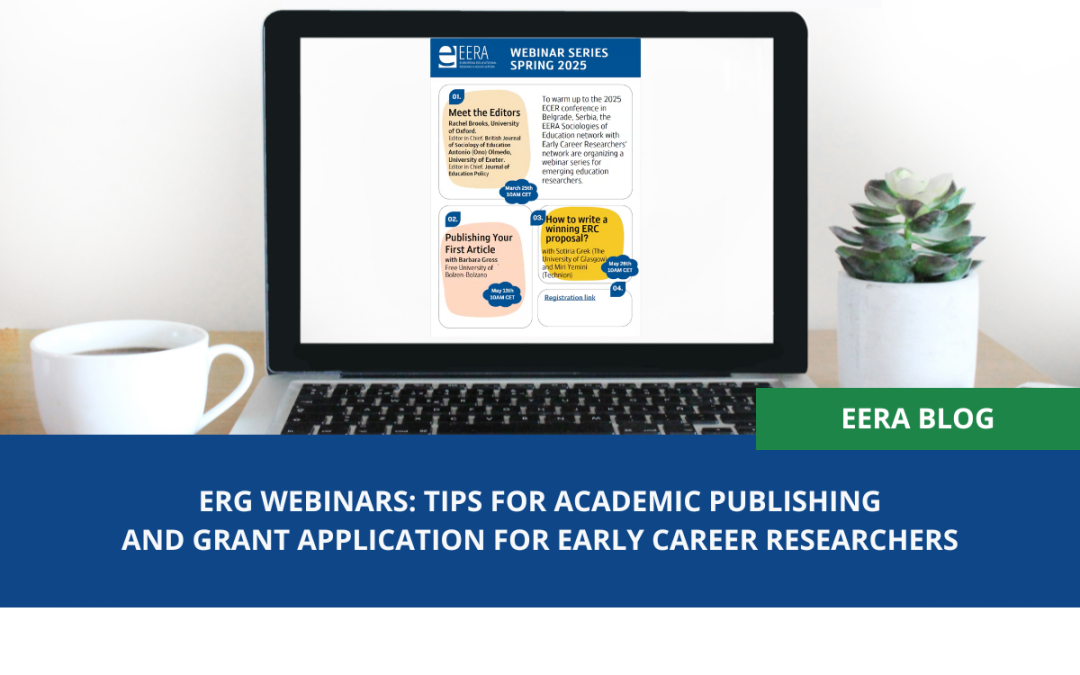
Between March and May 2025, EERA Sociology of Education Research Network and the Emerging Researchers’ Group, hosted a three-part webinar series aimed at supporting emerging scholars in navigating key stages of academic life. Each session opened a window into different aspects of early academic careers. Featuring tips on academic publishing and grant application writing, the webinars offered both practical strategies and personal reflections from experienced researchers.
Webinar 1: Meet the editors – Advice from journal editors on academic publishing
There’s a moment right after the PhD ends, when many early career researchers suddenly find themselves standing alone. No longer students, not yet fully established scholars, they’re now expected to publish, write grant applications, and shape an academic identity. But where do you learn how to do any of that? How do you figure out where to submit your article, or why one paper gets accepted while another is rejected? These are not just technical questions. For many of us, they’re questions about belonging, confidence, and finding our voice in a world that often assumes we already know the rules.
That’s why our recent “Meet the Editors” webinar felt so meaningful. It wasn’t just about insider tips on academic publishing, it was about opening the black box of publishing and hearing directly from those who sit on the other side. We had the privilege of hosting two generous and thoughtful editors, Prof. Rachel Brooks, University of Oxford, Editor-in-Chief of the British Journal of Sociology of Education and Prof. Antonio (Ono) Olmedo, University of Exeter, Editor-in-Chief of the Journal of Education Policy. They spoke about the differences between their journals, what kinds of scholarship each is looking for, and how editorial decisions are made.
Building on the spirit of the conversation, the webinar offered more than just practical tips, it opened a window into how experienced editors think about publishing, not only as gatekeepers but as mentors and scholars themselves. They reminded us that before submitting an article, it’s essential to read recent issues of the journal we’re aiming for. What topics are being discussed? What theoretical frameworks and styles of argumentation are common? A strong paper doesn’t just present something new; it actively engages with the existing conversation and signals why its contribution matters in that space and moment.
The editors also emphasized the importance of timing. Don’t rush to submit; ask yourself whether this is truly the best version of your paper, and whether you’re ready for it to be read critically. Too often, early-career researchers focus on showcasing their data or findings without thinking carefully enough about where the paper belongs and why now. Editors are not only looking for originality; they’re also looking for relevance: why this paper, in this journal, at this time?
More than anything, the conversation reminded us that finding your way into academic publishing isn’t just about following rules. It’s about developing a sense of voice, confidence, and connection. And that’s not something you have to figure out alone.
Webinar 2: Publishing your first journal article
This second webinar featured Prof. Barbara Gross from the Free University of Bolzano-Bozen, who shared reflections and practical tips on publishing a first academic article. With a particular focus on selecting an appropriate journal, the session offered insights drawn from Prof. Gross’s own experience as a researcher and author. Aimed at emerging researchers, the webinar provided concrete strategies to navigate the complexities of academic publishing and addressed key considerations involved in taking the first steps toward publication.
The session moved from big-picture ideas to practical steps, outlining different publishing options such as book chapters, conference proceedings, and most importantly, peer-reviewed journal articles. Participants explored the differences between national and international publishing cultures, the growing role of English for global visibility, and the ongoing value of publishing in national languages to reach local audiences.
A key focus was on selecting the right journal. Our guest lecturer explained how to evaluate a journal’s scope, audience, mission, and ranking – including impact factors and quartiles – and how to balance national and international outlets. She also touched on open access and the institutional support available to cover related costs.
When it came to writing, Prof. Gross highlighted the importance of identifying a clear research gap, building a well-structured article, and following journal guidelines closely. Ethics were stressed, from transparency in data use to participant privacy and disclosure of AI tools.
Prof. Gross then guided participants through the submission and peer-review process, noting that revisions are a normal and constructive part of publishing. She offered tips on responding to reviewer feedback, even when disagreeing, and reminded attendees to submit to only one journal at a time. Rejection, she said, can be an opportunity to improve and resubmit.
Finally, the webinar closed with strategies to increase the visibility and impact of published work, including conference presentations, networking on platforms, and tracking citations and metrics. By the end, participants had a clear sense of the steps involved in moving from research to publication, along with the confidence to start their own publishing journeys.
Webinar 3: Writing a successful ERC grant application
Our final webinar sought an insider view on how to write a successful European Research Council (ERC) grant application. While numerous webinars address the technical details of the application process, since education research is rather underrepresented amongst the successful applications, we were curious to invite colleagues who can speak from the particular perspective of education researchers.
To our great excitement, two distinguished scholars from the critical education field, Prof. Sotiria Grek and Prof. Miri Yemini accepted our invitation to share their reflections and experiences about the exceptionally competitive application process. Prof. Yemini is leading an ERC Consolidator Grant project exploring youth activism in diverse contexts, including climate crisis and human rights between 2023 and 2028 (See the project website here).
Prof. Grek led an ERC Starting Grant (2017-2022) on the ‘International Organisations and the Rise of a Global Metrological Field’ (METRO), researching the role of international organisations in the quantification of global governance, with a focus on the fields of education and sustainable development. Since 2024, she has been working on an ERC Consolidator Grant entitled ‘Art and Policy in the Global Contemporary: Examining the Role of the Arts in the Production of Public Policy’ (POLART, 2024-2029).
We had a rich and insightful conversation with the two scholars who shared details about their personal journey of developing the project proposal and their experiences about the interview phase in an informal yet right-to-the-point manner. The conversation had three key messages[1].
Grant proposal writing is a specific kind of writing
This can be learnt and should be practised. The best ideas need time and care to hatch. One needs to dedicate time to sit on them, talk about them, cook them, and dream about them.
Timing is key
This helps to successfully get the project together. One needs to block time to read and write, and to schedule a generous amount of time to receive feedback. A strong proposal gives the feeling to the reviewer that the idea is ‘timely’, and the time to do the research is now.
Balance and focus
Being centred and focused from the beginning to the end of the proposal leads to success. One needs to demonstrate a good balance between the project’s feasibility and ambition. From family and friends to mentors and colleagues; the more diverse audience the better. All of this provides a safety harness. Mock interviews with mentors and professional providers prove extremely helpful in the preparation for the interview, because they could accurately predict the reviewers’ questions and allow space to rehearse for them.
On a final note, both scholars emphasised that they realized how important the people they have been working with became for them. Project leadership is about building and valuing the team one creates and co-create researches with.
[1] The key points follow Prof. Grek’s presentation
Unfortunately, due to a technical issue, we do not have a recording of this webinar.
Together, these three webinars offered an insight into the journey of the challenges faced by early-career researchers. From finding one’s voice in publishing, to submitting that very first article, to preparing for ambitious grant applications, the series reflected our commitment as a community to supporting the next generation of scholars. We are grateful to all our speakers and participants, and we look forward to continuing the conversation.
Key Messages
- Early-career researchers must learn to navigate academic publishing, journal selection, and grant writing to build their academic identity.
- Engaging with journal editors provides essential insights into publishing expectations, peer review, and developing scholarly voice and confidence.
- Selecting the right journal, understanding publishing cultures, and responding to feedback are vital steps in publishing your first article.
- Successful grant writing requires dedicated time, clear focus, and learning from mentors, with strong project leadership and teamwork.
- Community support, mentorship, and sharing experiences are crucial for emerging researchers facing the challenges of early academic careers.