Teacher burnout: Lessons from the aftermath and what helps teachers thrive again

Teacher burnout: Lessons from the aftermath and what helps teachers thrive again

Teaching is one of the most rewarding professions, but also one of the most demanding. Across Europe, nearly half of teachers report experiencing high levels of work-related stress (European Commission, 2021). For some, this stress escalates into teacher burnout, a psychological syndrome marked by exhaustion, emotional detachment, and a reduced sense of personal accomplishment (Schaufeli et al., 2020).

Much of the existing research has focused on the causes of burnout before teachers leave the classroom, and on its consequences once they have dropped out (Ahola et al., 2017). But what happens after burnout, when teachers return to work? Too often, the story ends at the point of absence. Yet the period of reintegration can be just as challenging. Understanding this ‘teacher burnout aftermath’ is essential if schools want not only to support teachers effectively but also to retain them in the profession.

Our study into reintegration after teacher burnout
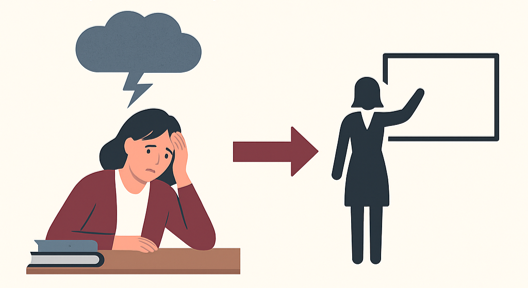
An illustration of a woman under a stormy cloud. She looks worried. An arrow points to a woman in front of a white board, indicating that this image references teacher burnout.

To address this gap, our study explored the experiences of ten teachers who returned to the classroom after burnout. Using semi-structured interviews, we investigated the challenges they faced and the factors that helped them reintegrate successfully. Although the teachers’ experiences varied, several recurring themes emerged.

Barriers teachers encounter

Many participants described workload as the most pressing obstacle to recovery. Administrative and bureaucratic tasks consumed precious energy that could otherwise have been invested in teaching. In some cases, schools placed teachers straight back into full schedules, leaving little room to rebuild their confidence.

Relationships also proved decisive. Strained interactions with colleagues or a lack of understanding from school leaders created additional stress. Some teachers reported feeling they had to “prove” themselves all over again, rather than being welcomed back with empathy. This sense of scrutiny often made the return heavier than expected.

Supportive factors that made a difference

Despite these barriers, teachers also pointed to a range of supportive factors that facilitated their reintegration after teacher burnout.

Positive collaboration with colleagues and school leaders created a sense of safety and belonging. Teachers highlighted the importance of professional support, such as therapy, counselling, or coaching, to help them process their experiences. As one participant explained, counselling helped her set clearer boundaries and avoid slipping back into old patterns.

For many, a genuine passion for teaching was a crucial source of motivation: the classroom itself gave them energy and meaning, even if it sometimes carried the risk of overcommitment. Finally, self-care practices such as adjusting workloads, saying “no” more often, or prioritising rest were described as essential in maintaining balance.

Together, these elements created the conditions for teachers to regain stability and gradually rebuild confidence in the classroom.

A complex balance

One of the most striking findings was the dual role of certain factors. Passion for teaching, for instance, could be both a protective resource and a risk. While it inspired teachers to return, it also tempted some to take on too much too soon, undermining recovery.

This highlights the complexity of teacher burnout aftermath: resources and risks are not separate, but deeply intertwined. A factor that enables reintegration in one context can easily become constraining in another. Successful support, therefore, requires continuous adjustment and awareness, rather than one-off measures.

Personal context matters
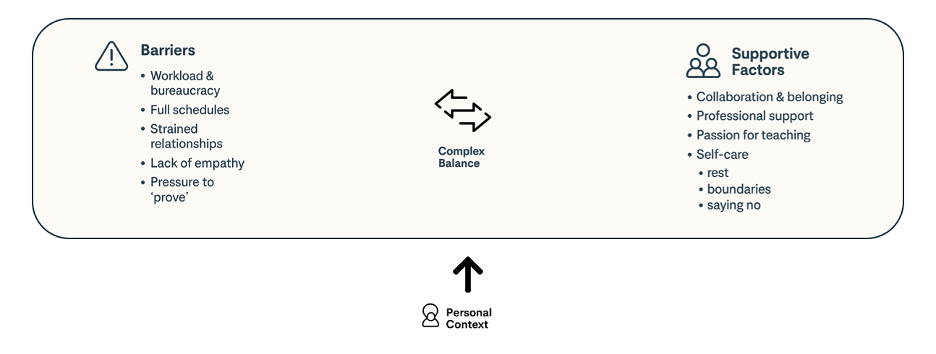
The barriers and supportive factors of teacher burnout. Barriers include workload and bureaucracy, full schedules, strained relationships, lack of empathy, and pressure to 'prove'. Supportive factors include collaboration and belonging, professional support, passion for teaching, and self-care – including rest, boundaries, and saying no. A set of arrows is between the columns of Barriers and Supportive Factors, pointing in both directions, to denote the complex balance between these.

The study also revealed the decisive role of personal circumstances. Teachers with supportive families or flexible private responsibilities generally found reintegration smoother. Those facing additional stressors, such as caring duties or financial pressures, often experienced a heavier burden.

This underlines that reintegration after burnout is not a one-size-fits-all process but highly context-dependent. Any support strategy must take account of both the professional and personal dimensions of teachers’ lives.

What schools can do

Our findings point to the critical role of school leadership in enabling successful reintegration. Support cannot rely on individual goodwill alone; it requires both organisation-wide frameworks and tailored measures.

At the organisational level, schools should:

  • Ensure a realistic workload for returning teachers.
  • Provide accessible professional support such as counselling.
  • Develop clear reintegration guidelines across the institution, so teachers know what to expect.

At the individual level, reintegration must move beyond a one-size-fits-all approach. Effective measures include:

  • Phased returns, where responsibilities are built up gradually.
  • Flexible scheduling and the reduction of non-core tasks.
  • Access to psychological support.

According to the teachers we spoke to, these personalised adjustments often made the difference between a sustainable return and a renewed risk of burnout.

Moving forward

Reintegration after burnout should not be seen as a private matter for the teacher to “manage better”.

It is a shared responsibility between the individual, the school, and the wider education system.

Addressing both structural and personal dimensions of the burnout aftermath is essential to protect teachers’ well-being and ensure their long-term retention in the profession.
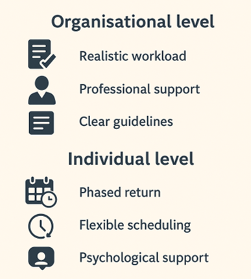
A graphic showing the support needed on an organisational level vs individual level for a reintegration after teacher burnout. On an organisational level: Realistic workload, professional support, and clear guidelines. On an individual level: phased return, flexible scheduling, and psychological support.

Conclusion

Teacher burnout does not end when a teacher leaves the classroom; in many ways, the story begins there. Returning to work presents its own set of challenges, requiring careful attention, supportive structures, and flexibility. By acknowledging the complexity of the “burnout aftermath” and implementing tailored strategies, schools can help teachers return stronger, healthier, and ready to thrive.

During the ECER conference in Belgrade, we had the chance to connect with fellow researchers and discuss the pressing challenges of teacher burnout. In particular, we explored the gaps in both research and practical strategies for supporting teachers as they return to work after burnout. Hearing their perspectives was incredibly enlightening and highlighted a shared commitment to promoting teacher well-being across diverse educational contexts

Key Messages

  • Returning to the classroom after burnout is just as challenging as the burnout itself; it’s a critical but often overlooked phase.
  • Workload, strained relationships, and lack of leadership support are major barriers to reintegration.
  • Supportive colleagues, counselling, and self-care practices help teachers to return.
  • Passion for teaching is both a motivator and a risk, highlighting the complexity of recovery.
  • Successful reintegration requires tailored, school-wide strategies that address both personal and professional contexts.

Aron Decuyper

Aron Decuyper

Department of Educational Studies, Ghent University, Belgium

Aron Decuyper is a doctoral researcher at the Department of Educational Studies, Ghent University (Belgium). In his PhD, he focuses on effective teaching behaviour in the context of team teaching. Furthermore, he conducts research on teacher educators and teacher well-being

Laura Thomas

Laura Thomas

Department of Educational Studies, Ghent University, Belgium

Laura Thomas is a postdoctoral researcher at the Department of Educational Studies, Ghent University (Belgium). Her research focuses on social networks and teacher wellbeing, spanning student teachers, early career teachers, and experienced teachers.

Maxime Moens

Maxime Moens

Department of Educational Studies, Ghent University, Belgium

Maxime Moens is a doctoral researcher at the Department of Educational Studies, Ghent University (Belgium). Her research focuses on school wellbeing policies, with a particular emphasis on teacher wellbeing.

Melissa Tuytens

Melissa Tuytens

Department of Educational Studies, Ghent University, Belgium

Melissa Tuytens is a professor at the Department of Educational Studies, Ghent University (Belgium). Her research and teaching focuses on policy, leadership, and people management in education.

Ruben Vanderlinde

Ruben Vanderlinde

Department of Educational Studies, Ghent University, Belgium

Ruben Vanderlinde is a professor at the Department of Educational Studies, Ghent University (Belgium). He focuses on educational innovation, teacher training and professionalisation and the integration of Information and Communication Technologies in education.

Other blog posts on similar topics:

References and Further Reading

European Commission/EACEA/Eurydice (2021). Teachers in Europe: Careers, Development and Well-being. Eurydice report. Luxembourg: Publications Office of the European Union. https://eurydice.eacea.ec.europa.eu/sites/default/files/teachers_in_europe_2020_chapter_1.pdf

Schaufeli, W., Desart, S., & De Witte, H. (2020). The Burnout Assessment Tool (BAT) – Development, validity and reliability. International Journal of Environmental Research and Public Health, 17(24), 9495. https://doi.org/10.3390/ijerph17249495

Ahola, K., Toppinen-Tanner, S., & Seppänen, J. (2017). Interventions to alleviate burnout symptoms and to support return to work among employees with burnout: Systematic review and meta-analysis. Burnout Research, 4, 1–11. https://doi.org/10.1016/j.burn.2017.02.001
Past reflections and future horizons

Past reflections and future horizons

EERA is celebrating 30 years in 2024, and as part of our anniversary celebrations, we have invited people who have been at the heart of the association to share their memories and reflections. In a series of blog posts, which will run throughout 2024, we will share those precious memories, from the people who helped foster the global EERA community.

Professor Venka Simovska, the first link-convenor of Network 8, Health and Wellbeing Education, and co-author of an EERA / Springer publication on wellbeing and schooling, thinks back on her years with EERA, the role of Network 8, and the new phase that EERA is entering.

As we mark the 30th Anniversary of the European Educational Research Association (EERA), I reflect on the incredible journey since the establishment of Network 8, Health and Wellbeing Education, in 2010. As the first link-convenor of this network in the period 2010-2017, and a member of the convenor group since then, my experience has been both fulfilling and transformative, providing me with unique insights into the role that EERA plays in shaping the landscape of educational research and the community of educational researchers.

Acknowledging the profound influence of education on the development and wellbeing of children and young people, and recognizing the interconnectedness between education and wellbeing, Network 8 was established to serve as a platform for researchers to engage in examining the complexities, tensions and ambiguities associated with health and wellbeing in schools. Our open and inclusive approach to research acts as a catalyst for collaboration crossing different disciplines and research paradigms, fostering critical examination of various conceptualizations, theoretical framings, and research methodologies related to school-based health and wellbeing.

I have vivid memories of ECER in Berlin in 2011 where Network 8 had its first slot in the conference agenda. The invigorating atmosphere of that conference has stayed with me throughout the past years and, remarkably, has even intensified in subsequent conferences. Year by year, I have had the pleasure of reconnecting with colleagues from Europe and beyond and creating new connections in this dynamic academic community. Another strong trace in my reflections is ECER in Budapest in 2015, marked by the refugee crisis in Europe, and the sense of solidarity and activism that the EERA community demonstrated. Fast forward to ECER 2021, the landscape shifted dramatically as the conference was held online due to the global COVID-19 pandemic. Despite the physical disconnect, the virtual setting provided a meaningful platform for researchers to stay connected during extraordinary times.

The following year, in a transition from the purely virtual experience, ECER 2022 was organized as a hybrid format. We were presented with the option to either travel to Yerevan or participate remotely. Carole Faucher, a distinguished member of the convenor group for Network 8, delivered a keynote in Yerevan. Her presentation addressed the global-local dichotomy in knowledge production, a topic that is a central focus of our network’s interests, and a theme we are dedicated to strengthening in the future. Finally, ECER 2023, hosted by the University of Glasgow, emerged as a milestone with a record-breaking number of participants. This resonated not only within Network 8 but across all EERA networks, highlighting the indispensable role of this research community on a global scale. In my view, this record-setting conference, as well as the evolving nature of ECER conferences, from the challenges of the refugee crisis to the adaptability demanded by a global health pandemic, underscores the resilience of the EERA community and its dedication to advancing research in the field of education.

Furthermore, EERA’s commitment to developing educational research is distinct in its support and nurturing of more than 30 thematic research networks like Network 8. This not only enhances the quality and diversity of educational research but also contributes to the professional development of researchers at various stages of their careers. By prioritizing both established thematic networks and the promotion of emerging scholars, EERA contributes to the vitality, capacity, and quality of educational research in times marked by neoliberal societal tendencies that can be inhospitable to research in humanities and social sciences.

Through its engagement in ECER, Network 8 has contributed to shaping fresh research agendas and fostering research cooperation. One significant outcome is manifested in the partnership with the Emerald Journal Health Education, resulting in several special issues portraying the state-of-the-art research in the field. One of the most recent collaborative research outcomes is the publication of the book “Wellbeing and Schooling: Cross-Cultural and Cross-Disciplinary Perspectives” in 2022 within the EERA Book Series by Springer. Co-edited by Ros McLellan, Carole Faucher, and myself, and with contributions from about 20 scholars from the network, this book revisits, challenges, and rearticulates taken-for-granted wellbeing conceptualizations, policies, and intervention frameworks.

As I turn towards the future, reflecting on the challenges Network 8 has confronted and navigated over the years, in the domains of reviewing, publishing, presenting, and debating research—a clear appeal emerges for EERA to strengthen its commitment to explicit acknowledgement and incorporation of diverse ethico-onto-epistemologies in the research presented at ECER and other EERA practices. The historical influence of Eurocentrism, rooted in the dominance of Western perspectives, has shaped the trajectory of academic research, often marginalizing non-European ways of knowing. By embracing a broader spectrum of cultural, social, and indigenous knowledge systems, EERA can not only enhance the quality and relevance of research but also contribute to challenging entrenched power imbalances within academia. This is not just a matter of intellectual diversity; it is a dedication to fostering a truly pluralistic and democratic scholarly landscape.

Marking three decades of existence, EERA is now entering a new phase characterized by maturity, resilience, accumulated experience, and a strong sense of community. As we celebrate this milestone, I am confident that EERA can be at the forefront of cultivating a research environment where diverse epistemological, ontological, methodological, and ethical perspectives are not only recognized but also celebrated, contributing to knowledges that reflects the richness of our global intellectual heritage. In embracing this transformative shift, collectively we can set the stage for a future where academic discourse is genuinely reflective of our complex, diverse and interconnected world.

Professor Venka Simovska

Professor Venka Simovska

Danish School of Education, Aarhus University, Copenhagen

Venka Simovska is a Professor in School Development, Learning, and Wellbeing at the Danish School of Education (DPU), Aarhus University, located in Copenhagen, Denmark. Her research interests lie at the intersection of educational theory, psychology, and health and wellbeing promotion in schools.

Simovska‘s scholarly work is characterized by qualitative and plural research methodologies, embracing interpretive and (post)critical paradigms. She is currently leading a research project funded by the Independent Research Fund Denmark (DFF), titled: “Paradoxes of Learning to be Well: Re-examining the Curriculization of Wellbeing” The project critically examines wellbeing discourses and practices in primary and lower secondary schools in Denmark.

In addition to her research, Simovska has recently co-edited the book “Wellbeing and Schooling: Cross-Cultural and Cross-Disciplinary Perspectives” alongside Ros McLellan and Carole Faucher. This publication is part of the EERA Book Series – Transdisciplinary Perspectives in Educational Research published by Springer.

The EERA Office – The view from within the spaceship

Angelika Wegscheider explains what it is like to steer the ‘spaceship’ of the EERA office, the changes she has seen over the years, and the lessons she’s learned from her time with the organisation.

A European Space for Educational Research and Dialogue

Past Secretary General of EERA, Professor Lisbeth Lundahl on the importance of EERA as an open and welcoming space for educational research and discourse.

20 Years a-going – Reflecting on two decades with EERA

Past President, Professor Joe O’Hara takes a walk down memory lane to celebrate EERA’s 30th anniversary, and reflects on the developments and achievements of the organisation.

Twenty years of participating in EERA’s 30 years

In this blog post, Professor Emeritus of Educational Sciences at Utrecht University in the Netherlands, and previous EERA president, Dr Theo Wubbels reflects on his involvement in EERA over the years, and where the organisation’s future lies.

My EERA story – from novice doctoral researcher to ERG Link Convenor

ERG Link Convenor Dr Saneeya Qureshi looks back on her journey, from her first conference, to her professional and personal growth with EERA, and the friendships made along the way.

Establishing Network 27 – and trends in didactics of learning and teaching over the past decades

Professor Emeritus Brian Hudson on the establishment and development of Network 27, and the associated trends in didactics of learning and teaching over the past few decades.

EERA’s unique buzz – and the lessons I’ve learned

Professor Emeritus Terri Seddon explains why the European Conference on Educational Research became her ‘first-choice’ academic conference, and worth the long-haul flights from her home in Melbourne. 

Experiences and benefits from collaborating in the international ethnography network

Four long-term Network 19 members, currently serving as network convenors, share their stories and insights into what the network means to them.

Developing an EERA Network Identity – NW 20 through the years

As part of our 30th anniversary celebration, Professor Raimonda Brunevičiūtė reflects on her EERA journey, and the development of Network 20, Research in Innovative Intercultural Learning Environment.

Growing (with) EERA Network 14

As part of our 30 years of EERA celebrations, Dr Joana Lúcio reflects on her time as Link Convenor of Network 14, and her professional and personal growth.

Pleasure, confusion, and friendship – 30 years of EERA

EERA’s first Secretary General and founding editor of the EERJ, Professor Martin Lawn, looks back at the sometimes rocky road of EERA, the developments into the organisation it is today, and considers where the journey should go next.

Improving the quality of education – EERA Network 11 through the years

To celebrate EERA’s 30th anniversary, Dr Gento takes a look at the activities of Network 11 to improve the quality of education, within EERA and in the wider educational research community.

Serendipity in Action: Being a link convenor for the ERG was a vibrant thread in the vast tapestry of my academic life

For the 30th anniversary celebrations of EERA, Dr Patricia Fidalgo reflects on her time as Link Convenor of the Emerging Researchers’ Group, and the joy this fulfilling role brought her.

A Transformative Journey: Nurturing Emerging Researchers at the European Conference for Educational Research.

In our blog series celebrating 30 years of EERA, Professor Fiona Hallett reflects on the sense of belonging within a supportive community of scholars.