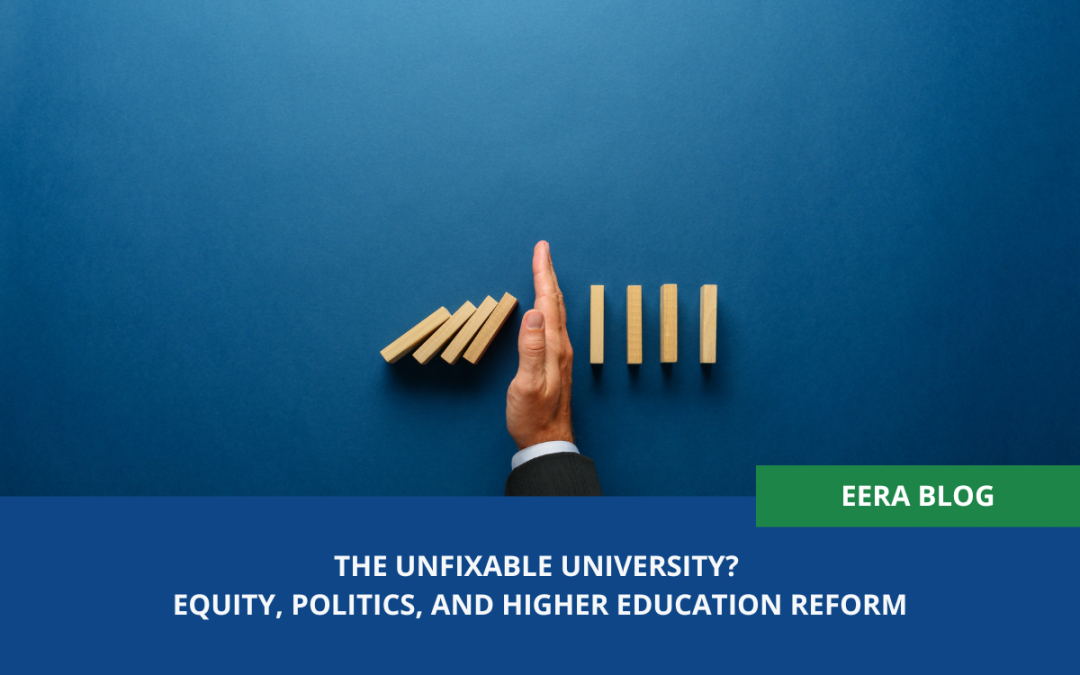
The unfixable university? Equity, politics, and Higher Education reform

The unfixable university? Equity, politics, and Higher Education reform

Richard Budd is a Lecturer in Higher Education at Lancaster University and the keynote speaker at the Emerging Researchers Conference 2026 in Tampere. His keynote, “Making Space for Socially Just Academic Practice,” draws on the themes explored in this post.

University staff around the world are being made redundant, courses are closing, departments are being restructured, and the institutions hit hardest are often the most inclusive ones. The current state of higher education raises a question that educational researchers can’t easily answer – can universities ever actually be fixed? 

What’s wrong with Higher Education?

The list of problems encountered by and within universities is considerable. As an illustration, the sector I work in, in the UK, is shrinking and being substantially reshaped. The term crisis is potentially overused in analyses of higher education, but it is hard to see it as hyperbole in this case when virtually every institution is in the process of implementing extensive internal reorganisations, large scale redundancies, and course closures. This has been a nervous time for me, still is for many others, and the worst-case scenario has already been realised for tens of thousands of dedicated staff.

How we arrived here – as well as how we are trying to get out of it – has been widely discussed. It is the result of policies which frame education solely as a financial investment and knowledge as a commodity for exploitation, with management approaches complementing this mindset. It is notable that the institutions hardest hit are those with the most inclusive admissions and pedagogical cultures, while the subjects at the greatest risk are those in the arts, humanities, and social sciences. This potentially takes those subjects away from students who are not privileged, which is a travesty. At the same time staff workloads are known to be too high, and precarious work is widespread. Staff morale is understandably low, and there are ongoing concerns for students’ deteriorating mental health.

The implications for both equity and quality are troubling. Despite decades of international research highlighting how and why students and staff from historically marginalised groups are systematically disadvantaged in (higher) education, and policies and interventions seeking to address this, progress towards better representation, experiences, and outcomes has been excruciatingly slow. This is manifest in resilient awarding gaps between White and global majority students, an overrepresentation of White, middle class men in the professoriate, and exclusionary cultures within universities themselves. With the cuts and changes impacting our capacity to teach well, support students, administer our processes, and undertake research, these are troubling times.

Not just a UK problem

While the precise manifestations of this are specific to the UK, with its particular political history and a starkly hierarchical society and university system, these themes will be familiar to many. Worldwide increases in student populations over time presents governments with a conundrum around how to fund and steer this either directly or at a distance, and how they and universities themselves (are able to) resolve this varies widely. As elsewhere, these are intertwined with the impact of interrelated global conflicts, climate change, and economic disruptions, increasing inequality and political polarisation, the rise of the far right, and questions around the risks and affordances of Generative Artificial Intelligence. What a time to be alive.

To many stakeholders for a consensus? 

Solutions are a question of perspective, and this is complicated through universities’ connection with virtually every social sphere. We educate and train a large proportion of our populations, particularly those who work in professions and who wield influence, and research virtually every aspect of our world (as well as beyond it).

This means that everyone – and everything, from a post-humanist stance – is a ‘stakeholder’ in higher education. Some have a consistent and focused interest in universities, in particular students and staff, but this extends to research funders, mission groups, think tanks, accreditors, student unions, academic publishers, and university rankers. Others may have a sustained or intermittent connection to what we do, ranging from local and national governments, schools, political parties, mainstream media, NGOs, professional bodies, employers, churches, suppliers, and financial institutions.

These constituencies have their own specific interests and priorities, some of which may operate in conflict, and possess varying degrees of leverage when it comes to being heard and effecting change. While the state looms large, it not unrestricted in its reach, and the distribution of agency and voice throughout higher education is uneven, influenced by formal and informal inherited practices, structures, and ways of thinking and doing. Students and staff want appropriate facilities and conditions for learning, living and working, but budgetary, space, and other constraints limit what is possible. They may have little influence individually but can collectively call for (or resist) change through feedback and committee structures, extending to their unions and even leading to nation-wide protests, such as those ongoing in Serbia.

Diverging interests and ideologies

Other examples can be seen through research funders’ imposition of thematic directions, often in response to what they perceive as the most pressing (or lucrative) topics, but their mandatory administrative procedures can impede the research they are seeking to support. A current issue is the need for many universities to recruit fee-paying international students but at the same time xenophobic immigration policy is making this increasingly difficult. Similarly, employers have long demanded work-ready graduates, but the world of work is changing, and labour markets can be unpredictable, such as the sudden rise in unemployment for architects after the 2008 economic crash. At a more fundamental level, clashes in underlying ideologies within and outside higher education promote or hinder change. While many – including me – would argue that our curricula, pedagogy, and practices need decolonising to broaden our knowledge and be more inclusive, others see this as a threat to cultural and disciplinary norms (and dominant groups’ advantages). This observation connects the seemingly disparate moves to stifle protests on university campuses in Australia, state attacks on equity in US higher education, and the bar on women progressing beyond primary education in Afghanistan, among others.

Where does this leave us?

Most of the ongoing debates around higher education relate to these tensions, particularly where there is a shift in the precarious balance between universities’ multiple purposes, values, and practices. Because of the diversity of groups in and around universities, where we are at a given time will never please all of them as they want different things, and someone’s interests are always being extended, retained, or denied, at the expense of others. In some ways these dynamics are what makes studying them so fascinating as we try to make sense of where we are, while being mindful of our histories, as we imagine – and try to shape – our future trajectories. It remains, however, enormously frustrating that we have the knowledge to improve universities, but progress is remains glacial, and at times, even operates in reverse.

Key Messages

Crisis is not hyperbole. UK universities are shrinking, shedding staff, and closing courses — and the institutions hit hardest are the most inclusive ones.

Policy is the problem. Treating education as a financial transaction and knowledge as a commodity drives inequity and erodes quality.

Progress on equity is agonisingly slow. Despite decades of research, awarding gaps, exclusionary cultures, and underrepresentation persist.

Everyone is a stakeholder — but not everyone has a voice. Power in higher education is unevenly distributed, and competing interests make change messy and contested.

We know what needs to happen. The evidence exists. What’s lacking is the political will and structural conditions to act on it.

ERC Keynote

At the Emerging Researchers Conference (ERC) 2026 in Tampere, Richard Budd will give the ERC Keynoteon “Making space for socially just academic practice”.

Richard Budd

Richard Budd

School of Social Sciences at Lancaster University, UK

Richard Budd is a Lecturer in Higher Education in the School of Social Sciences at Lancaster University, UK. His research interests relate to conceptualising and investigating how different groups experience and negotiate studying at or working in universities. This incorporates relational and social justice questions around personal and professional identity, organisational cultures and practices, and the geographical and physical elements of university campuses. He is particularly interested in exploring how these questions compare on a domestic and international basis. Alongside and within this work, he is actively involved in moves to decolonise higher education and his own practice.

Other blog posts on similar topics:
References and Further Reading

24 | HESA. (n.d.). Retrieved August 14, 2026, from https://www.hesa.ac.uk/news/28-01-2025/higher-education-staff-statistics-and-data-202324

AI and the Future of Universities. (2025, October 16). HEPI. https://www.hepi.ac.uk/reports/right-here-right-now-new-report-on-how-ai-is-transforming-higher-education/

Arday, J., Zoe Belluigi, D., & Thomas, D. (2021). Attempting to break the chain: Reimaging inclusive pedagogy and decolonising the curriculum within the academy. Educational Philosophy and Theory, 53(3), 298–313. https://doi.org/10.1080/00131857.2020.1773257

Australia’s universities have found themselves in crisis. But it has been decades in the making. (2026, March 16). The Guardian. https://www.theguardian.com/commentisfree/2026/mar/17/australias-universities-have-found-themselves-in-crisis-but-it-has-been-decades-in-the-making

Boero, G., Karanja, B., Naylor, R., & Thiele, T. (2025). Awarding gaps in higher education by ethnicity, schooling and family background: A UK university case study. Education Economics, 33(3), 462–477. https://doi.org/10.1080/09645292.2024.2357652

Cassidy, C. (2024, July 7). University of Sydney students and staff blast new ‘draconian’ protest crackdown. The Guardian. https://www.theguardian.com/australia-news/article/2024/jul/08/university-of-sydney-students-and-staff-blast-new-draconian-protest-crackdown

Global conflict and co-operation: Trends Shaping Education 2025. (2025, January 22). OECD. https://www.oecd.org/en/publications/trends-shaping-education-2025_ee6587fd-en/full-report/global-conflict-and-co-operation_7bb5cc7d.html

Homepage. (n.d.). The Post-18 Project. Retrieved August 14, 2026, from https://post18.co.uk/

London, K. C. (n.d.). Student mental health problems have almost tripled, study finds. King’s College London. Retrieved August 14, 2026, from https://www.kcl.ac.uk/news/student-mental-health-problems-have-almost-tripled-study-finds

Macfarlane, B. (2024). The ideology of crisis in higher education. Higher Education Quarterly, 78(4), e12500. https://doi.org/10.1111/hequ.12500

Percival, J. (2009, March 20). Architect job losses soar as crunch hits construction. The Guardian. https://www.theguardian.com/business/2009/mar/20/architecture-job-losses-construction-unemployment

Political Polarisation. (n.d.). VoxDev. Retrieved August 14, 2026, from https://voxdev.org/voxdevlit/political-polarisation

Protecting the right to education for all Afghans | UNESCO. (2026, August 14). https://www.unesco.org/en/emergencies/education/afghanistan

Review of research bureaucracy. (2024, February 9). GOV.UK. https://www.gov.uk/government/publications/review-of-research-bureaucracy

Schoonover, J. (n.d.). Academic precarity negatively impacts research culture. Wonkhe. Retrieved August 14, 2026, from https://wonkhe.com/blogs/academic-precarity-negatively-impacts-research-culture/

Stevens, M. L., Armstrong, E. A., & Arum, R. (2008). Sieve, Incubator, Temple, Hub: Empirical and Theoretical Advances in the Sociology of Higher Education. Annual Review of Sociology, 34, 127–151. https://doi.org/10.1146/annurev.soc.34.040507.134737

UK HE shrinking. (2024, March 23). https://qmucu.org/qmul-transformation/uk-he-shrinking/

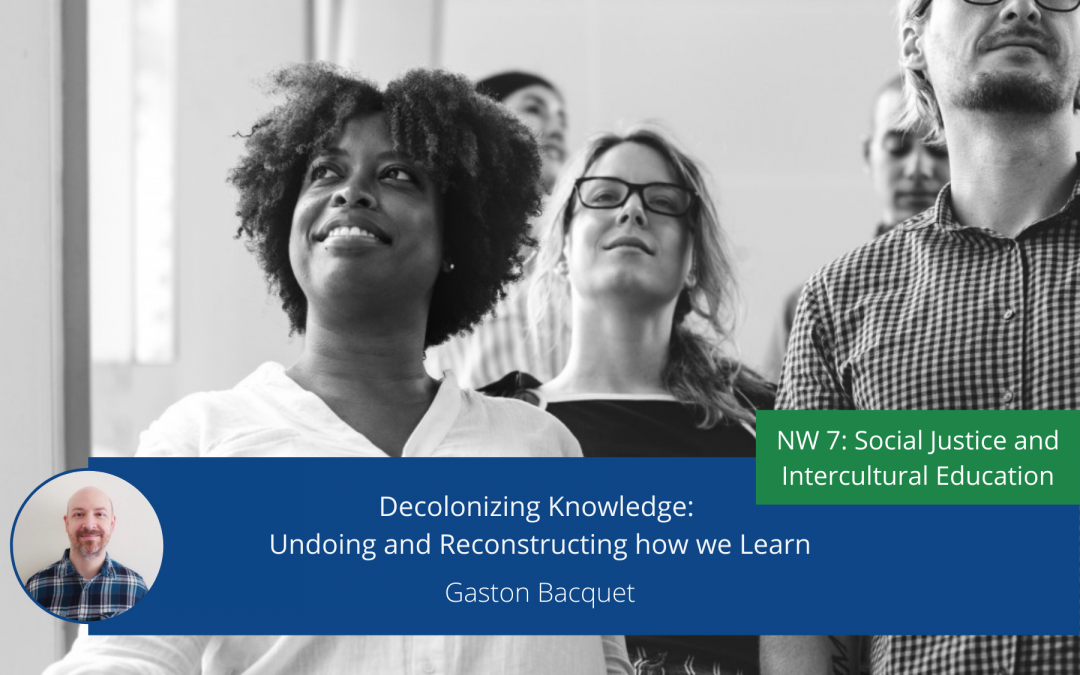
Decolonizing Knowledge: Undoing and Reconstructing how we Learn

Decolonizing Knowledge: Undoing and Reconstructing how we Learn

When British-Ghanaian philosopher Kwame Anthony Appiah was asked during a lecture about cultural belonging, he suggested avoiding falling victim to the questionable idea that culture belongs to specific groups. Further, if the dubious concept of ‘Westerner’ were to disappear, it needed not be replaced with something else but that we should rather learn to relate to people in different ways, respectful of each other’s differences without an excess of identification. The lecture host (an English woman), cautiously navigating from question to assertion, said in relation to Western civilization, “But what holds us all together are these things you’ve sort of praised: liberalism, human rights, rule of law, all those things. That gives us the right to choose, it gives us control over who we are. There are people around the world, particularly in Islamic countries, who don’t have that kind of choice. And these things ARE Western” (Appiah, 2016, m.30-36).

This view that Western knowledge and culture are somehow the core of a ‘universal knowledge’ and yet very much ‘remaining the history of the West,’ according to Tuhiwai-Smith (2012, p.66), has existed for centuries. In fact, she explains, the colonized cultures and their forms of knowledge were historically repositioned in a way that would allow for the validation of colonial domination and authority by being labeled as ‘oriental’ or ‘outsider’ by colonial powers. In line with this, Mitova (2020) defines the decolonization of knowledge as the necessity to undo our way of thinking about knowledge and to reconstruct it by learning anew and in new ways rather than those imposed on people, institutions, or nations through the process of colonization (Mitova, 2020; Wiredu, 2002).

Because Eurocentrism has succeeded in creating the idea of universal knowledge, Mignolo (2009) encourages us to ask ourselves: who and when, how, and where is knowledge generated?  Grosfoguel (2013) argues (in a description that matches my own experience as a doctoral student in the UK) that the social theory canon in Western universities has become dominated by a few men from five countries: Italy, France, England, Germany, and the USA; to this, I will further add that on a personal level, 80% of my Social Theory classes not only involved men from only two of those five countries (Germany and France) and but also that they were all white, adding an additional element to the self-arrogated intellectual (and sexist) domination: what Grosfoguel (2012) called epistemic racism. I am not arguing that every one of those social theorists was either of those things, but the recognition of their work should not come at the cost of the institutional eradication of other forms of knowledge that, especially since the 1980s, have begun to reshape and re-inform other intellectual traditions: feminist social epistemology, Eastern, African, Africana, Latin American and ‘Continental’(Mitova, 2020). 

Lessons from the Global South

Latin America presents us with a couple of valuable examples from which the academy can perhaps learn; one of them is in Chile, where, as Nuñez (2017) details, beginning in 2008, the Universidad Catolica de Temuco began to tackle the issue of curricular Eurocentrism within their teacher training programs. They started by offering a degree called “Elementary Intercultural Pedagogy in the Mapuche[1] context”. They also experimented by offering a program titled “Pedagogical Experience in Intercultural Approaches”, geared towards increasing sociocultural indigenous knowledge amongst graduate students in Education.

Burman (2016) offers a somewhat similar example from his experience in Bolivia. While researching within an Aymara community there, he was able to talk to a number of indigenous activists who remained deeply skeptical of Evo Morales’[2] policies regarding decolonization and interculturality. The activists viewed these policies as a disguised perpetuation of the colonial mode of knowledge production in Bolivia. While the Bolivian government did create indigenous universities (something that has not happened in Chile) and introduced reforms into the national educational system, many activists distrusted these policies and engaged in ‘epistemic and ontological disobedience’ (ibid, p.20). The activists opened their own spaces for knowledge creation, such as indigenous universities that function outside the national framework, as well as community sessions and seminars where indigenous people, including intellectuals, are invited to guide debates and deliberations regarding ways to preserve their knowledge and therefore, their social experience. These acts of disobedience are guided, according to Burman, by defiance to three elements that in his view have become an intrinsic part of Bolivia’s intellectual colonization:


“…the subjugation of subjectivities (“Be who we want you to be!”); epistemic domination (“Know what we want you to know and in the way we want you to know; create the kind of knowledge we want you to and in the way we want you to!”); and ontological domination (“Live in the one and only world we recognize as real!”). (Burman, 2016, p. 21)


Of course, the issue here is not the number, quality, or contributions of Eurocentric philosophers; as Dabashi (2015) elaborates, the question is not how Eurocentric Europeans are, but rather how European thinking has continued to reach a level of universality that has come to the detriment of non-European visions. Perhaps these examples from Latin American nations can offer us lessons to draw from that would allow us to embrace the fact that, as has been argued and widely demonstrated (de Sousa Santos, 2001, 2014, 2018; Smith, 2012; Apple, 2011, 2012, 2013; Semali and Kincheloe, 1999), there is no one single source of knowledge, not one single knowledge pursuit and not one single, linear development of knowledge.

The challenge for Western higher education institutions is to start thinking about ways to give these non-Eurocentric perspectives and knowledge not only wider recognition but also a broader space within their curriculum. As new feminist, Eastern, African, Latin American, and indigenous voices emerge within the academy, we must ask, how much are we paying attention and how much are we listening to them?

Other blog posts on similar topics:

Gaston Bacquet

Gaston Bacquet

Associate Tutor, University of Glasgow

Gaston Bacquet works as an Associate Tutor at the University of Glasgow, where he supervises master’s dissertations within the TESOL program and where he is also a first-year PhD student in Education. His research seeks to develop inclusive teaching practices in Latin American classrooms using an intersection of Critical Pedagogy and non-Western knowledge systems.

LinkedIn: https://www.linkedin.com/in/gaston-bacquet-59a38b9b/
Research Gate: https://www.researchgate.net/profile/Gaston_Bacquet2
Orcid: https://orcid.org/0000-0002-9802-7249

References and Further Reading

[1] Mapuches are the largest indigenous community in Chile, and Temuco, the city where the university in question is based, is located near a large Mapuche enclave in the south of Chile

[2] Evo Morales, a former farmer and an Aymara person himself, was the president of Bolivia from 2006 to 2019.


Appiah, K.A. (2018). The lies that bind: Rethinking Identity. New York: Liveright (Based on his 2016 BBC Reith Lectures).

Apple, M.(2011). Democratic education in neoliberal and neoconservative times. International Studies in Sociology of Education, 21(1), 21–31.

Apple, M. (2012b). Knowledge, power, and education: The selected works of Michael W. Apple. New York: Routledge.

Apple, M. (2013). Can Education Change Society? New York; Routledge.

Burman, A. (2016). Indigeneity and Decolonization in the Bolivian Andes: Ritual Practice and Activism. Lanham: Lexington Books.

Dabashi, H. (2015). Can Non-Europeans Think? London: Zed Books.

de Sousa Santos, B. (2001). Nuestra America. Theory, Culture & Society, 18(2–3), 185–217.

de Sousa Santos, B. (2014). Epistemologies of the South. New York: Routledge.

De Sousa Santos, B. (2018). The end of the cognitive empire: the coming of age of epistemologies of the South. Durham: Duke University Press.

Grosfoguel, R. (2012). The Dilemmas of Ethnic Studies in the United States: Be­tween Liberal Multiculturalism, Identity Politics, Disciplinary Colonization, and Decolonial Epistemologies. Human Archi­tecture: Journal of the Sociology of Self-Knowl­edge, X (I), 81-90.

Grosfoguel, R. (2013). Epistemic Racism/Sexism, Westernized Universities and the Four Genocides/Epistemicides of the Long Sixteenth Century, in Araujo, M. & Rodriguez Maeso, S. (Eds.), Eurocentrism, Racism and Knowledge, Debates on History and Power in Europe and the Americas. London: Palgrave

Mignolo, W. (2009). Epistemic Disobedience, Independent Thought and Decolonial Freedom. Theory, Culture & Society. 26(7-8), 159-181. 

Mitova, V. (2020). Decolonising Knowledge Here and Now, Philosophical Papers, 49(2), 191-212.

Nuñez, D. (2017). Reflecxiones en torno a la interculturalidad y la Educacion Superior en Chile. Polyphōnia, 1, 72-94.

Semali, L.M. and Kincheloe, J.L. (1999) What is indigenous knowledge? Voices from the academy (Eds.) New York/London: Falmer

Tuhiwai-Smith, L. (2012). Decolonizing Methodologies: Research and Indigenous People. London: Zed (2nd Edition).

Wiredu, K. (2002). Conceptual decolonization as an imperative in contemporary African philosophy: some personal reflections. Rue Descartes, 36(2), 53-64.