Advancing international comparative research on the roles of teaching assistants in schools

Advancing international comparative research on the roles of teaching assistants in schools

Despite the growing number of teaching assistants (TAs) in schools worldwide, comparative international research on their roles remains limited. Most are small-scale qualitative inquiries involving just two or three countries. While cross-country summaries exist, they are usually descriptive rather than systematic, making meaningful comparison difficult. One major barrier has been the absence of a shared framework for collecting and analysing data on TAs at scale.

That is where the International Teaching Assistant Research Network (ITARN) comes in. Formed in response to an EERA blog calling for wider collaboration in this field, our network has developed the Comparative Framework on TAs (CoFTA). This draft framework is designed to structure the collection and analysis of comparative data about TAs and their roles in schools.

Members of ITARN presented the framework for the first time at a symposium at the European Conference on Educational Research (ECER) in Belgrade in September [1]. The focus was on the formal and informal roles of TAs across five major education systems: the US, England, Shanghai (China), Germany, and Ireland.

Each paper explored how policies and wider forces shape both the intended and the actual work of TAs in practice. The final paper brought these perspectives together, highlighting key similarities and differences across the contexts, and identifying the contextual factors and drivers that explain the misalignment between TAs’ formal role and their enacted role.

Six factors shaping TA roles
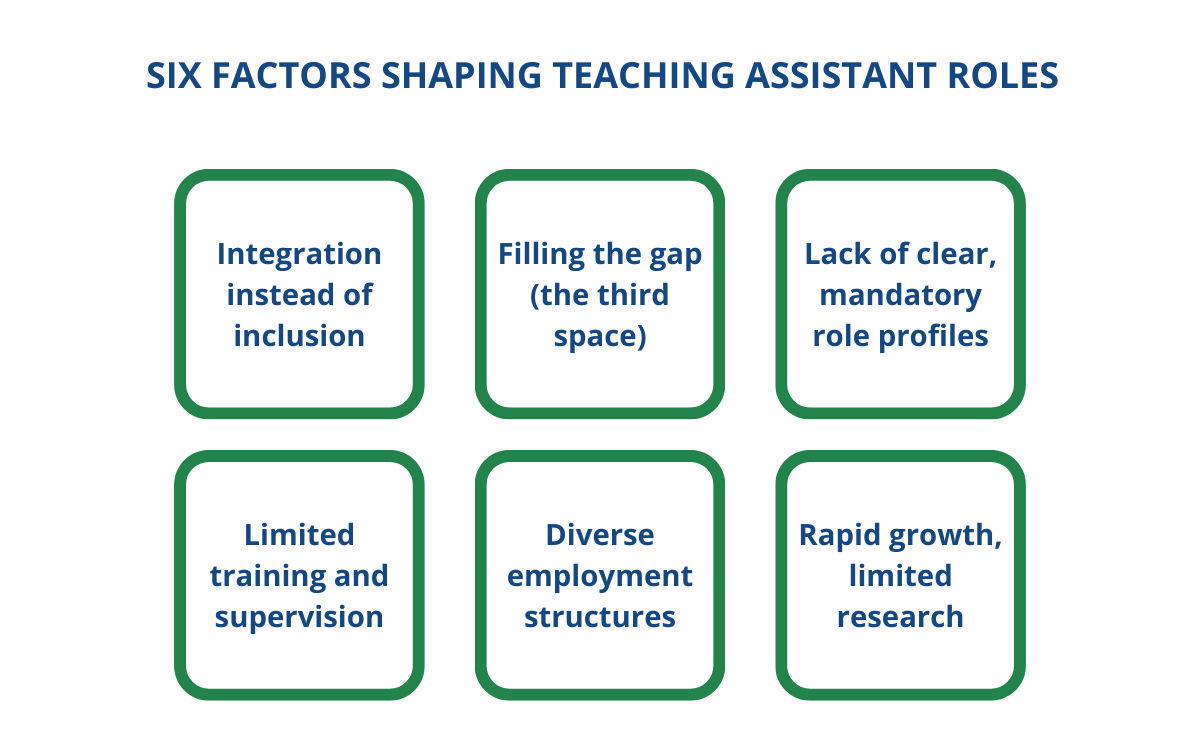
Six factors shaping teaching assistant roles - according to research - Integration instead of inclusion, Filling the gap (the third space), Lack of clear, mandatory role profiles, limited training and supervision, diverse employment structures, and rapid growth with limited research.
  1. Integration instead of inclusion. Too often, students with special educational needs (SEN) are expected to adapt to existing systems and processes, with TAs supporting them to ‘fit in’ rather than schools adapting to their needs. In each country context, TAs are viewed as pivotal to the educational and social inclusion of students with SEN. Yet at the same time, the high amounts of high intensity support these students receive from TAs cuts across and replaces time with teachers and peers, creating (unintentional) barriers to a more authentic model of inclusion.
  1. Filling the gap (or the ‘third space’). TAs are frequently deployed reactively, stepping in where there are shortages of teachers, special educators, or therapeutic support. This places them in a ‘third space’ between care and education. There are concerns where these roles overlap or stray into the jurisdiction/responsibility of professionals. For example, in Ireland, where TAs are not qualified or trained in providing emotional support to emotionally-vulnerable students; and in England, where TAs are deployed to cover classes and lead lessons because schools are short on teachers.
  1. Lack of clear role profiles. Few countries have up-to-date national policies that define TAs’ formal responsibilities. Those that do can be advisory, not mandatory. This lack of clarity not only helps explain the occupation of ‘third spaces’, but also the ways in which TAs interact with students in ways that, while well-meaning, are ultimately unhelpful. For instance, in Germany, TAs’ tendency to scribe and organise materials can erode, rather than build, students’ independence.
  1. Limited training and supervision. Possibly connected to the lack of role clarity, there is also a widespread lack of evidence-based guidance and training for TAs. However, practical guidance, which incorporates training and advice on deploying TAs to support student independence, does exist in England.
  1. Employment structures. TA employment patterns varies widely. In England, Ireland, and the US, TAs are employed by schools and part of the school system/workforce. While in Germany, TAs are employed by welfare organisations, and in China, often by the parents of children with SEN.
  1. Rapid growth, limited research. The number of TAs worldwide has grown – and continues to grow – substantially. While there is relatively more research in England, overall, research is patchy. There is vanishingly little large-scale work at the national level, let alone the international level. Also, perspectives from the global south are underrepresented.

What’s next for ITARN

The ECER symposium is just the start. ITARN is now preparing its first written outputs (including on CoFTA), bringing together the symposium papers and new contributions from a wider range of countries, including the global south. Our aim is to publish a collection that compares and contrasts international evidence and perspectives, and reflects on how social and cultural contexts shape TA roles.

Alongside this, we will continue to develop the CoFTA framework. Future work will expand its scope to include TA education and training, employment conditions, and school-level processes, such as planning, feedback, staff integration, and professional belonging.

Teaching assistants play a critical role in education systems around the world. By developing common tools for comparison and creating space for new and diverse voices, ITARN is helping to move the field forward. The work begun at ECER 2025 marks an important step toward building a truly international understanding of the TA role.

We welcome new members! If you’d like to join ITARN, or learn more about our work, please email Run Tan at r.tan@rug.nl

Key Messages

  • International understanding of teaching assistant roles is fragmented, and the newly formed International Teaching Assistant Research Network (ITARN) is addressing this by creating a shared comparative framework to unify global research efforts.

  • Across countries, teaching assistants often take on complex responsibilities shaped by policy gaps, workforce shortages, and differing interpretations of inclusion.

  • There is a persistent mismatch between how education systems intend TAs to work and the realities of their day-to-day practice, influenced by cultural, organisational, and structural factors.

  • The rapid expansion of the TA workforce contrasts with the limited scale and scope of existing research, underscoring the need for more systematic and internationally diverse evidence.

  • ITARN’s ongoing work aims to build a more coherent global picture of TA roles, enabling policymakers, researchers, and school leaders to develop more effective, equitable, and evidence-informed approaches.

Dr Rob Webster

Dr Rob Webster

Associate Professor at UCL Institute of Education, UK

Dr Rob Webster is an Associate Professor at UCL Institute of Education, UK. He was part of the research team that conducted the world’s largest study of teaching assistants: the ground-breaking Deployment and Impact of Support Staff project. Rob writes extensively on the role of teaching assistants, and he also created the award-winning Maximising the Impact of Teaching Assistants programme for schools (maximisingtas.co.uk). Prior to research, Rob worked as a teaching assistant in mainstream and special schools.

Website: www.rob-webster.com
http://orcid.org/0000-0003-1416-4439

Dr. Run Tan

Dr. Run Tan

Faculty of Behavioural and Social Sciences, University of Groningen, The Netherlands

Run Tan is Assistant Professor in inclusive and special needs education at the Faculty of Behavioural and Social Sciences in Groningen University, Netherlands. Guided by critical disability theory and cultural–historical framework, she conducts cross-cultural comparative studies to understand how inclusion takes place and how to sustain and maximize it, while bringing in the voice of the Global South. While positing children’s voice in the centre, she critically examines three key stakeholders (teachers’, teaching assistants’ and families’) agency (attitude, self-efficacy) and how their daily practice facilitate inclusion from the main four dimensions of: access, acceptance, participation and achievement.

Uni profile page: https://www.rug.nl/staff/r.tan/?lang=en

ORCID: https://orcid.org/my-orcid?orcid=0000-0002-3515-788X

Dr. Claire Griffin

Dr. Claire Griffin

Mary Immaculate College, University of Limerick, Ireland

Dr. Claire Griffin is a Chartered Educational Psychologist and Assistant Professor in Educational and Developmental Psychology at Mary Immaculate College, Limerick, Ireland. She is programme leader of the B.Ed in Education and Psychology programme and placement supervisor of trainee Educational Psychologists and trainee teachers. Claire’s PhD research focused on the preparedness and deployment of Special Needs Assistants (SNAs) when supporting pupils’ behavioural care needs and independence development in mainstream primary schools in Ireland. Since graduating, Claire has continued research in this area, with particular interest in evidence-based frameworks and procedures to enhance pupil outcomes. Claire is currently a member of the Steering Group of the SNA Workforce Development Plan in Ireland. She has previously worked on national and regional research projects in Ireland and has been recipient of a range of teaching and research awards.

Uni profile page: https://www.mic.ul.ie/staff/370-claire-griffin


Other blog posts on similar topics:

References and Further Reading

Note

[1] In addition to the authors of this blog, the following members of the ITARN network presented papers at ECER 2025:


Internationalising research on teaching assistants: A call for expressions of interest in creating a research network

Internationalising research on teaching assistants: A call for expressions of interest in creating a research network

Across the globe, the drive towards the inclusion of pupils with special educational needs (SEN) in mainstream schools has become contingent on the creation and utilisation of a paraprofessional workforce, commonly known as teaching assistants or teacher aides (TAs).  

Australia, Sweden, Canada, Finland, Ireland, New Zealand, the US, and the UK have all experienced large increases in this section of their education workforce over the last quarter-century. It is claimed that in many territories, policies of inclusion and provision for pupils with SEN rely heavily on this ‘non-teaching’ workforce (Masdeu Navarro, 2015). And recent evidence from the UK shows how vital TAs have been to keeping schools open and ensuring children can learn during the COVID pandemic (Moss et al, 2021). 

The growing prevalence and prominence of TAs in schools has attracted attention from researchers, who are keen to identify effective approaches to TA deployment and preparation, describe and measure their impact in various forms, and to characterise their experiences of work. Peer-reviewed papers on TAs started to noticeably pepper the academic literature in the mid-1990s, appearing mainly in US journals. Yet, in the subsequent decades, there have been no collections of international writing on TAs.

Until now.

A new special issue of the European Journal of Special Needs Education, which I have guest-edited with Anke de Boer (University of Groningen), draws together research and perspectives on the role, deployment, and impact of TAs from international contexts. It intends to serve as an indicative summary of work and thinking in the field to date and as a point of departure for future research and development. All articles in the special issue are free to access online from 14 May until the end of June. 

The call for papers generated a truly international response. We received nearly 50 abstracts from researchers in 17 countries across five continents. The selected papers provide insights into the liminal space between educator, caregiver, behaviour manager, and facilitator of learning and of peer relations, which characterises the TA role.

The papers consider the features of team-working and cooperation between TAs and teachers and explore the TA’s role as a facilitator of peer interactions, personal care, and instructional support for pupils with SEN. Two papers focus on the pupils’ perspective of TA support and the implications for social inclusion and the development of independence. One of the foremost researchers on TAs, Michael Giangreco from the University of Vermont (USA), reflects on more than 40 years of experience in the field in a specially-commissioned article.

Our own contribution (Webster & de Boer, 2021) draws attention to a situation that came quickly to light in the process of curating the special issue. While the call for papers shows the extent of the activity and global reach of research on TAs, it also revealed how the field lacks any coordinated network or forum for researchers to convene, share and debate ideas, and disseminate their work.

Many national educational research associations have a special interest group for those researching special and inclusive education. While these tend to provide an intellectual home for researchers studying TAs, research on/involving TAs transcends this discipline and straddles areas such as economics, feminism, and labour relations. Therefore, the launch of the special issue presents a timely opportunity to call for the creation of a network specifically designed to support research on TAs.

It could be, however, that TAs is too narrow a focus for a viable special interest group and that our field would be better served by widening and reframing our focus onto something we might nascently term ‘paraprofessional studies’.

The increase of TAs in education can be seen in the broader context of the rise in paraprofessionals across a range of public services. These are people who work alongside and support those working in professional roles in fields such as medicine, health, social work, law, and the police. Evidence from the UK and the US shows how the introduction of paraprofessionals has led to a redrawing of the boundaries between the roles of established professionals and others who work in their respective fields (Kessler, Bach & Heron, 2005; Thornley, 1997; Wallace, 2003). Indeed, papers in the special issue (for example, Östlund et al., 2021; Zhao et al., 2021) suggest that there are contexts in which TAs may have multiple paraprofessional identifies, with the roles of individual TAs combining or bridging between functions of education and care.

Our international research network would be a lively, democratic space in which researchers from across education and the social sciences could convene around the topic of paraprofessionals. Work on TAs would constitute a productive site for activity in its own right. Still, there would also be potential for rich, innovative ideas to bloom from exciting exchanges and interactions with researchers across the world investigating the role and lives of paraprofessionals in other areas (e.g., healthcare assistants). We would want our network to draw in policymakers and practitioners as well, thereby creating a dynamic, multidisciplinary interface between the worlds of research, policy, and practice.

The pandemic has reshaped ideas about connectedness. It is easier than ever (at least technically) for researchers to come together with multiple stakeholders to share experiences, discuss, debate, and develop ideas and proposals. We see potential for online gatherings and discussion, leading in years to come to real-world symposia and even an international conference – all with a major focus on TAs and TA research.

Such an endeavour, we believe, would greatly expand, empower and raise the esteem of the field of scholarship on TAs. The publication of the special issue presents an unmissable opportunity to reach out to researchers across a range of disciplines, studying any and all aspects relating to the life and work of TAs, who are interested in creating an international network for TA research.

Our paper invites readers to make contact in order to express support for, and thoughts on, establishing such a network. It is an invitation that I am happy to extend to readers of this blog. Please email rob.webster@ucl.ac.uk.


Other blog posts on similar topics:

Dr Rob Webster

Dr Rob Webster

Associate Professor at UCL Institute of Education, UK

Dr Rob Webster is an Associate Professor at UCL Institute of Education, UK. He was part of the research team that conducted the world’s largest study of teaching assistants: the ground-breaking Deployment and Impact of Support Staff project. Rob writes extensively on the role of teaching assistants, and he also created the award-winning Maximising the Impact of Teaching Assistants programme for schools (maximisingtas.co.uk). Prior to research, Rob worked as a teaching assistant in mainstream and special schools.

Website: www.rob-webster.com
Twitter: https://twitter.com/RobWebster_
http://orcid.org/0000-0003-1416-4439

References and Further Reading

Kessler, I., Bach, S. & Heron, P. (2005) Assistant roles and changing job boundaries in the public services. Final report. London: ESRC.

Masdeu Navarro, F. (2015). Learning support staff: A literature review. OECD Education Working paper no.125. https://doi.org/10.1787/5jrnzm39w45l-en.

Moss, G., Webster, R., Harmey, S., and Bradbury, A. (2021) Unsung Heroes: The role of teaching assistants and classroom assistants in keeping schools functioning during lockdown. London: UCL Institute of Education http://maximisingtas.co.uk/assets/unsung-heroesfinal.pdf 

Östlund, D., Barow, T., Dahlberg, K. & Johansson, A. (2021) In between special needs teachers and students: Paraprofessionals work in self-contained classrooms for students with intellectual disabilities in Sweden. European Journal of Special Needs Education, 36(2). https://www.tandfonline.com/doi/full/10.1080/08856257.2021.1901370

Thornley, C. (1997) The invisible workers: An investigation into the pay and employment of health care assistants in the NHS. London: Unison.

Wallace, T. (2003) Paraprofessionals. Minnesota, USA: Center on Personnel Studies in Special Education.

Webster, R. & de Boer, A. (2021) ‘Where next for research on teaching assistants: The case for an international response’. European Journal of Special Needs Education, 36(2).

https://www.tandfonline.com/doi/full/10.1080/08856257.2021.1901368

Zhao, Y., Rose, R. & Shevlin, M. (2021) Paraprofessional support in Irish schools: From Special Needs Assistants to Inclusion Support Assistants. European Journal of Special Needs Education, 36(2). https://www.tandfonline.com/doi/full/10.1080/08856257.2021.1901371  

What can international data tell us about education paraprofessionals? Almost nothing

What can international data tell us about education paraprofessionals? Almost nothing

In many schools and classrooms across the globe, the drive towards the inclusion of pupils with special educational needs (SEN) in mainstream schools has become contingent on the creation and utilisation of a relatively new paraprofessional workforce, known variously as teaching assistants or teacher aides (TAs). It is claimed that in many countries, policies of mainstreaming pupils with SEN rely heavily on this ‘non-teaching’ workforce (Masdeu Navarro, 2015).

The intertwining of inclusion and TAs leads to the view that TAs have become ‘the mortar in the brickwork … hold[ing] schools together in numerous and sometimes unnoticed ways’ (Webster et al., 2021, p2). Its relative intuitiveness – more individualised support for pupils that struggle most – is arguably why it is the model of choice for education systems and schools striving for inclusion and why it has replicated itself more successfully than just about any other model. 

Despite all this, there are virtually no macro-level data on the characteristics, role, and contribution of TAs and their relationship to and impact on inclusion. The most influential international study on schools and classrooms, the Organisation for Economic Co-operation and Development’s (OECD) Teaching and Learning International Survey (TALIS), is lauded by policymakers and researchers of advanced nations for the richness of its data and the detailed insights it provides. It, however, has vanishing little say about TAs.

The third and most recent wave of TALIS from 2018 – which involved over 275,000 respondents from 31 countries (OECD, 2021a) – stated that ‘teacher aides [and] pedagogical support staff … were not considered to be teachers and, thus, not part of the TALIS international target population’ (OECD, 2021b). Leaving aside whether there is, or there ought to be, an equivalence between TAs and teachers, the decision to exclude TAs from TALIS matters. Not just, I would argue, in and of itself, but because other high-level analyses of education rely on the data it collects, such as the authoritative Global Education Monitoring (GEM) annual report (which is hosted and published by UNESCO).

The focus of the 2020 GEM report was inclusion, yet it was unable to report much at all about TAs because ‘data on teaching assistants is limited, even in high-income countries’ (UNESCO, 2020, p300). The report concluded that ‘comparable international data on inclusion-related use of support personnel are not generally available’ (UNESCO, 2020, p306).

Elsewhere, a rare international survey, commissioned by Education International (the global union federation of teacher trade unions), of the characteristics, employment and working conditions of just over 3,000 ‘education support personnel’ [ESP] – a group among which TAs are prominent – concluded: ‘there are significant gaps in the knowledge and understanding of ESP: who they are, what they do, and what they need to do their jobs effectively’ (Butler, 2019, p1). 

If recent trends are anything to go by, and as the near-global drive towards inclusion continues, large amounts of public money will be spent on employing more and more TAs. In England, for example, school census data show that 28% of the school workforce are employed as TAs (and 35% of the primary schools’ workforce)1. However, there are no public data on what this costs or to what extent it represents value for taxpayers’ money. Such questions can be both reductive and a rather blunt way of quantifying TAs’ highly nuanced contributions to education. Nonetheless, these are the kinds of questions that motivate policymakers and imply a prima facia case for national governments to show as much interest in the working lives, practices, and perspectives of TAs as they do in those of teachers.

For this reason, in a paper for an upcoming special issue of the European Journal of Special Needs Education2, guest editors Anke de Boer (University of Groningen) and I, call for the OECD to extend TALIS in ways that reflect, and are proportionate to, the global trend towards employing and deploying TAs in educational settings (Webster & de Boer, 2021). 

Many of the themes selected for inclusion in the 2018 TALIS survey are relatable to the lives of TAs:

    • instructional practices
    • professional practices
    • initial preparation for the role
    • school climate
    • job satisfaction
    • human resource issues
    • stakeholder relations
    • career opportunities
    • professional responsibility and autonomy.


At the more basic but nonetheless essential, descriptive level, a survey of TAs would be able to track demographic trends relating to equality, diversity, and representation. Crucial, you would think, for a role synonymous with inclusion.

UNESCO Global Education Monitoring reports ‘serve as a foundation for evidence-based advocacy to promote progress towards SDG 4’ (the fourth Sustainable Development Goal on education) (OECD, 2021c). The 2020 report on inclusion points to how a broader ‘shortage of data on teachers’ from countries that are not included in TALIS represents one of three ‘data gaps remain[ing] in key areas of the SDG 4 monitoring framework’ (UNESCO, 2020, p198). The macrodata gap relating to TAs can be seen as part of the same issue. Providing and sharing the robust evidence needed to underpin policymaking and practice, and to hold world leaders to account, are essential if we are to achieve SDG 4. Progress will be all the slower, if not unworkable, without a coordinated and consolidated data collection effort that incorporates and reflects the role and contribution of TAs.

In our paper, we argue that the potentially transformative ideas for improving policy and practice in relation to TAs exist in the skillful accumulation, harmonisation, and utilisation of data at the macro, meso, and micro levels. Expanding an existing data collection effort that is funded by, and maps education labour force trends in, the world’s most advanced economies seems to us a good place to start.

The next cycle of TALIS, due in 2024, is perhaps the first opportunity to pilot a survey for TAs in a select number of territories where they are a well-established part of the school workforce.

Survey items could be limited to questions drawn from several of the most relatable themes from the teacher survey (see above), and trialled in countries such as the US, the UK, Norway, and Finland; countries that are not only above the OECD average in terms of TA-pupil ratio (7.3 TAs per 1,000 pupils) (Masdeu Navarro, 2015), but also have large enough numbers of TAs from which a meaningful sample can be drawn. We might extend our pilot to Brazil, Chile, France, the Netherlands, and Sweden, which interrogation of the most recent OECD data from 2018 suggests also have sufficiently sizable and sampleable TA populations across both primary and secondary education (OECD, 2021d).

A successful pilot could lead to approaches which, within a couple of TALIS cycles, are capable of producing the kind of data on TAs that have impressively – and in relatively short order – transformed and enhanced our understanding of teachers and teaching.

Dr Rob Webster

Dr Rob Webster

Associate Professor at UCL Institute of Education, UK

Dr Rob Webster is an Associate Professor at UCL Institute of Education, UK. He was part of the research team that conducted the world’s largest study of teaching assistants: the ground-breaking Deployment and Impact of Support Staff project. Rob writes extensively on the role of teaching assistants, and he also created the award-winning Maximising the Impact of Teaching Assistants programme for schools (maximisingtas.co.uk). Prior to research, Rob worked as a teaching assistant in mainstream and special schools.

Website: www.rob-webster.com
Twitter: https://twitter.com/RobWebster_
http://orcid.org/0000-0003-1416-4439

Further Reading

Notes

  1. Department for Education (2021) School Workforce in England: November 2019. Available at: https://explore-education-statistics.service.gov.uk/find-statistics/school-workforce-in-england (accessed 09.03.21).
  2. A special issue of the European Journal of Special Needs Education entitled ‘Teaching assistants: Their role in the inclusion, education and achievement of pupils with special educational needs’ will be published in April 2021. It draws together research and perspectives on the role, deployment and impact of TAs from six European countries.

References

Butler, P. (2019) Understanding the invisible workforce. Education support personnel’s roles, needs and the challenges they face. Brussels: Education International. Available online: https://issuu.com/educationinternational/docs/research_esp_final_report. Accessed: 04.02.21.

Masdeu Navarro, F. (2015). Learning support staff: A literature review. OECD Education Working paper no.125. Available online: https://doi.org/10.1787/5jrnzm39w45l-en. Accessed: 11.02.21.

Organisation for Economic Co-operation and Development (2021a) TALIS FAQ. Available online: https://www.oecd.org/education/talis/talisfaq/. Accessed: 04.02.21.

Organisation for Economic Co-operation and Development (2021b) Annex A. Technical notes on sampling procedures, response rates and adjudication for TALIS 2018. Available online: https://www.oecd-ilibrary.org/sites/1d0bc92a-en/1/3/1/index.html?itemId=/content/publication/1d0bc92a-en&_csp_=1418ec5a16ddb9919c5bc207486a271c&itemIGO=oecd&itemContentType=book. Accessed: 04.02.21.

Organisation for Economic Co-operation and Development (2021c) The Global Education Monitoring Report, in brief. Available online: https://en.unesco.org/gem-report/about. Accessed: 04.02.21.

 United Nations Educational, Scientific and Cultural Organization (2020) Global Education Monitoring Report 2020: Inclusion and education: All means all. Paris: UNESCO. Available online: https://en.unesco.org/gem-report/report/2020/inclusion. Accessed: 04.02.21.

 Webster, R. Bosanquet, P., Franklin, S. & Parker, M. (2021) Maximising the impact of teaching assistants in primary schools: Guidance for school leaders. Oxon: Routledge http://maximisingtas.co.uk/our-books.php

 Webster, R. & de Boer, A. (2021) ‘Where next for research on teaching assistants: The case for an international response’. European Journal of Special Needs Education, 36(2). https://doi.org/10.1080/08856257.2021.1901368