Making participation part of everyday childhood: the Everyday Model of Children’s Participation (EMCP)
Children have a right to be heard and to see their voices make a difference. These rights are central to the UN Convention on the Rights of the Child (UNCRC, 1989), yet in early childhood education, they are often inconsistently realised—sometimes limited to tokenistic gestures rather than meaningful engagement (Chicken & Tyrie, 2023). Our research seeks to deepen our understanding of how participation rights can actually be enacted for young children. We propose a new, empirically grounded model that addresses limitations in existing frameworks, particularly for younger children who are often overlooked (Alderson, 2008).
The Everyday Model of Children’s Participation (EMCP) was developed through the Children’s Participation in Schools Project, a three-year ESRC-funded study involving lower primary classrooms in Wales (Dec 2022–Nov 2025). The Research was undertaken by a team of researchers, Dr Sarah Chicken, Jacqui Lewis, Dr Patrizio De Rossi, Dr Alison Murphy, Dr Jennie Clement, Prof. Jane Williams and Dr Jane Waters-Davies.
Drawing on interviews with 14 early years educators, the model highlights how participation rights can be integrated into everyday teaching in relational, responsive, and practical ways. It also maps ecological factors – individual, organisational, and cultural – that enable or constrain adults’ ability to support these rights in daily practice.
The model in brief
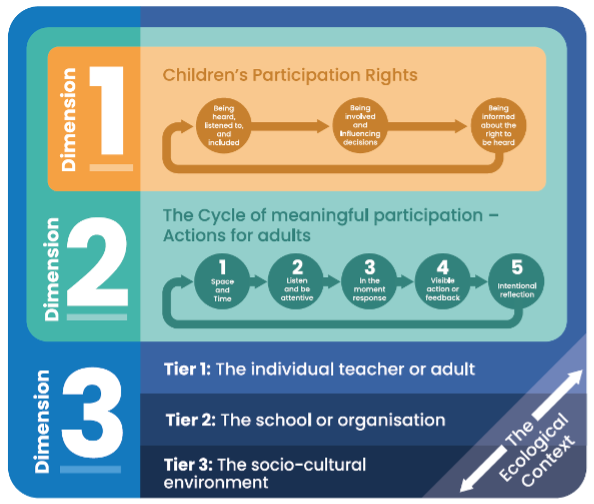
The first dimension, (1) Children’s Participation Rights, encompasses the child’s entitlement to be heard, to have their views taken seriously in decisions that affect them, and to be informed about these participatory rights.
The second dimension, (2) Actions for Adults, is articulated through the Cycle of Meaningful Children’s Participation, a five‑step reflective and action‑oriented process designed to guide adults in creating and sustaining participatory practices.
The third dimension, (2) Ecological Context, recognises that the realisation of children’s participation is shaped by enabling or constraining factors operating across three interconnected levels: the individual teacher/adult, the organisational environment (such as the school or service), and the wider cultural context.
Together, these dimensions provide a holistic, multi‑layered framework for understanding and enhancing children’s meaningful participation. Without all three elements being fully understood and enacted, children’s participation rights cannot be effectively realised.
Dimension 1
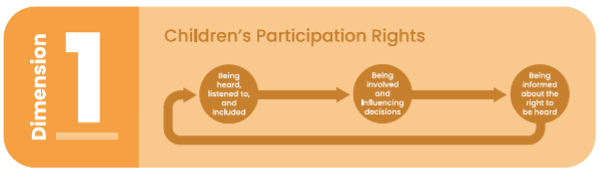
At the heart of the EMCP are three interdependent rights. These rights work together: listening enables influence, action builds understanding, and explanation encourages further participation.
We define participation as a multidimensional right that extends beyond Article 12 of the UNCRC (1989), recognising children as agentic rights-holders (Olsen, 2023). Informed by key literature,* participation encompasses three interdependent rights: the right to be heard and listened to, the right to influence decisions, and the right to know these rights. This framing views participation as a holistic, inherent right, not something granted by adults. While its realisation is shaped by cultural, structural, and relational factors (explored in our model), these rights are not contingent on adult permission.
*Lundy, 2007; Lundy et al., 2019; McMellon & Tisdall, 2020; Ree & Emilson, 2020) and additional UNCRC articles, particularly 13, 15, and 17, and General Comments 7 and 12 (CRC/C/GC/7; CRC/C/GC/12)
Dimension 2
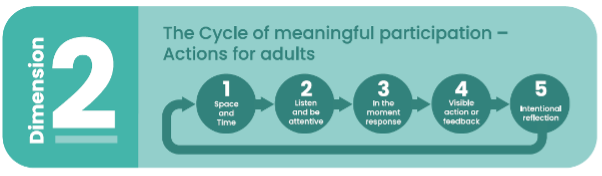
The model’s second dimension is a call for action to adults to engage in a recurring, iterative cycle that makes children’s participation a sustained part of daily practice. Inspired by Fletcher’s (2005) five-step Cycle of Meaningful Student Involvement; listening, validating, authorising, mobilising, and reflecting, and drawing on work related to listening to young children (Wall et al., 2019) and the principles of the Lundy model (2007). Our adapted model retains the cyclical logic from Fletcher (2005), while the components reflect our definition of participation and the specific needs of early educational setting and the everyday practices of teachers.
The action points within our cycle align with the conditions for meaningful, everyday child participation by considering the core principles from Lundy’s (2007) model alongside our empirical findings, yielding a coherent, evidence-informed roadmap for practitioners and researchers seeking to embed participation rights in a consistent and responsive way.
Step 1) Create space and time
This involves protecting moments where their interests can shape activity, co-constructing environments, and adapting routines around unpredictable, child-led directions. In our data, teachers described carving out dialogue moments and observational windows to attune to each child’s needs, rhythms, interests and modes of expression. It is where participation begins, not with children speaking, but with adults creating the space and time to truly listen. Teachers in the study described co-constructing learning environments to reflect children’s needs and interests, yet they also recognised the challenge of adapting planning around unpredictable child-focused directions.
To enact this step, educators could ask themselves:
- Have I made time today to truly listen to each child?
- Does the environment invite children to express themselves, including non-verbally?
- Am I prepared to act on what I hear from children, even if it challenges my original plans?
Step 2) Listen and be attentive
The second step of the cycle is informed by the data which showed that teachers’ sustained, sensitive attention to both verbal and nonverbal cues is central to participation. This step focuses on the adult’s sustained presence and responsiveness while listening and being attentive to children’s diverse “languages” of expression: verbal, non-verbal, gestural, affective, playful, and silent, all of which carry meaning within a relational and rights-respecting framework (Edwards et al., 1998).
To enact this step, educators should ask themselves:
- Am I present and open to everyday forms of communication from children?
- Am I enabling a range of “languages” through which children can be heard, such as movement, play, gesture, and silence?
- Do I actively listen outside of formal or expected moments of expression?
Step 3) In-the-moment response
This involves acting on spontaneous cues, adapting learning as it unfolds, and following children’s evolving curiosities. This responsiveness positions children as collaborators and builds ownership. By centring learning around children’s cues, teachers ensure that their in-the-moment adaptations honour children’s agency and reinforce the authenticity of participation.
Ephgrave (2020) highlights how this responsive approach supports children’s agency, engagement, and participation. As Baker et al. (2023) observe such strategies ‘make space for the child to continue making meaning through their learning… the child is… in the driving seat’ (p. 374). By positioning children as rights-holders whose views directly shape learning, teachers honour the principle that participation is not tokenistic but substantive. In short, immediate response respects children as agentic collaborators in decisions related to their learning, extending engagement and self-directed exploration.
To enact this step, educators could ask themselves:
- When a child expresses a view, idea, or feeling, how quickly do I respond in a way that shows I have truly listened?
- Do I use children’s spontaneous comments as opportunities to extend or deepen learning in the moment, rather than putting them off until later?
- Am I attentive to when a child’s interest shifts, and am I prepared to adjust planned activities accordingly?
Step 4) Visible action or feedback
Visible action or feedback enables children to see that their contributions have an effect; whether through a direct change, a class decision reflecting their input, or feedback explaining why an idea can’t be adopted. Teachers suggested that authentic engagement hinges on children seeing their ideas translated into real change. As Karan noted, when children see “some sort of manifestation in change in school,” they know their voices matter, avoiding tokenism and reinforcing trust in the participatory process. When actions are visible or feedback is given, participation becomes a relational experience rather than a performative gesture (Lundy 2018). Thus, this is an essential element of adults’ enactment of participative rights, as when children receive honest feedback, they learn that participation is a meaningful right.
To enact this step, educators could ask themselves:
- Have I shown the child that their view has been heard and considered?
- Have I taken their idea to a person or place where it can lead to meaningful change?
- Have I communicated any actions taken (or not taken) in a way the child can understand?
Step 5) Intentional reflection
Both in the moment and afterwards, this means adjusting as events unfold, and using team discussions to evaluate what worked, what was missed, and how power has shaped decisions.
This stage of the cycle emphasises the value of intentional, retrospective reflection as a key driver of meaningful participation in early childhood settings. Teachers in our research found that regularly engaging in reflective practices—such as discussing children’s voices in planning meetings, evaluating the impact of initiatives like recycling schemes, and critically examining their own professional dispositions—supported participation enactment.
Fletcher (2005) and Cahill & Dadvand (2018) position reflection as essential for adults to surface power dynamics and biases, while Venninen & Leinonen (2013) argue that without ongoing reflection, participation degrades into a procedural checklist. Hultgren & Johanssen’s (2018) multidirectional models likewise insist that reflection be woven through every stage of the cycle.
By recognising and structuring these reflective routines, the model supports a dynamic and responsive approach to children’s rights, ensuring that participation remains authentic, equitable, and grounded in lived experience.
To enact this step, educators could ask themselves:
- How did I respond, and was that response appropriate, respectful, and empowering?
- What can I learn from this interaction to improve future participation opportunities?
- Did my own assumptions, routines, or time constraints limit children’s input?
- How can I involve colleagues or children in reflecting on this engagement?
Dimension 3: The ecological context
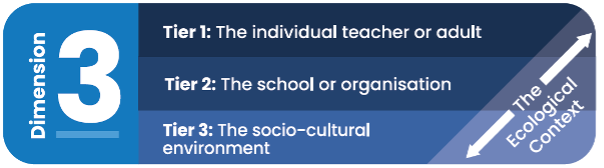
The final dimension if a surrounding layer showing that participation enactment is shaped by the broader ecological context. The wider ecological context encompasses; individual practitioners, organisational structures, and cultural norms.
Drawing on Gal’s ecological framework (2017), participation is understood as context-sensitive and shaped by dynamic systems. Others have similarly emphasised how power, decision-making, and community dynamics impact children’s voice and agency (Driskell, 2002; Jans & De Backer, 2002). The ecological layer signals that meaningful participation requires more than individual effort; it involves cultivating supportive environments across all levels. It also highlights the often-invisible factors that enable or constrain participation, prompting action across classrooms, schools, and broader systems.
Key Messages
Embedding children’s participatory rights is an ongoing commitment. It means listening with genuine curiosity, making space for their ideas, and showing that children’s contributions matter. The EMCP offers one practical route, but sustained effort from teachers, schools, and the wider system is needed to make participation part of the everyday fabric of learning. The takeaway message from this work has been:
- Children’s participation rights are often tokenistic applied – despite the UNCRC, young children’s voices are inconsistently heard in early childhood education
- Participation rests on three interdependent rights – children’s rights to be heard, to influence decisions, and to know about these rights
- Adults can use a five-step reflective cycle – creating space, listening attentively, responding in the moment, providing visible feedback, and reflecting intentionally. Each step requires critical self-questioning – educators must examine their assumptions and be prepared to adapt practice based on what children communicate.
- Participation needs supportive ecological conditions – meaningful change requires commitment from individual practitioners, schools, and wider education systems

Dr Jacky Tyrie
Department for Education and Childhood Studies at Swansea University
Jacky Tyrie is a Senior Lecturer in Early Childhood Studies in the Department for Education and Childhood Studies at Swansea University. Her research focuses on young children’s participation, voice in decision‑making, and their human rights under the United Nations Convention on the Rights of the Child (UNCRC).

Lauren Henderson
Swansea University, UK
Lauren Henderson is a PhD researcher at Swansea University, specialising in young children’s (0–5) participation rights in early childhood education and care (ECEC) settings in Wales. Prior to her doctoral studies, Lauren spent over ten years teaching in primary schools across England and Wales, where she developed a strong interest in children’s rights and inclusive pedagogies.
The Project Team
- Dr Sarah Chicken is the Principal Investigator and an Associate Professor in Childhood and Education at the University of the West of England.
- Jacqui Lewis is a Research Associate at the University of the West of England.
- Dr Patrizio De Rossi is a Research Associate at the University of the West of England.
- Dr Alison Murphy is a Lecturer in the Athrofa: Institute of Education at the University of Wales Trinity Saint David.
- Dr Jennie Clement is a Senior Lecturer in Teacher Education and Professional Learning at Cardiff Metropolitan University
- Dr Jane Waters-Davies is an Associate Professor in Early Education and the Applied Research Lead for Education at University of Wales Trinity Saint David.
- Jane Williams is an Emeritus Professor of Law at Swansea University’s Hillary Rodham Clinton School of Law and a co-founder of the Observatory on Human Rights of Children.
Other blog posts on similar topics:
Alderson, P. (2008). Young children’s rights: Exploring beliefs. Jessica Kingsley Publishers.
Baker, S., Le Courtois, S., & Eberhart, J. (2023). “Making Space for Children’s Agency with Playful Learning”, International Journal of Early Years Education 31(2), 372–384. DOI: 10.1080/09669760.2021.1997726
Cahill, H., & Dadvand, B. (2018). Re‑conceptualising youth participation: A framework to inform action. Children and Youth Services Review, 95, 243–253.
Chicken, S., & Tyrie, J. (2023). Can you Hear me? Problematising the Enactment of UNCRC Article 12 in Welsh Early Years Classrooms: Exploring the Challenges of “Children’s Voice”. The International Journal of Children’s Rights, 31(2), 301-325. https://doi.org/10.1163/15718182-31010001
Driskell, D. (2002). Creating better cities with children and youth: A manual for participation. UNESCO.
Edwards, C., Gandini, L., & Forman, G. (1998). The hundred languages of children: The Reggio Emilia approach—Advanced reflections. Ablex.
Ephgrave, A. (2020). Planning in the moment with young children. Routledge.
Fletcher, A. (2005). Meaningful student involvement: Guide to students as partners in school change (2nd ed.). HumanLinks Foundation.
Gal, T. (2017). An ecological model of child and youth participation. Children and Youth Services Review, 79, 57–64.
Hultgren, F., & Johansson, B. (2018). Including babies and toddlers: a new model of participation. Children’s Geographies, 17(4), 375–387. DOI: 10.1080/14733285.2018.1527016
Jans, M., & De Backer, K. (2002). Children as citizens. Childhood, 9(1), 5–18.
Lundy, L. (2007). “Voice” is not enough: Conceptualising Article 12. British Educational Research Journal, 33(6), 927–942.
Lundy, L. (2018). In defence of tokenism? Children’s right to participate in collective decision‑making. Childhood, 25(3), 340.
Lundy, L., McEvoy, L., & Byrne, B. (2019). Working with young children as co‑researchers. In J. Tobin (Ed.), The United Nations Convention on the Rights of the Child: A Commentary, Oxford University Press.
McMellon, C., & Tisdall, E. K. M. (2020). Children and young people’s participation rights: Looking backwards and moving forwards. The International Journal of Children’s Rights, 28(1), 157–182.
Olsen, R. K. (2023). Key factors for child participation – an empowerment model for active inclusion in participatory processes. Frontiers in Psychology, 14, 1247483.
Ree, M., & Emilson, A. (2020). Participation in communities in ECEC expressed in child–educator interactions. Early Child Development and Care. DOI: 10.1080/03004430.2019.1566230
United Nations (1989) Convention on the Rights of the Child. Retrieved 3rd June 2025 from https://www.ohchr.org/en/instruments-mechanisms/instruments/convention-rights-child
Venninen, T., & Leinonen, J. (2013). Considering children’s participation. Early Child Development and Care, 183(8), 1083–1095.
Wall, K., Cassidy, C., Robinson, C., Hall, E., Beaton, M., Kanyal, M., & Mitra, D. (2019). Look who’s talking: Factors for considering the facilitation of very young children’s voices. Journal of Early Childhood Research, 17(4), 263–278.