From outsider to researcher: Making the invisible barriers to education progression visible
Melissa Lynch’s educational journey truly began almost two decades after her initial attempt at higher education, “with two children in tow and life experiences the length and breadth of the island of Ireland”. Despite being “full of drive and ambition”, hoping to achieve the dream of going to university, she never got past the first day. It wasn’t till many years later that she found the courage to return to education as a mature student. In this personal essay, Melissa reflects on her journey and what it reveals about the barriers to further education for people like her.
My journey begins
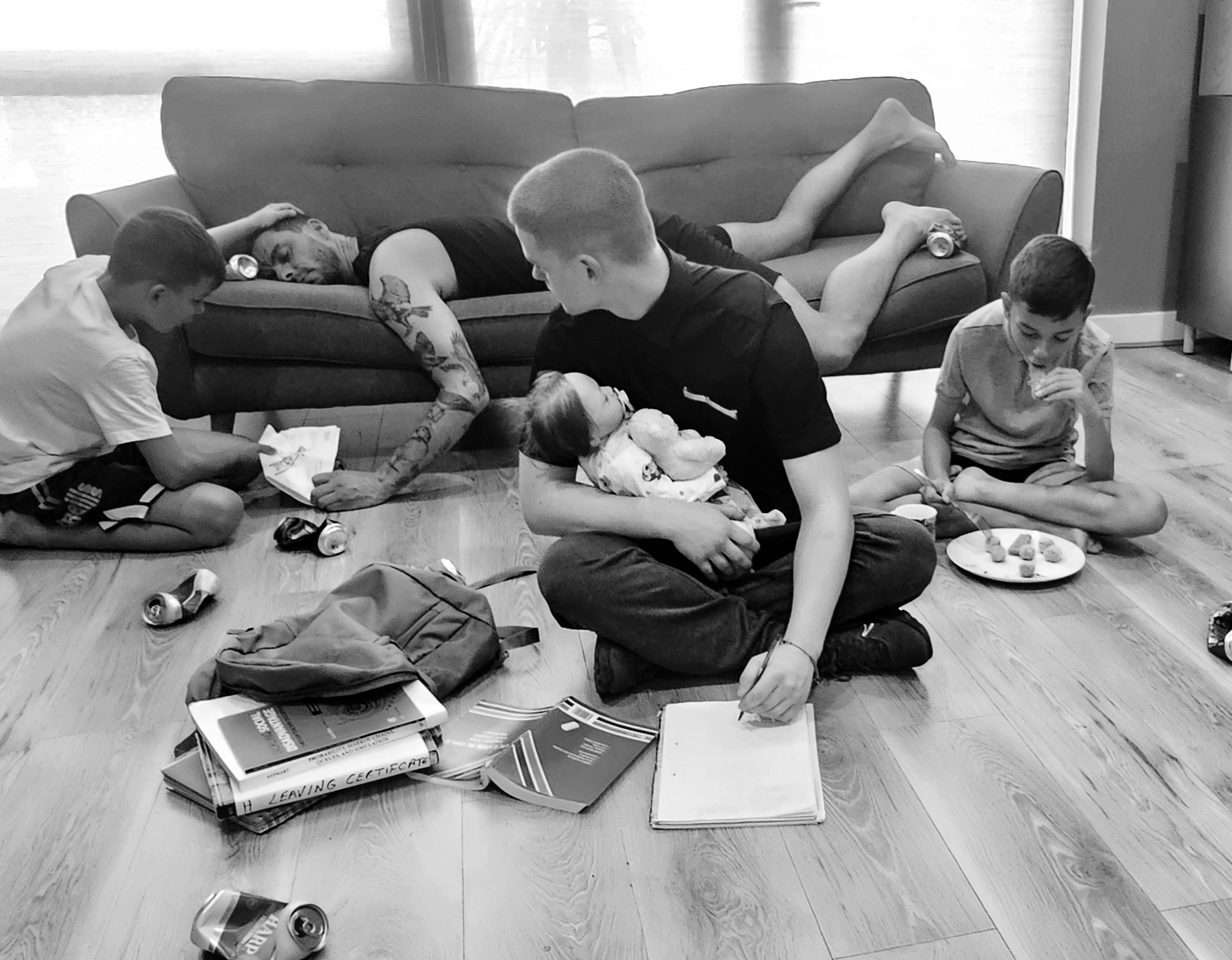
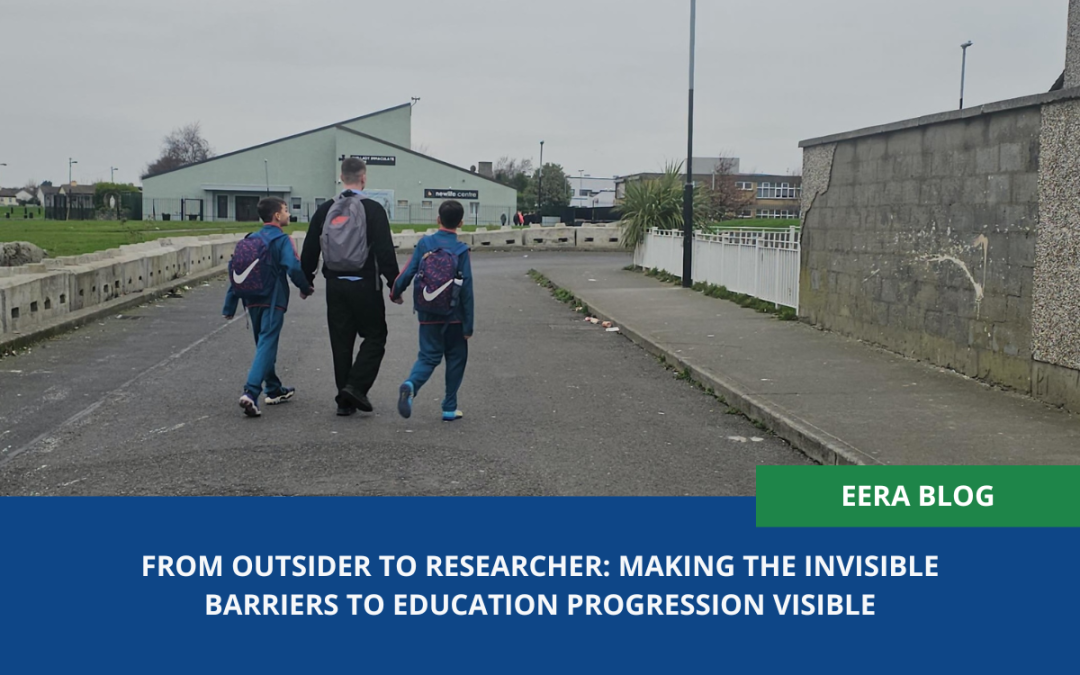
I created this image using my family to show my research in an image. It won the Research on walls competition. I would like to use this image as I feel it allows people to see what they refuse to see, and once we do see it we cant unsee it. It’s the realities of many lives of the students im researching.
My educational journey began with a blocked path. First, by a lack of navigational knowledge, followed by a lack of leaving certificate points in the so-called ‘equitable’ Irish entry system known as the ‘Points Race’ (O’Connor, 2017). The Irish Leaving Certificate points system allocates specific points to exam grades, which are then totalled to create a rank order for higher education applicants (Hyland, 2011). Though I found a workaround and was able to attend university, it wasn’t enough.
My journey was also defined by the prejudgment I faced from others within hours of stepping foot inside a place I felt I didn’t belong. Even though I was in an access programme designed for students like me – from a low socio-economic status background – there was no one like me! I never got past the first day and for that I branded that initial attempt at educational progression a complete personal failure because I couldn’t make myself fit in nor look and sound like the others. Yet, I knew deep down the failure wasn’t mine; it was systemic.
The hidden obstacles facing students from LSES in Ireland
As a teenager from a low socio-economic status background (LSES), how was I expected to succeed alone when an unstable home life, chaotic circumstances, and a lack of ‘insider’ cultural knowledge made higher education navigation impossible? The Irish education system was set up to favour students who already possessed unspoken social and cultural advantages, and I had nothing to inherit. That personal failure and the persistent musing it provoked is now the basis of my ongoing PhD research, exploring why students from similar LSES backgrounds remain underrepresented in further/higher education despite decades of new policies and initiatives.
The Irish Higher Education Authority reported that only 10% of students from LSES areas who attend Delivering Equality of Opportunity in Schools (DEIS) in Ireland progressed to higher education in contrast to 85% of students from affluent areas attending private schools (HEA, 2022;2023). I argue that until we acknowledge and understand how the hidden obstacles of social and cultural capital impact educational progression of LSES students, our equity and inclusion policies are destined to fail the very students they aim to help.
To understand why a system designed for fairness still produces fundamental inequality, we must change our focus. We must stop looking only at what the system provides in terms of funding and assistance and start looking at what students inherit.
The Irish educational paradox
My initial ‘personal failure’ was painful; I am speaking of the dual burden faced by many students from low-LSES backgrounds. First, there is the objective failure: not obtaining the university qualification we are socially conditioned to see as the sole metric of success. Second, and more corrosive, is the internalised belief that this shortcoming is a reflection of individual defect, rather than a consequence of lacking the social and cultural capital needed to navigate a judgmental system. This was my reality when, upon entering an access programme, the very stigma it was meant to erase led me to withdraw. It was, however, also a single reflection of a much larger, fundamental flaw in how the Irish educational system approaches equity. And now two decades later, it hasn’t changed a whole lot.
For a long time, the system has attempted to address inequality through many initiatives and policies, such as the introduction of the Delivering Equality of Opportunity in Schools (DEIS) programme, launched in 2005. This is one of the well-intentioned initiatives that are still in place and currently under review to be upgraded to ‘DEIS PLUS’. The central purpose of the DEIS Initiative is to support students from low socio-economic status (LSES) backgrounds to combat educational disadvantage and break the cycle of poverty through targeted support for schools and students. Its aim has been to level the playing field by directing additional resources, funding, and support to schools that serve communities with the highest levels of socio-economic disadvantage. These major government initiatives are well-intentioned, backed by significant investment, and focus heavily on two things the system can easily measure and deliver: academic support and financial aid.
This is where the paradox emerges; if we are pouring finances and resources into extra teaching resources, smaller class sizes, book-grant schemes, school completion programmes and so on – Why do students from LSES backgrounds or DEIS schools remain underrepresented in further and higher education?
Studies show the gap in progression to third level is still significantly low (Smyth, McCoy & Kingston, 2015; Fleming & Harford, 2021). We’ve treated the visible wounds, such as the lack of points and the cost of college, but the deep infection remains. Why is this conclusion unavoidable? Because the system is rewarding what it can see and ignoring what it can’t, or should I say, chooses not to see. My research is grounded in the belief that until we look beyond academics and economics, and start identifying and understanding the invisible barriers and impacts of social and cultural capital on students progression to FET/HE, the cycle of intergenerational educational disadvantage, poverty and inequality will continue.
Beyond Ireland – The lens of capital
To understand why a system designed for fairness still produces fundamental inequality, we must change our focus.
My PhD research adopts the framework of the French sociologist Pierre Bourdieu, who argued that success is not just about having money (economic capital) or good grades (academic capital). As established in his seminal work (Bourdieu, 1986), it is fundamentally about capital that is invisible.
This social and cultural capital is the invisible curriculum the system rewards, but never formally teaches.
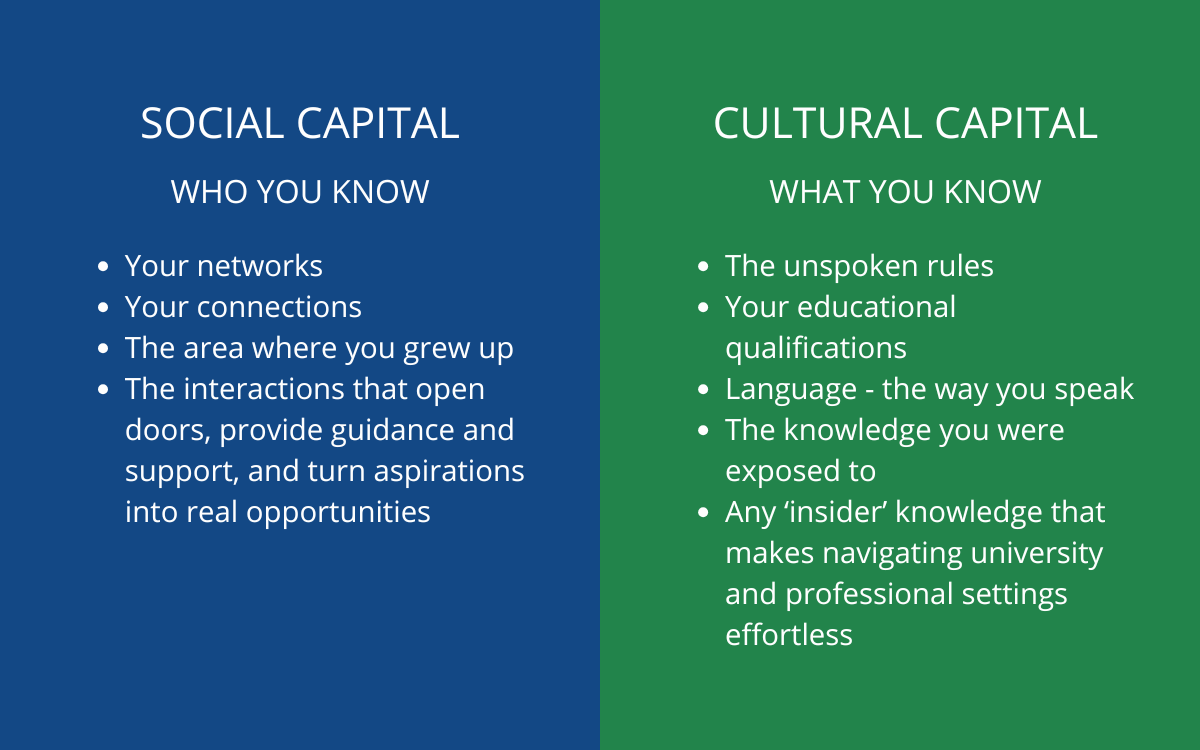
Research by Hannon, Faas & O’Sullivan (2017) shows that the Irish educational system inadvertently rewards this inherited social and cultural capital. This invisible curriculum is a set of unwritten instructions: how to pick the right subjects for your career when in 4th year in school, how to apply for the appropriate higher education courses, how to behave in a college environment, or how to secure a professional network.
When I was a teenager from a LSES background, I didn’t fail because I lacked the intelligence, drive or the work ethic; I failed because I lacked the map and the compass, I had nothing of this crucial capital to inherit, and the system did not provide it. This realisation is the engine driving my research to measure this missing map, and understand the scale of the capital gap.
Mapping the invisible gap
My ongoing qualitative doctoral research – based on focus groups and interviews with DEIS post-primary students, staff, families, education and community professionals – uses this Bourdieusian lens to map the capital gap. The preliminary findings are heartbreakingly consistent.
The preliminary discovery is that for LSES students, the barriers to educational progression are rarely just financial; they are overwhelmingly navigational (SOLAS, 2017). Students often have high aspirations, but their families and social networks cannot provide the ‘insider’ cultural knowledge required to translate those aspirations into successful further and higher level educational progression. Without networks, students lack exposure to professionals or university graduates who can explain what a particular career or degree actually involves. It is extremely difficult to envision becoming someone no one you know has become. This lack of connection was confirmed by a parent:
“Like I said, we don’t know anyone. It’s not just about knowing people with fancy jobs, it’s about knowing anyone who’s been through the system.”
– Brooke, parent
The social web that guides more affluent students toward high-capital degrees (law, medicine, engineering) is simply absent.
Families and students often don’t know many of the initiatives that are available to them and those that do are intimidated by the educational bureaucracy. Terms like HEAR, DARE, ACCESS, CAO points calculation, and FET route become a confusing, impenetrable language barrier, constraining choices regardless of a student’s academic or financial ability.
One parent, whose child was doing well academically, summed up the anxiety perfectly:
” I’ve heard some things about student grants, but the forms look really complicated, and I don’t really understand all the questions. I’d be worried about filling them in wrong and messing it up.”
– Amy, parent
This also soundly debunks the persistent narrative that LSES students lack aspiration. They are ambitious, resilient, and intelligent, but they lack the cultural confidence that comes from familiarity. For many, college remains an ‘alien’ or hostile environment. Students reported feeling they wouldn’t ‘fit in’ or that the university was ‘not a place for people like us’. Aligning with international research on identity and inequality (Hutchings & Archer, 2001), this demonstrates that our equity policies, by focusing narrowly on measurable deficits, fail to provide the most essential ingredient for successful progression and transition – a sense of belonging and the cultural competency to navigate the landscape.
Becoming a teacher – and seeing myself in my students
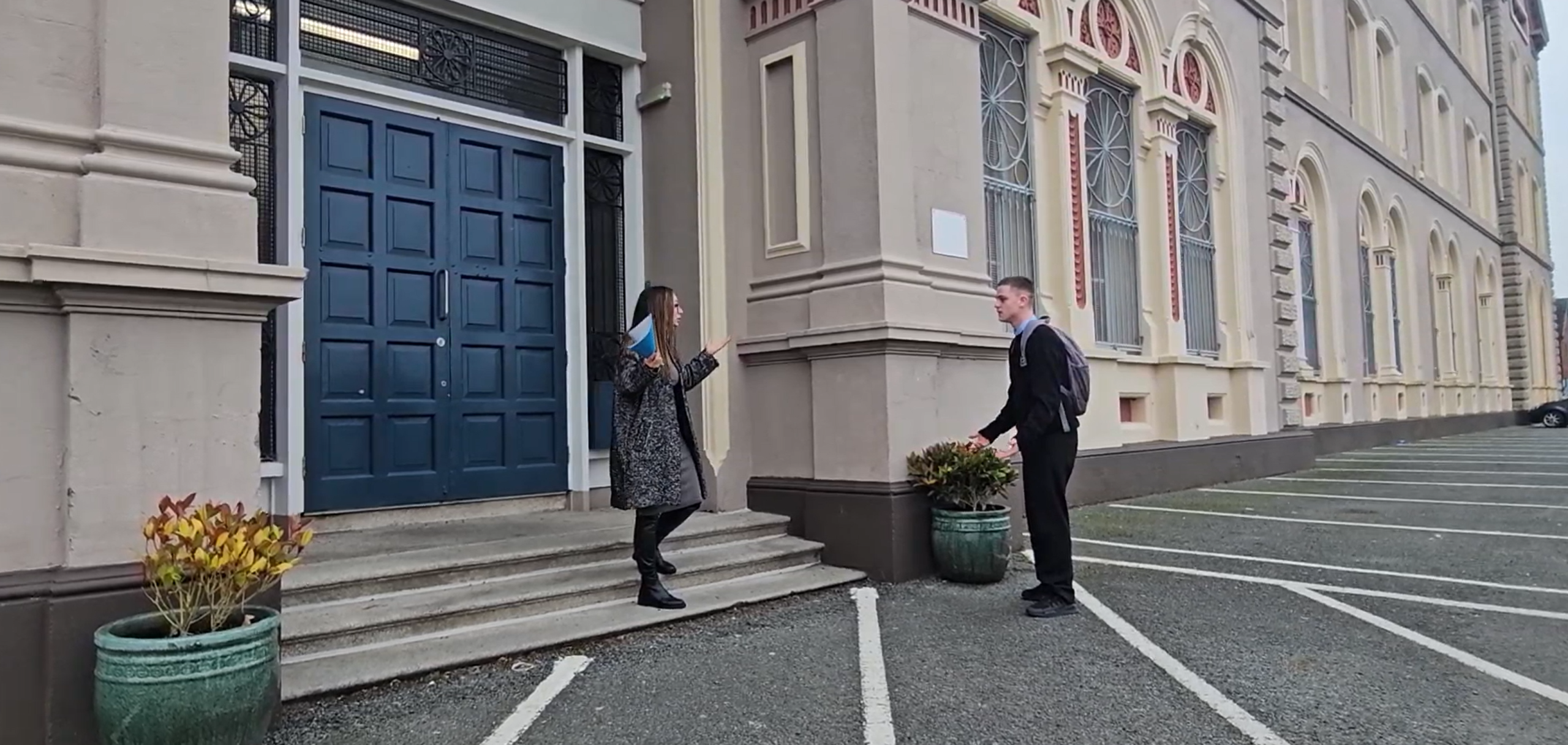
My own educational path was not a straight line; it was a rescue mission, and the turning point that came years later, sparked by a disorienting dilemma; a health scare that reminded me life is too short to settle.
While working as a Special Needs Assistant (SNA) in a North Dublin primary school, I received a pivotal piece of external validation when the school principal agreed with me I had the capability to lead a classroom, not just assist in one. That belief gave me the courage to return to education as a mature student, overcoming the fear of my initial failure and also the imposter syndrome that had caused me to back out of applications three times before.
Becoming a qualified teacher was a triumph, but returning to teach in disadvantaged settings held up a mirror to my past. I saw students with immense raw talent who, like my younger self, were paralysed by a lack of confidence. This was heartbreakingly familiar. I saw brilliant students limiting their own potential because they had internalised the idea that they weren’t “academic.” They didn’t lack intelligence; they lacked opportunity, belief and they were impacted by their lack of social and cultural capital.
I realised that teaching a few students at a time wasn’t enough; I wanted to change the narrative for them on a larger scale. Today, my PhD research is not just an academic exercise; it is fueled by this ‘insider knowledge.’ I am researching educational barriers not because I read about them in a textbook, but because I climbed over them.
Call to action
My journey from being an outlier, seen as a ‘complete personal failure’ to becoming an educator and a PhD researcher has one singular purpose: to shift the conversation. My research suggests that, while financial and academic support are necessary, they are no longer sufficient. As one principal participant, Keith (2025), put it, we must stop ‘putting plasters over the visible wounds’ and start building the crucial capital that has been unintentionally starved out of the system.
The next generation of equity initiatives and policy cannot be about ‘equal opportunity’ alone; it must be about ‘equity of capital’ and my call to action is clear and practical.
We need to systematically embed capital-building initiatives directly into our support framework.
By co-creating these initiatives with our stakeholders and centering their lived experiences, we can structure initiatives that truly meet the needs of LSES students. Until we acknowledge that the Irish educational system, policies and initiatives inadvertently rewards what is inherited and not just what is achieved, our current efforts will continue to fail LSES students.
My research aims to make the invisible visible, and I pose the question for policymakers: Will you look with your eyes truly open?
Key Messages
- Education systems reward what students inherit, not just what they achieve.
- Financial aid alone cannot close the education gap – we must address invisible barriers.
- Students from disadvantaged backgrounds don’t lack aspiration; they lack the map to navigate higher education.
- Social and cultural capital are the invisible curriculum the system rewards but never teaches.
- Educational equity requires shifting from equal opportunity to equity of capital.

Melissa Lynch
Dublin City University
Melissa is an educator, researcher, and equity advocate dedicated to dismantling barriers in education. Currently a PhD candidate and lecturer at DCU’s Institute of Education, her research investigates how social and cultural capital impact the progression of students from disadvantaged backgrounds into higher education.
Her academic work, funded by Research Ireland and recognised with internal awards, is deeply informed by her own lived experience. In addition to her research, Melissa serves as a Board Director for Youth Advocate Programmes Ireland, Is a member of ATD the All together in Dignity Alliance (#AddThe10th) and is a Research Associate at the Educational Disadvantage Centre (EDC) in DCU.
Google Scholar: https://scholar.google.com/citations?user=45QzcSsAAAAJ&hl=en#d=gs_hdr_drw&t=1762540028190
Other blog posts on similar topics:
Bourdieu, P. (1986). The forms of capital. In J. G. Richardson (Ed.), Handbook of theory and research for the sociology of education (pp. 241–258). Greenwood.
O’Connor, C. (2017) Education Matters Yearbook 2016–2017. Dublin: Education Matters, pp. 202-205.
Fleming, B., & Harford, J. (2021). The DEIS programme as a policy aimed at combating educational disadvantage: fit for purpose? Irish Educational Studies, 40(4), 481-499. Available at: https://www.tandfonline.com/doi/full/10.1080/03323315.2021.1964568
Higher Education Authority (2022) National Access Plan for Equity to Access Participation and Success in Higher Education 2022-2028. Available at: https://www.gov.ie/en/department-of-further-and-higher-education-research-innovation-and-science/publications/national-access-plan-2022-to-2028/. [Accessed 2 November 2025]
Hannon, C., Faas, D., & O’Sullivan, K. (2017). Widening the Educational Capabilities of Socio-Economically Disadvantaged Students Through a Model of Social and Cultural Capital Development. British Educational Research Journal, 43(6), 1225-1245.
Hutchings, M., & Archer, L. (2001). ‘Higher Than Einstein’: Constructions of Going to University among Working-Class non-Participants. Research Papers in Education, 16(1), 69–91.
Hyland, Á. (2011). Entry to higher education in Ireland in the 21st century. National Council for Curriculum and Assessment.
Smyth, E., McCoy, S., & Kingston, G. (2015). Learning from the Evaluation of DEIS. Research Series, 39. Dublin: Economic and Social Research Institute (ESRI). Available at: https://www.esri.ie/system/files/publications/RS39.pdf
SOLAS (2017). Barriers to Further Education and Training with Particular Reference to Long Term Unemployed Persons and Other Vulnerable Individuals. Solas: The Further Education and Training Authority. Available at: https://www.solas.ie/f/70398/x/432b2fa3ba/barriers-to-fet-final-june-2017.pdf