From outsider to researcher: Making the invisible barriers to education progression visible

From outsider to researcher: Making the invisible barriers to education progression visible

Melissa Lynch’s educational journey truly began almost two decades after her initial attempt at higher education, “with two children in tow and life experiences the length and breadth of the island of Ireland”. Despite being “full of drive and ambition”, hoping to achieve the dream of going to university, she never got past the first day. It wasn’t till many years later that she found the courage to return to education as a mature student. In this personal essay, Melissa reflects on her journey and what it reveals about the barriers to further education for people like her.

My journey begins

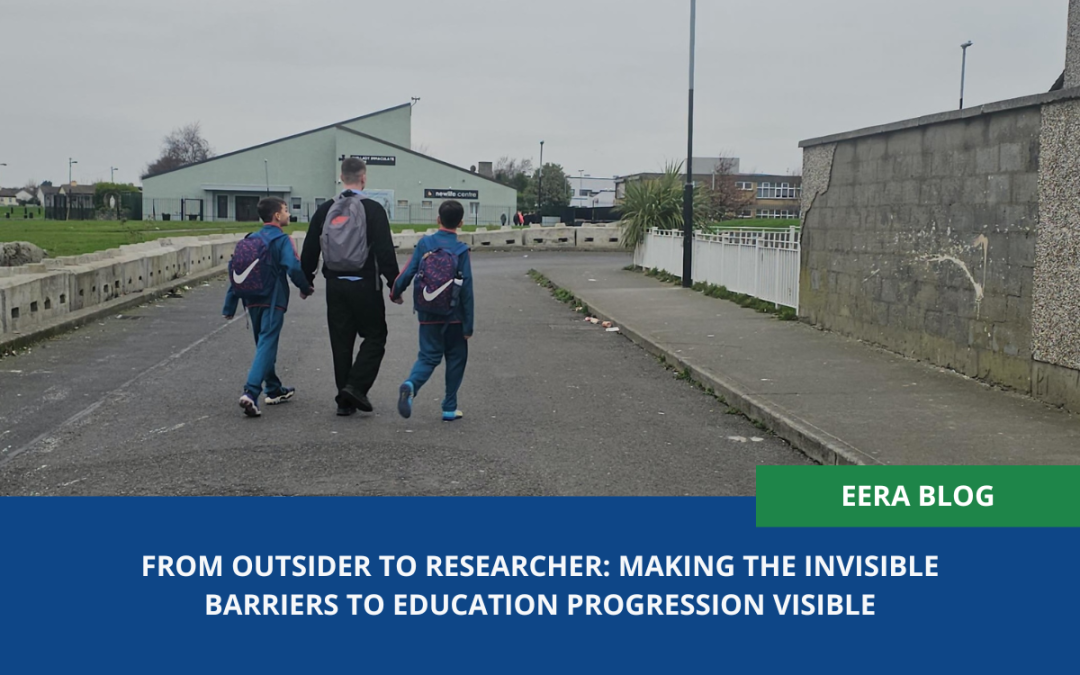
I created this image using my family to show my research in an image. It won the Research on walls competition. I would like to use this image as I feel it allows people to see what they refuse to see, and once we do see it we cant unsee it. It’s the realities of many lives of the students im researching.

My educational journey began with a blocked path. First, by a lack of navigational knowledge, followed by a lack of leaving certificate points in the so-called ‘equitable’ Irish entry system known as the ‘Points Race’ (O’Connor, 2017). The Irish Leaving Certificate points system allocates specific points to exam grades, which are then totalled to create a rank order for higher education applicants (Hyland, 2011). Though I found a workaround and was able to attend university, it wasn’t enough.

My journey was also defined by the prejudgment I faced from others within hours of stepping foot inside a place I felt I didn’t belong. Even though I was in an access programme designed for students like me – from a low socio-economic status background – there was no one like me! I never got past the first day and for that I branded that initial attempt at educational progression a complete personal failure because I couldn’t make myself fit in nor look and sound like the others. Yet, I knew deep down the failure wasn’t mine; it was systemic.

The hidden obstacles facing students from LSES in Ireland

As a teenager from a low socio-economic status background (LSES), how was I expected to succeed alone when an unstable home life, chaotic circumstances, and a lack of ‘insider’ cultural knowledge made higher education navigation impossible? The Irish education system was set up to favour students who already possessed unspoken social and cultural advantages, and I had nothing to inherit. That personal failure and the persistent musing it provoked is now the basis of my ongoing PhD research, exploring why students from similar LSES backgrounds remain underrepresented in further/higher education despite decades of new policies and initiatives.

The Irish Higher Education Authority reported that only 10% of students from LSES areas who attend Delivering Equality of Opportunity in Schools (DEIS) in Ireland progressed to higher education in contrast to 85% of students from affluent areas attending private schools (HEA, 2022;2023). I argue that until we acknowledge and understand how the hidden obstacles of social and cultural capital impact educational progression of LSES students, our equity and inclusion policies are destined to fail the very students they aim to help.

To understand why a system designed for fairness still produces fundamental inequality, we must change our focus. We must stop looking only at what the system provides in terms of funding and assistance and start looking at what students inherit.

The Irish educational paradox

My initial ‘personal failure’ was painful; I am speaking of the dual burden faced by many students from low-LSES backgrounds. First, there is the objective failure: not obtaining the university qualification we are socially conditioned to see as the sole metric of success. Second, and more corrosive, is the internalised belief that this shortcoming is a reflection of individual defect, rather than a consequence of lacking the social and cultural capital needed to navigate a judgmental system. This was my reality when, upon entering an access programme, the very stigma it was meant to erase led me to withdraw. It was, however, also a single reflection of a much larger, fundamental flaw in how the Irish educational system approaches equity. And now two decades later, it hasn’t changed a whole lot.

For a long time, the system has attempted to address inequality through many initiatives and policies, such as the introduction of the Delivering Equality of Opportunity in Schools (DEIS) programme, launched in 2005. This is one of the well-intentioned initiatives that are still in place and currently under review to be upgraded to ‘DEIS PLUS’. The central purpose of the DEIS Initiative is to support students from low socio-economic status (LSES) backgrounds to combat educational disadvantage and break the cycle of poverty through targeted support for schools and students. Its aim has been to level the playing field by directing additional resources, funding, and support to schools that serve communities with the highest levels of socio-economic disadvantage. These major government initiatives are well-intentioned, backed by significant investment, and focus heavily on two things the system can easily measure and deliver: academic support and financial aid.

This is where the paradox emerges; if we are pouring finances and resources into extra teaching resources, smaller class sizes, book-grant schemes, school completion programmes and so on – Why do students from LSES backgrounds or DEIS schools remain underrepresented in further and higher education?

Studies show the gap in progression to third level is still significantly low (Smyth, McCoy & Kingston, 2015; Fleming & Harford, 2021). We’ve treated the visible wounds, such as the lack of points and the cost of college, but the deep infection remains. Why is this conclusion unavoidable? Because the system is rewarding what it can see and ignoring what it can’t, or should I say, chooses not to see. My research is grounded in the belief that until we look beyond academics and economics, and start identifying and understanding the invisible barriers and impacts of social and cultural capital on students progression to FET/HE, the cycle of intergenerational educational disadvantage, poverty and inequality will continue.

Beyond Ireland – The lens of capital

To understand why a system designed for fairness still produces fundamental inequality, we must change our focus.

My PhD research adopts the framework of the French sociologist Pierre Bourdieu, who argued that success is not just about having money (economic capital) or good grades (academic capital). As established in his seminal work (Bourdieu, 1986), it is fundamentally about capital that is invisible.

This social and cultural capital is the invisible curriculum the system rewards, but never formally teaches.

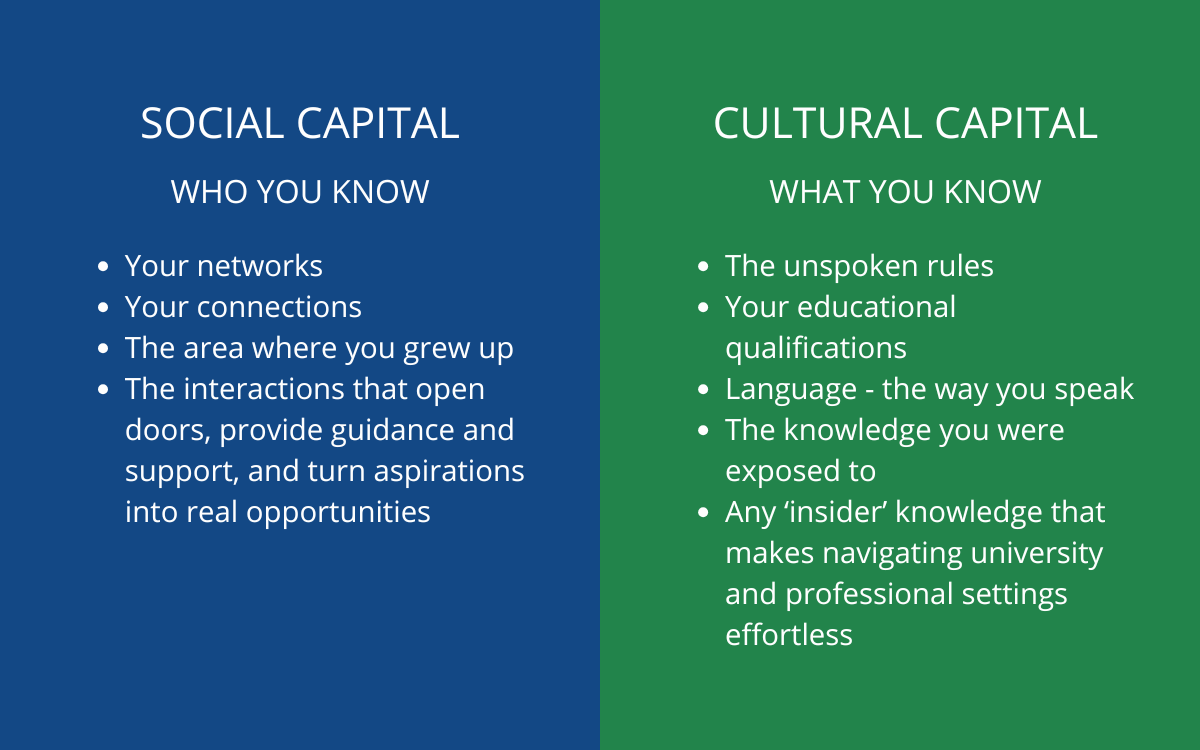
Social Capital – Who you know
•	Your networks
•	Your connections 
•	The area you grow up in
•	Your interactions that open doors, provide guidance, and support turning aspirations into real opportunities

Cultural Capital – What you know
•	The unspoken rules
•	Your educational qualifications
•	Language– as in the way you speak
•	The knowledge you've been exposed to, and the life you have been born into
•	Any 'insider' knowledge that makes navigating a university or professional setting feel effortless for some, and impossible for others.

Research by Hannon, Faas & O’Sullivan (2017) shows that the Irish educational system inadvertently rewards this inherited social and cultural capital. This invisible curriculum is a set of unwritten instructions: how to pick the right subjects for your career when in 4th year in school, how to apply for the appropriate higher education courses, how to behave in a college environment, or how to secure a professional network.

When I was a teenager from a LSES background, I didn’t fail because I lacked the intelligence, drive or the work ethic; I failed because I lacked the map and the compass, I had nothing of this crucial capital to inherit, and the system did not provide it. This realisation is the engine driving my research to measure this missing map, and understand the scale of the capital gap.

Mapping the invisible gap

My ongoing qualitative doctoral research – based on focus groups and interviews with DEIS post-primary students, staff, families, education and community professionals – uses this Bourdieusian lens to map the capital gap. The preliminary findings are heartbreakingly consistent.

The preliminary discovery is that for LSES students, the barriers to educational progression are rarely just financial; they are overwhelmingly navigational (SOLAS, 2017). Students often have high aspirations, but their families and social networks cannot provide the ‘insider’ cultural knowledge required to translate those aspirations into successful further and higher level educational progression. Without networks, students lack exposure to professionals or university graduates who can explain what a particular career or degree actually involves. It is extremely difficult to envision becoming someone no one you know has become. This lack of connection was confirmed by a parent:

“Like I said, we don’t know anyone. It’s not just about knowing people with fancy jobs, it’s about knowing anyone who’s been through the system.”

– Brooke, parent

The social web that guides more affluent students toward high-capital degrees (law, medicine, engineering) is simply absent.

Families and students often don’t know many of the initiatives that are available to them and those that do are intimidated by the educational bureaucracy. Terms like HEAR, DARE, ACCESS, CAO points calculation, and FET route become a confusing, impenetrable language barrier, constraining choices regardless of a student’s academic or financial ability.

One parent, whose child was doing well academically, summed up the anxiety perfectly:

” I’ve heard some things about student grants, but the forms look really complicated, and I don’t really understand all the questions. I’d be worried about filling them in wrong and messing it up.”

– Amy, parent

This also soundly debunks the persistent narrative that LSES students lack aspiration. They are ambitious, resilient, and intelligent, but they lack the cultural confidence that comes from familiarity. For many, college remains an ‘alien’ or hostile environment. Students reported feeling they wouldn’t ‘fit in’ or that the university was ‘not a place for people like us’. Aligning with international research on identity and inequality (Hutchings & Archer, 2001), this demonstrates that our equity policies, by focusing narrowly on measurable deficits, fail to provide the most essential ingredient for successful progression and transition – a sense of belonging and the cultural competency to navigate the landscape.

Becoming a teacher – and seeing myself in my students

My own educational path was not a straight line; it was a rescue mission, and the turning point that came years later, sparked by a disorienting dilemma; a health scare that reminded me life is too short to settle.

While working as a Special Needs Assistant (SNA) in a North Dublin primary school, I received a pivotal piece of external validation when the school principal agreed with me I had the capability to lead a classroom, not just assist in one. That belief gave me the courage to return to education as a mature student, overcoming the fear of my initial failure and also the imposter syndrome that had caused me to back out of applications three times before.

Becoming a qualified teacher was a triumph, but returning to teach in disadvantaged settings held up a mirror to my past. I saw students with immense raw talent who, like my younger self, were paralysed by a lack of confidence. This was heartbreakingly familiar. I saw brilliant students limiting their own potential because they had internalised the idea that they weren’t “academic.” They didn’t lack intelligence; they lacked opportunity, belief and they were impacted by their lack of social and cultural capital.

I realised that teaching a few students at a time wasn’t enough; I wanted to change the narrative for them on a larger scale. Today, my PhD research is not just an academic exercise; it is fueled by this ‘insider knowledge.’ I am researching educational barriers not because I read about them in a textbook, but because I climbed over them.

Call to action

My journey from being an outlier, seen as a ‘complete personal failure’ to becoming an educator and a PhD researcher has one singular purpose: to shift the conversation. My research suggests that, while financial and academic support are necessary, they are no longer sufficient. As one principal participant, Keith (2025), put it, we must stop ‘putting plasters over the visible wounds’ and start building the crucial capital that has been unintentionally starved out of the system.

The next generation of equity initiatives and policy cannot be about ‘equal opportunity’ alone; it must be about ‘equity of capital’ and my call to action is clear and practical.

We need to systematically embed capital-building initiatives directly into our support framework.

By co-creating these initiatives with our stakeholders and centering their lived experiences, we can structure initiatives that truly meet the needs of LSES students. Until we acknowledge that the Irish educational system, policies and initiatives inadvertently rewards what is inherited and not just what is achieved, our current efforts will continue to fail LSES students.

My research aims to make the invisible visible, and I pose the question for policymakers: Will you look with your eyes truly open?

Key Messages

  • Education systems reward what students inherit, not just what they achieve.
  • Financial aid alone cannot close the education gap – we must address invisible barriers.
  • Students from disadvantaged backgrounds don’t lack aspiration; they lack the map to navigate higher education.
  • Social and cultural capital are the invisible curriculum the system rewards but never teaches.
  • Educational equity requires shifting from equal opportunity to equity of capital.
Melissa Lynch

Melissa Lynch

Dublin City University

Melissa is an educator, researcher, and equity advocate dedicated to dismantling barriers in education. Currently a PhD candidate and lecturer at DCU’s Institute of Education, her research investigates how social and cultural capital impact the progression of students from disadvantaged backgrounds into higher education.

Her academic work, funded by Research Ireland and recognised with internal awards, is deeply informed by her own lived experience. In addition to her research, Melissa serves as a Board Director for Youth Advocate Programmes Ireland, Is a member of  ATD the All together in Dignity Alliance (#AddThe10th) and is a Research Associate at the Educational Disadvantage Centre (EDC) in DCU.

Google Scholar: https://scholar.google.com/citations?user=45QzcSsAAAAJ&hl=en#d=gs_hdr_drw&t=1762540028190

ORCID: https://orcid.org/0000-0001-5503-1603

Other blog posts on similar topics:

References and Further Reading

Bourdieu, P. (1986). The forms of capital. In J. G. Richardson (Ed.), Handbook of theory and research for the sociology of education (pp. 241–258). Greenwood.

O’Connor, C. (2017) Education Matters Yearbook 2016–2017. Dublin: Education Matters, pp. 202-205.

Fleming, B., & Harford, J. (2021). The DEIS programme as a policy aimed at combating educational disadvantage: fit for purpose? Irish Educational Studies, 40(4), 481-499. Available at: https://www.tandfonline.com/doi/full/10.1080/03323315.2021.1964568

Higher Education Authority (2022) National Access Plan for Equity to Access Participation and Success in Higher Education 2022-2028. Available at: https://www.gov.ie/en/department-of-further-and-higher-education-research-innovation-and-science/publications/national-access-plan-2022-to-2028/. [Accessed 2 November 2025]

Hannon, C., Faas, D., & O’Sullivan, K. (2017). Widening the Educational Capabilities of Socio-Economically Disadvantaged Students Through a Model of Social and Cultural Capital Development. British Educational Research Journal, 43(6), 1225-1245. 

Hutchings, M., & Archer, L. (2001). ‘Higher Than Einstein’: Constructions of Going to University among Working-Class non-Participants. Research Papers in Education, 16(1), 69–91. 

Hyland, Á. (2011). Entry to higher education in Ireland in the 21st century. National Council for Curriculum and Assessment.

Smyth, E., McCoy, S., & Kingston, G. (2015). Learning from the Evaluation of DEIS. Research Series, 39. Dublin: Economic and Social Research Institute (ESRI). Available at: https://www.esri.ie/system/files/publications/RS39.pdf

SOLAS (2017). Barriers to Further Education and Training with Particular Reference to Long Term Unemployed Persons and Other Vulnerable Individuals. Solas: The Further Education and Training Authority. Available at: https://www.solas.ie/f/70398/x/432b2fa3ba/barriers-to-fet-final-june-2017.pdf

Calling for AI-informed student activism in K-12 schools beyond learnification

Calling for AI-informed student activism in K-12 schools beyond learnification

The global education landscape is witnessing promising strides in the integration of artificial intelligence (AI) into policy frameworks. Across borders, education policymakers, aware of AI’s growing impact on world societies and global economies, are calling for robust, trustworthy measures to understand its digital capabilities more fully. For example, the European Union’s (2024) Artificial Intelligence Act, a regulatory framework, mandates the monitoring of AI systems. The OECD (2025) has made recommendations on generative AI aimed at increasing innovation, fostering international cooperation, and sustaining democracy. The AI Action Summit (2025), hosted in Paris in February 2025, brought together leaders from different countries for AI dialogue on such topics as innovation, trustworthiness, and investment. These and other organizational entities have been underscoring the urgency of grasping AI’s transformative impact on the labor market and international community.

Current education policy and research on AI integration in schools

Education policy and research’s convergence on the frontier of AI integration in schools signals something more than a wave of classroom innovation. At this moment, systemic recalibration is reaching into the infrastructural and legislative foundations of education and across borders. AI implementation demands vision, infrastructure, and, crucially, investment. As nations race to harness AI’s potential in education, major actors have been stepping forward with bold commitments and strategic funding (European Parliamentary, 2024). China’s Ministry of Education (2024) and the White House (2025)—joined by the United Arab Emirates—are presently at the forefront of the global AI-in-schools movement. All such highly influential actors have extended the scope of AI, encompassing primary and middle schools (Amir, 2025). 

AI’s role in education is recognized by such countries, with convergence around not just its potential for economic investment but also democratic investment. Perhaps underlying this thinking is the belief that AI should not be limited to a technocratic, efficiency focus geared around political influence and agendas, instead promulgating a depoliticized version of simulated human-like intelligence (Mullen & Eadens, 2026; Sætra, 2020).

We are reminded of Biesta’s (2020) critical appraisal of education as “learnification”—the concern is that this dominant paradigm (learnification) is overly narrow in its focus on learning as individualistic (sidestepping relationships) and learning as a process (omitting content and the purpose of learning).

Scholars are busy examining AI’s transformative potential in education and associated challenges whilst confronting conventional barriers to being educated (Banoğlu et al., 2025; Mullen & Eadens, 2026; Zhong & Zhao, 2025). This line of inquiry supports the use of AI in public education for guiding students’ interests, passions, and strengths in addition to cultivating their own voice, agency, and leadership, in effect transcending schooling’s traditional “grammar” (Tyack &Tobin, 1994).

Mishra (2025), an expert in technology integration in teaching, cautioned policymakers that when human “needs” are reduced to technological capabilities, risks ensue. Of great concern is that educational goals could be reshaped around machine capability without accounting for students’ and teachers’ genuine needs. This thinking has also been articulated for digital learning and instruction. On an up note, theory-informed models and actionable strategies that contribute to the evolving discourse on AI ethics are available (see Mullen & Eadens, 2026).

What do student leaders think about AI?

While politics are in motion and policies are being formulated, some areas of academia support these initiatives even though critical perspectives may not be included or attention on the student voice. Banoğlu et al. (2025) critiqued the prevailing narrative that overlooks AI’s untapped potential. This international research team from Hong Kong, Canada, and the US reframed AI as a catalyst for democratic renewal in schools. AI-informed student activism was introduced. Generative AI (which creates text/images using large language models) and agentic AI (which can act on behalf of users) were interrogated for their potential to amplify student voices, protect rights, and support well-being, as well as to tackle problems like cyberbullying.

The research draws upon student experiences, specifically of three former K-12 student leaders—then in their early 20s—from the US, Japan, and Türkiye. Their stories provoke thinking about how AI can be an ally. The student leader from Japan emphasized the role of feedback in democratic processes by enhancing feedback mechanisms within K-12 schools, noting, “If we could use AI-enhanced feedback systems, it would help us improve our system continuously” (p.103). The US student leader suggested that AI could reduce mundane tasks that consume time, explaining, “AI actually removes that friction for you and does boring things most of the time” (p. 102).

Healthy debate around point–counterpoint is necessary when it comes to AI’s role in education and the future. Pasi Sahlberg, faculty at the University of Melbourne, alluded to a growing disconnect from authentic human interaction and relationships due to AI (as cited in Rubin, 2025): “Whereas a lot can be learned through digital media, there is a lot that can’t…. One of those things is the power of human relationships, face-to-face.” Sahlberg warned that systems overly focused on content delivery risk missing the heart of education: “Making first-class humans requires a different understanding of what human interaction can do.”

In this spirit, albeit acknowledging AI’s technical capabilities, two student leaders from Türkiye and the US underscored human interaction’s irreplaceable role in student leadership, to quote: “If you have wise friends or wise family members, I …ask them about a topic that involves leadership ethics [or] that involves emotions” (see Banoğlu et al., 2025, p. 100).

As such, scholars (e.g., Banoğlu et al.,2025; Mullen & Eadens, 2026) suggest the AI’s multifaceted potential and natural limitations enrich student voice, agency, autonomy, and leadership. Priority areas are outlined in research. These include empowering learners to develop more autonomously as leaders, dismantling barriers to information access, emphasizing ethical considerations, and promoting cultural sensitivity.

Key implications of AI-informed student activism are:

Empowering Informed Dialogue: AI can foster student engagement in informed dialogue and meaningful decision-making, enhancing their agency and participation in student-led governance. In some countries, K-12 students are not authorized to organize independently or pursue their own agendas without approval, they often do not know how to establish autonomous organizations without the involvement of adult allies. As voiced by a former student leader: “These are high schoolers who are defending their rights and autonomy, and they lack most knowledge to fully gather the tools to build a student organization or fight against … the administration for their own autonomy” (Banoğlu et al., 2025, p. 103).

AI can help bridge the student activism gap by (a) informing young people about their rights and (b) encouraging them to support and build their own organizations. This engagement could enhance agency and participation in student-led governance structures, potentially leading to more democratic and responsive environments in which younger and older learners alike are capable of leading for impact.

Streamlining Communication: AI can facilitate seamless communication among students, enabling large groups to effectively collaborate on projects. Unlike feedback methods that may favor more vocal or dominant voices, AI can be trained to highlight marginalized and minority perspectives, ensuring that diverse ideas—particularly those advocating for child rights and democratic participation—are both recognized and valued. Feedback can be shared en masse, and AI can distill this information into comprehensible reports that reflect a broad range of peers’ ideas, rather than prioritizing the most common or median views.

This inclusive approach to student leadership and consultation promotes an equitable platform where all students are acknowledged, helping to prevent marginalization of less-heard perspectives. Such comprehensive feedback can assist in discerning next steps in leadership activities, fostering a greater sense of community, collaboration, and ownership of learning.

Bridge-Building: AI’s ability to connect learners cannot be understated. By sharing insights about student leadership initiatives, AI can help to level the playing field. Enhanced knowledge capabilities can empower students to rely less on others, fostering autonomy while reducing the risk of vulnerability to disempowerment and isolation.

This democratizing function of AI is highlighted by a former K-12 school leader: “AI could … provide a legal, equitable way [for] young students who don’t have enough experience … who are trying to initiate an organization or who already are in a student body but don’t like how it’s ruled or their relationship with the school; they can use AI … to [help] compensate [for their] lack of knowledge” (Banoğlu et al., 2025, p. 103).

Cultivating Student Leadership: An expectation is for AI to be grounded in ethical principles and approaches to guide its proper use as well as to monitor misuses. To cultivate student leadership, it is vital that a more complete understanding of AI, together with appropriate uses of applications, inform instruction, apprenticeship, and mentorship.

Further research could put AI’s potential for student leadership to the test, observing its integration with youth leadership to discern the extent to which young people might be empowered with the skills, knowledge, and opportunities to take initiative, make decisions, and enact agency in their communities. From this standpoint, AI would be encompassing various youth activities and programs designed to foster cognitive awareness, leadership skills, civic engagement, and personal development.

Charting a path toward AI-informed student activism

Interest groups influence school knowledge, reducing teachers and students alike to curriculum conduits (Mullen, 2022). Viewing AI as a top-down policy initiative for technology integration in schools circumvents the rich learning shaped by student agency and relationships, echoing previous waves of computerization that have generated millions in technology investments, absent learner voices and input. The AI paradigm poses a significant threat to school and student agency, calling for activism from education stakeholders in schools and higher education.

While optimism about AI’s vast transformative potential is warranted, national politics and policies have been known to fall short of effectively involving school actors and more fully supporting them. By fostering trust and encouraging children’s AI-informed activism, steps can be taken to create a more democratic, equitable, and peaceful world. Empowering students to utilize AI to advocate for their rights, development, and well-being promotes educational equity, globally.

This leads us to say what we envision, which is an AI-informed student leadership “frontline” dedicated to child rights, activism, and democratic participation. Given the tide of AI-driven, profit-oriented ventures in public education systems, creative thinking and resistive efforts are needed. Narrowly focused AI initiatives interfere with or even halt equity in schooling, especially for children from low-income homes or rural communities lacking reliable access to computers, internet connectivity, and/or digital tools, especially in remotely delivered online learning contexts. By prioritizing student voices and learning communities and by integrating AI thoughtfully and ethically into schools, ethical technological advancement can support democratic values and a collective humanity.

Quite possibly, every reader of this blog has an important role to play in shaping the digital landscape in ways that are favorable to the healthy development and leadership of future generations of children and youth.

Key Messages

A global AI-in-schools movement is emerging, collectively portraying AI’s role in education as technocratic and depoliticized, echoing the long-critiqued concept of “learnification.”

An empirical study by Banoğlu et al. (2025) critically challenges this dominant narrative, offering a critical counter-narrative, showcasing AI’s potential to democratize education through insights from K-12 student leaders in the U.S., Japan, and Türkiye.

AI can empower students to amplify their agency, safeguard rights, support well-being, and enhance student leadership, fostering democratic renewal in schools.

AI can enable informed dialogue, streamline communication, and bridge gaps, enhancing collaboration, autonomy, and equity in student-led initiatives.

Encouraging AI-informed student activism can create a more democratic, equitable, and peaceful world, ensuring education aligns with genuine student needs.

Dr Köksal Banoğlu

Dr Köksal Banoğlu

Education University of Hong Kong

Köksal Banoğlu, Ph.D., is a Postdoctoral Research Fellow at the Education University of Hong Kong. His research focuses on the intersection of technology leadership, inferential social network analysis and AI-informed student action, exploring how these interconnections strengthen school leadership, organisational learning and student agency. His recent work has appeared in Educational Management Administration & Leadership, Leadership and Policy in Schools, Leading & Managing, Journal of Professional Capital & Community, School Leadership & Management, Journal of School Leadership, and Professional Development in Education. He is the recipient of the 2025 BELMAS Best Blog Runner-up Award. He serves as Chief Editor of Research in Educational Administration & Leadership, and as Assistant Editor of the International Journal of Leadership in Education. He also sits on the editorial boards of Review of Education, Methodological Innovations, and International Studies in Sociology of Education.

ORCID: https://orcid.org/0000-0002-3314-1032

Researchgate: https://www.researchgate.net/profile/Koeksal-Banoglu

Linkedin: https://www.linkedin.com/in/koksalbanoglu


Dr Carol A. Mullen

Dr Carol A. Mullen

Virginia Tech, Virginia, USA

Carol A. Mullen, Ph.D., is a Canadian–American Professor of Educational Leadership and Policy Studies at Virginia Tech, Virginia, USA and a Fulbright Senior Scholar alumnus. She is an internationally acclaimed, award-winning mentoring researcher who uses equity/justice and policy lenses. Her research also examines the impact of creativity in different testing cultures through Fulbright-sponsored scholarships to China and Canada, with related study in Australia. Her authored and edited books include Equity in School Mentoring and Induction (2025), Handbook of Social Justice Interventions in Education (2021, edited), and The SAGE Handbook of Mentoring and Coaching in Education (2012, coedited). She is Editor Emerita of the Mentoring & Tutoring journal (Routledge) and past-president of the International Council of Professors of Educational Leadership (ICPEL), Society of Professors of Education, and University Council for Educational Administration (UCEA).

Dr Mullen has received over 30 awards in leadership, research, and mentorship in the social sciences, specifically educational leadership and administration and related fields. These honors include UCEA’s Master Professor Award and Jay D. Scribner Mentoring Award, in addition to ICPEL’s Living Legend Award and the University of Toronto’s Leaders and Legends Excellence Award. She has published 29 books, over 250 journal articles and chapters in others’ books, and 18 guest-edited special issues. Forthcoming is Improving Your College Courses: A Guide for Engaging In Digital Learning, a book coedited with Dr. Daniel Eadens (Myers Education Press). Formerly, she served as school director, associate dean for the college, and department chair at a previous university.

ORCID: https://orcid.org/0000-0002-4732-338X;

Wikipedia: https://en.wikipedia.org/wiki/Carol_A._Mullen;

Researchgate: https://www.researchgate.net/profile/Carol-Mullen-2 

Other blog posts on similar topics:

References and Further Reading

Amir, K. A. (2025, May 4). Sheikh Mohammed announces AI as mandatory subject in UAE schools. Gulf News. https://gulfnews.com/uae/government/sheikh-mohammed-announces-ai-as-mandatory-subject-in-uae-schools-1.500115349

AI Action Summit.(2025).https://www.elysee.fr/admin/upload/default/0001/17/786758b38da7b4c16f26dc56e51884b3346684aa.pdf

Banoğlu, K., Patrick, J., & Hacıfazlıoğlu, Ö. (2025). Promises of artificial intelligence (AI) in reframing student agency and democratic participation in K-12 Schools: Perspectives from student leaders. Leading & Managing, 31(1), 90-111.

Biesta, G. (2020). Risking ourselves in education: Qualification, socialization, and subjectification revisited. Educational Theory, 70(1), 89-104. https://doi.org/10.1111/edth.12411

China’s Ministry of Education. (2024, December 2). MOE issues guidance on how to teach AI in primary and middle schools. http://en.moe.gov.cn/news/press_releases/202412/t20241210_1166454.html

European Parliament. (2024). AI investment: EU and global indicators. European Parliament Research Service. https://www.europarl.europa.eu/RegData/etudes/ATAG/2024/760392/EPRS_ATA(2024)760392_EN.pdf

European Union. (2024). Artificial Intelligence Act. https://artificialintelligenceact.eu/wp-content/uploads/2024/11/Future-of-Life-InstituteAI-Act-overview-30-May-2024.pdf

Mishra, P. (2025, April 23). Who ordered that? On AI, education, and the illusion of necessity. https://punyamishra.com/2025/04/23/who-ordered-that-on-ai-education-and-the-illusion-of-necessity

Mullen, C. A. (2022). Corporate networks’ grip on the public school sector and education policy. In C. H. Tienken & C. A. Mullen (Eds.), The risky business of education policy (pp. 1-22). Routledge.

Mullen, C. A. (2025). Guest editor of special issue, “Creative Responses to Leadership Challenges and Constraints.” Leading &Managing, 31(1). https://journals.flvc.org/leading-and-managing/issue/view/6509/403

Mullen, C. A., & Eadens, D. W. (Eds.). (2026). Improving your college courses: A guide for engaging in digital learning. Myers Education Press.

Organisation for Economic Co-operation and Development. (2025). OECD Recommendation of the Council on Artificial Intelligence. https://legalinstruments.oecd.org/en/instruments/oecd-legal-0449 

Rubin, C. M. (2025,July 4). Are schools ready for the next shutdown? Forbes. https://www.forbes.com/sites/cathyrubin/2025/07/04/are-schools-ready-for-the-next-shutdown

Sætra, H. K. (2020). A shallow defense of a technocracy of artificial intelligence: Examining the political harms of algorithmic governance in the domain of government. Technology in Society, 62, 101283, 1-10. https://doi.org/10.1016/j.techsoc.2020.101283

Schleicher, A., & Mitchell, S. (2025, June 3,). From PISA to AI: How the OECD is measuring what AI can do. OECD. https://oecd.ai/en/wonk/from-pisa-to-ai-how-the-oecd-is-measuring-what-ai-can-do

Tyack, D., & Tobin, W. (1994). The “grammar” of schooling: Why has it been so hard to change? American Educational Research Journal, 31(3), 453-479. https://doi.org/10.3102/00028312031003453

White House, The. (2025, April 23). Advancing artificial intelligence education for American youth.https://www.whitehouse.gov/presidential-actions/2025/04/advancing-artificial-intelligence-education-for-american-youth

Zhong, R., & Zhao, Y. (2025). Education paradigm shifts in the age of AI: A spatiotemporal analysis of learning. ECNU Review of Education. https://doi.org/10.1177/2096531125131 5204