From outsider to researcher: Making the invisible barriers to education progression visible

From outsider to researcher: Making the invisible barriers to education progression visible

Melissa Lynch’s educational journey truly began almost two decades after her initial attempt at higher education, “with two children in tow and life experiences the length and breadth of the island of Ireland”. Despite being “full of drive and ambition”, hoping to achieve the dream of going to university, she never got past the first day. It wasn’t till many years later that she found the courage to return to education as a mature student. In this personal essay, Melissa reflects on her journey and what it reveals about the barriers to further education for people like her.

My journey begins

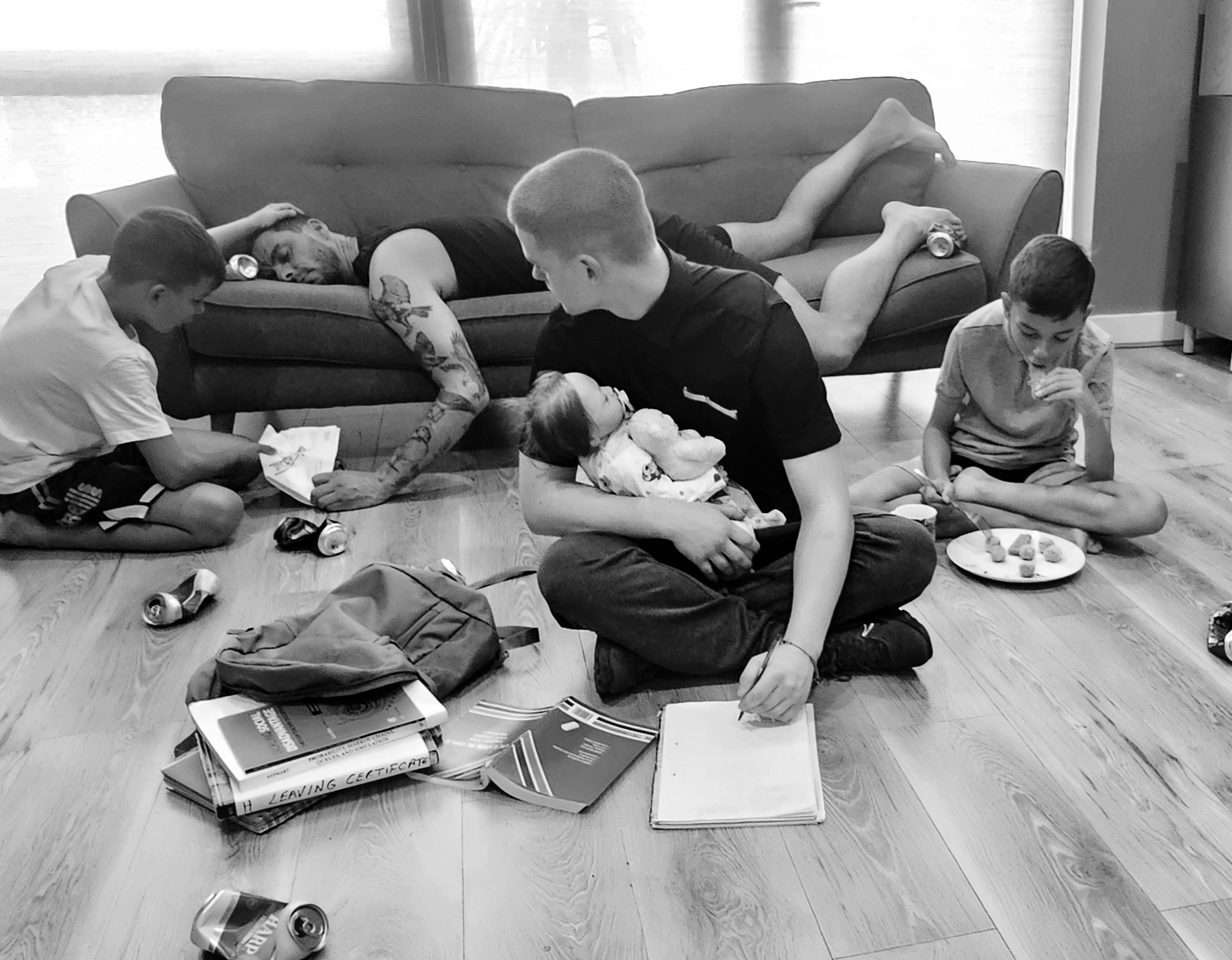
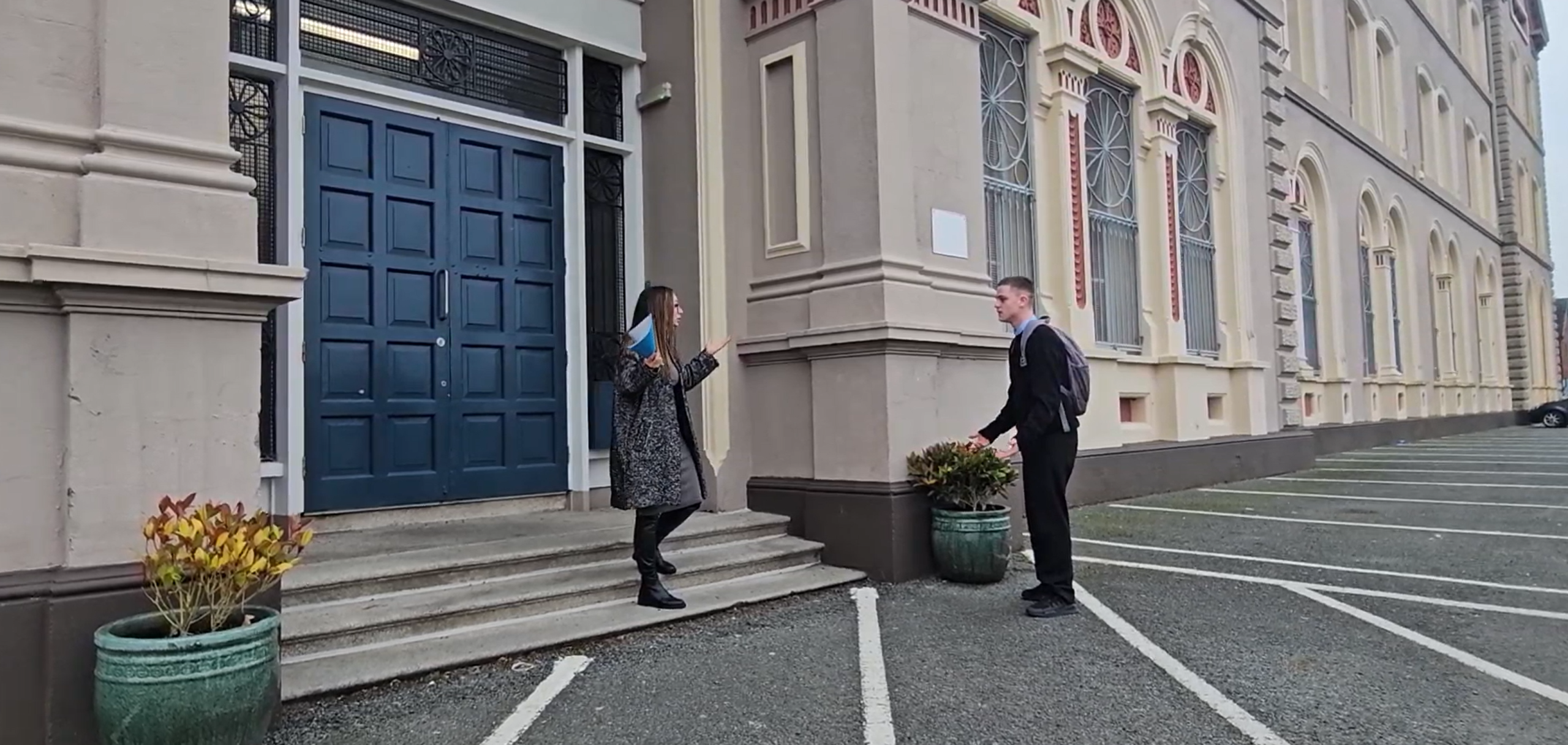
I created this image using my family to show my research in an image. It won the Research on walls competition. I would like to use this image as I feel it allows people to see what they refuse to see, and once we do see it we cant unsee it. It’s the realities of many lives of the students im researching.

My educational journey began with a blocked path. First, by a lack of navigational knowledge, followed by a lack of leaving certificate points in the so-called ‘equitable’ Irish entry system known as the ‘Points Race’ (O’Connor, 2017). The Irish Leaving Certificate points system allocates specific points to exam grades, which are then totalled to create a rank order for higher education applicants (Hyland, 2011). Though I found a workaround and was able to attend university, it wasn’t enough.

My journey was also defined by the prejudgment I faced from others within hours of stepping foot inside a place I felt I didn’t belong. Even though I was in an access programme designed for students like me – from a low socio-economic status background – there was no one like me! I never got past the first day and for that I branded that initial attempt at educational progression a complete personal failure because I couldn’t make myself fit in nor look and sound like the others. Yet, I knew deep down the failure wasn’t mine; it was systemic.

The hidden obstacles facing students from LSES in Ireland

As a teenager from a low socio-economic status background (LSES), how was I expected to succeed alone when an unstable home life, chaotic circumstances, and a lack of ‘insider’ cultural knowledge made higher education navigation impossible? The Irish education system was set up to favour students who already possessed unspoken social and cultural advantages, and I had nothing to inherit. That personal failure and the persistent musing it provoked is now the basis of my ongoing PhD research, exploring why students from similar LSES backgrounds remain underrepresented in further/higher education despite decades of new policies and initiatives.

The Irish Higher Education Authority reported that only 10% of students from LSES areas who attend Delivering Equality of Opportunity in Schools (DEIS) in Ireland progressed to higher education in contrast to 85% of students from affluent areas attending private schools (HEA, 2022;2023). I argue that until we acknowledge and understand how the hidden obstacles of social and cultural capital impact educational progression of LSES students, our equity and inclusion policies are destined to fail the very students they aim to help.

To understand why a system designed for fairness still produces fundamental inequality, we must change our focus. We must stop looking only at what the system provides in terms of funding and assistance and start looking at what students inherit.

The Irish educational paradox

My initial ‘personal failure’ was painful; I am speaking of the dual burden faced by many students from low-LSES backgrounds. First, there is the objective failure: not obtaining the university qualification we are socially conditioned to see as the sole metric of success. Second, and more corrosive, is the internalised belief that this shortcoming is a reflection of individual defect, rather than a consequence of lacking the social and cultural capital needed to navigate a judgmental system. This was my reality when, upon entering an access programme, the very stigma it was meant to erase led me to withdraw. It was, however, also a single reflection of a much larger, fundamental flaw in how the Irish educational system approaches equity. And now two decades later, it hasn’t changed a whole lot.

For a long time, the system has attempted to address inequality through many initiatives and policies, such as the introduction of the Delivering Equality of Opportunity in Schools (DEIS) programme, launched in 2005. This is one of the well-intentioned initiatives that are still in place and currently under review to be upgraded to ‘DEIS PLUS’. The central purpose of the DEIS Initiative is to support students from low socio-economic status (LSES) backgrounds to combat educational disadvantage and break the cycle of poverty through targeted support for schools and students. Its aim has been to level the playing field by directing additional resources, funding, and support to schools that serve communities with the highest levels of socio-economic disadvantage. These major government initiatives are well-intentioned, backed by significant investment, and focus heavily on two things the system can easily measure and deliver: academic support and financial aid.

This is where the paradox emerges; if we are pouring finances and resources into extra teaching resources, smaller class sizes, book-grant schemes, school completion programmes and so on – Why do students from LSES backgrounds or DEIS schools remain underrepresented in further and higher education?

Studies show the gap in progression to third level is still significantly low (Smyth, McCoy & Kingston, 2015; Fleming & Harford, 2021). We’ve treated the visible wounds, such as the lack of points and the cost of college, but the deep infection remains. Why is this conclusion unavoidable? Because the system is rewarding what it can see and ignoring what it can’t, or should I say, chooses not to see. My research is grounded in the belief that until we look beyond academics and economics, and start identifying and understanding the invisible barriers and impacts of social and cultural capital on students progression to FET/HE, the cycle of intergenerational educational disadvantage, poverty and inequality will continue.

Beyond Ireland – The lens of capital

To understand why a system designed for fairness still produces fundamental inequality, we must change our focus.

My PhD research adopts the framework of the French sociologist Pierre Bourdieu, who argued that success is not just about having money (economic capital) or good grades (academic capital). As established in his seminal work (Bourdieu, 1986), it is fundamentally about capital that is invisible.

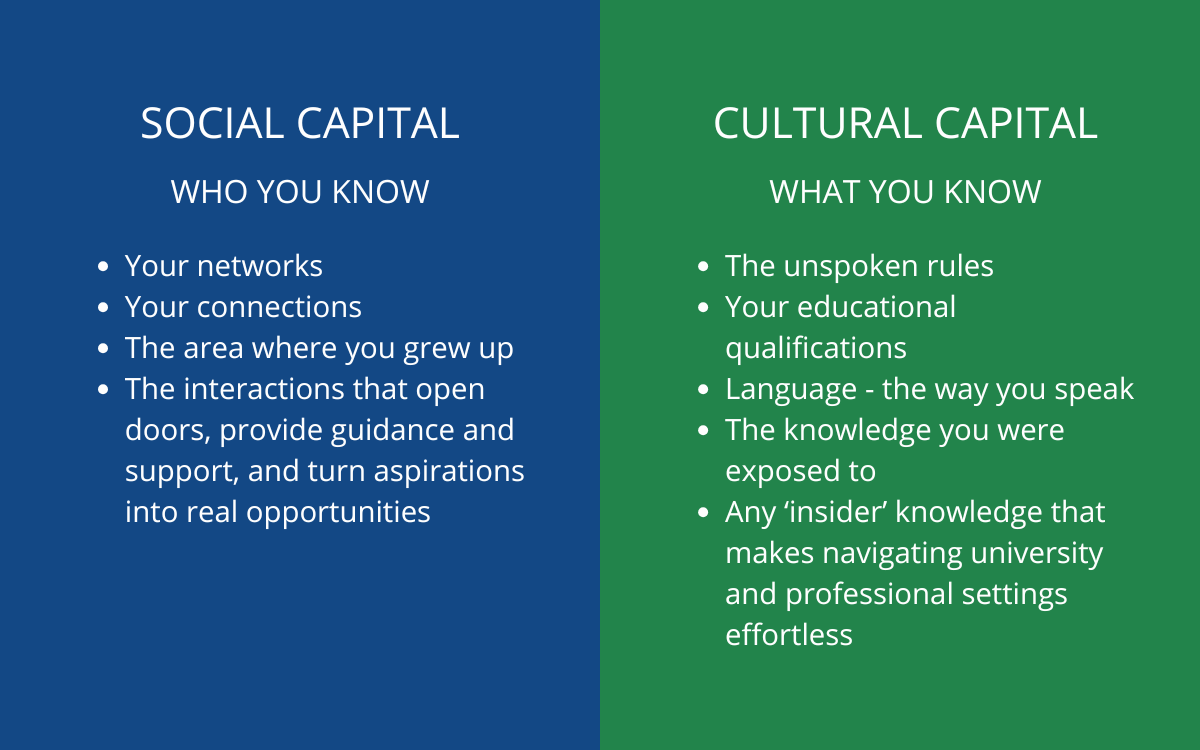
This social and cultural capital is the invisible curriculum the system rewards, but never formally teaches.

Social Capital – Who you know
•	Your networks
•	Your connections 
•	The area you grow up in
•	Your interactions that open doors, provide guidance, and support turning aspirations into real opportunities

Cultural Capital – What you know
•	The unspoken rules
•	Your educational qualifications
•	Language– as in the way you speak
•	The knowledge you've been exposed to, and the life you have been born into
•	Any 'insider' knowledge that makes navigating a university or professional setting feel effortless for some, and impossible for others.

Research by Hannon, Faas & O’Sullivan (2017) shows that the Irish educational system inadvertently rewards this inherited social and cultural capital. This invisible curriculum is a set of unwritten instructions: how to pick the right subjects for your career when in 4th year in school, how to apply for the appropriate higher education courses, how to behave in a college environment, or how to secure a professional network.

When I was a teenager from a LSES background, I didn’t fail because I lacked the intelligence, drive or the work ethic; I failed because I lacked the map and the compass, I had nothing of this crucial capital to inherit, and the system did not provide it. This realisation is the engine driving my research to measure this missing map, and understand the scale of the capital gap.

Mapping the invisible gap

My ongoing qualitative doctoral research – based on focus groups and interviews with DEIS post-primary students, staff, families, education and community professionals – uses this Bourdieusian lens to map the capital gap. The preliminary findings are heartbreakingly consistent.

The preliminary discovery is that for LSES students, the barriers to educational progression are rarely just financial; they are overwhelmingly navigational (SOLAS, 2017). Students often have high aspirations, but their families and social networks cannot provide the ‘insider’ cultural knowledge required to translate those aspirations into successful further and higher level educational progression. Without networks, students lack exposure to professionals or university graduates who can explain what a particular career or degree actually involves. It is extremely difficult to envision becoming someone no one you know has become. This lack of connection was confirmed by a parent:

“Like I said, we don’t know anyone. It’s not just about knowing people with fancy jobs, it’s about knowing anyone who’s been through the system.”

– Brooke, parent

The social web that guides more affluent students toward high-capital degrees (law, medicine, engineering) is simply absent.

Families and students often don’t know many of the initiatives that are available to them and those that do are intimidated by the educational bureaucracy. Terms like HEAR, DARE, ACCESS, CAO points calculation, and FET route become a confusing, impenetrable language barrier, constraining choices regardless of a student’s academic or financial ability.

One parent, whose child was doing well academically, summed up the anxiety perfectly:

” I’ve heard some things about student grants, but the forms look really complicated, and I don’t really understand all the questions. I’d be worried about filling them in wrong and messing it up.”

– Amy, parent

This also soundly debunks the persistent narrative that LSES students lack aspiration. They are ambitious, resilient, and intelligent, but they lack the cultural confidence that comes from familiarity. For many, college remains an ‘alien’ or hostile environment. Students reported feeling they wouldn’t ‘fit in’ or that the university was ‘not a place for people like us’. Aligning with international research on identity and inequality (Hutchings & Archer, 2001), this demonstrates that our equity policies, by focusing narrowly on measurable deficits, fail to provide the most essential ingredient for successful progression and transition – a sense of belonging and the cultural competency to navigate the landscape.

Becoming a teacher – and seeing myself in my students

My own educational path was not a straight line; it was a rescue mission, and the turning point that came years later, sparked by a disorienting dilemma; a health scare that reminded me life is too short to settle.

While working as a Special Needs Assistant (SNA) in a North Dublin primary school, I received a pivotal piece of external validation when the school principal agreed with me I had the capability to lead a classroom, not just assist in one. That belief gave me the courage to return to education as a mature student, overcoming the fear of my initial failure and also the imposter syndrome that had caused me to back out of applications three times before.

Becoming a qualified teacher was a triumph, but returning to teach in disadvantaged settings held up a mirror to my past. I saw students with immense raw talent who, like my younger self, were paralysed by a lack of confidence. This was heartbreakingly familiar. I saw brilliant students limiting their own potential because they had internalised the idea that they weren’t “academic.” They didn’t lack intelligence; they lacked opportunity, belief and they were impacted by their lack of social and cultural capital.

I realised that teaching a few students at a time wasn’t enough; I wanted to change the narrative for them on a larger scale. Today, my PhD research is not just an academic exercise; it is fueled by this ‘insider knowledge.’ I am researching educational barriers not because I read about them in a textbook, but because I climbed over them.

Call to action

My journey from being an outlier, seen as a ‘complete personal failure’ to becoming an educator and a PhD researcher has one singular purpose: to shift the conversation. My research suggests that, while financial and academic support are necessary, they are no longer sufficient. As one principal participant, Keith (2025), put it, we must stop ‘putting plasters over the visible wounds’ and start building the crucial capital that has been unintentionally starved out of the system.

The next generation of equity initiatives and policy cannot be about ‘equal opportunity’ alone; it must be about ‘equity of capital’ and my call to action is clear and practical.

We need to systematically embed capital-building initiatives directly into our support framework.

By co-creating these initiatives with our stakeholders and centering their lived experiences, we can structure initiatives that truly meet the needs of LSES students. Until we acknowledge that the Irish educational system, policies and initiatives inadvertently rewards what is inherited and not just what is achieved, our current efforts will continue to fail LSES students.

My research aims to make the invisible visible, and I pose the question for policymakers: Will you look with your eyes truly open?

Key Messages

  • Education systems reward what students inherit, not just what they achieve.
  • Financial aid alone cannot close the education gap – we must address invisible barriers.
  • Students from disadvantaged backgrounds don’t lack aspiration; they lack the map to navigate higher education.
  • Social and cultural capital are the invisible curriculum the system rewards but never teaches.
  • Educational equity requires shifting from equal opportunity to equity of capital.
Melissa Lynch

Melissa Lynch

Dublin City University

Melissa is an educator, researcher, and equity advocate dedicated to dismantling barriers in education. Currently a PhD candidate and lecturer at DCU’s Institute of Education, her research investigates how social and cultural capital impact the progression of students from disadvantaged backgrounds into higher education.

Her academic work, funded by Research Ireland and recognised with internal awards, is deeply informed by her own lived experience. In addition to her research, Melissa serves as a Board Director for Youth Advocate Programmes Ireland, Is a member of  ATD the All together in Dignity Alliance (#AddThe10th) and is a Research Associate at the Educational Disadvantage Centre (EDC) in DCU.

Google Scholar: https://scholar.google.com/citations?user=45QzcSsAAAAJ&hl=en#d=gs_hdr_drw&t=1762540028190

ORCID: https://orcid.org/0000-0001-5503-1603

Other blog posts on similar topics:

References and Further Reading

Bourdieu, P. (1986). The forms of capital. In J. G. Richardson (Ed.), Handbook of theory and research for the sociology of education (pp. 241–258). Greenwood.

O’Connor, C. (2017) Education Matters Yearbook 2016–2017. Dublin: Education Matters, pp. 202-205.

Fleming, B., & Harford, J. (2021). The DEIS programme as a policy aimed at combating educational disadvantage: fit for purpose? Irish Educational Studies, 40(4), 481-499. Available at: https://www.tandfonline.com/doi/full/10.1080/03323315.2021.1964568

Higher Education Authority (2022) National Access Plan for Equity to Access Participation and Success in Higher Education 2022-2028. Available at: https://www.gov.ie/en/department-of-further-and-higher-education-research-innovation-and-science/publications/national-access-plan-2022-to-2028/. [Accessed 2 November 2025]

Hannon, C., Faas, D., & O’Sullivan, K. (2017). Widening the Educational Capabilities of Socio-Economically Disadvantaged Students Through a Model of Social and Cultural Capital Development. British Educational Research Journal, 43(6), 1225-1245. 

Hutchings, M., & Archer, L. (2001). ‘Higher Than Einstein’: Constructions of Going to University among Working-Class non-Participants. Research Papers in Education, 16(1), 69–91. 

Hyland, Á. (2011). Entry to higher education in Ireland in the 21st century. National Council for Curriculum and Assessment.

Smyth, E., McCoy, S., & Kingston, G. (2015). Learning from the Evaluation of DEIS. Research Series, 39. Dublin: Economic and Social Research Institute (ESRI). Available at: https://www.esri.ie/system/files/publications/RS39.pdf

SOLAS (2017). Barriers to Further Education and Training with Particular Reference to Long Term Unemployed Persons and Other Vulnerable Individuals. Solas: The Further Education and Training Authority. Available at: https://www.solas.ie/f/70398/x/432b2fa3ba/barriers-to-fet-final-june-2017.pdf

Reflections on teacher protest in Serbia — When educational change becomes political

Reflections on teacher protest in Serbia — When educational change becomes political

Across different parts of the world, the start of the school year has often been marked by teachers taking to the streets. In 2024, educators in Spain demanded smaller class sizes and less administrative burden; in Greece, they opposed the merging of schools; and in Italy, they rose up for fair pay and job security [1].

At the start of the 2024/25 school year, the same was true in Serbia. Teachers once again protested, calling for better working conditions in education. But then something shifted: what began as professional demands grew into calls for broader social change.

This is the story of that school year in Serbia, told by us—a group of schoolteachers and university professors engaged in teacher education—drawn from our shared experiences and reflections. Above all, it is the story of how the teachers’ rebellion in Serbia was forged.

Where do we begin?

Even though the roots of this education crisis run deep, shaped by decades of policy decisions and systemic neglect, in recent years, the devaluation of the teaching profession in Serbia has become painfully evident. One of the turning points came in 2014, when a hiring freeze was introduced as a cost-saving measure. As a result, today, one in four teachers works under a fixed-term contract [2]. Additionally, half of all teachers do not have a full-time workload at a single school, piecing together hours across multiple schools—often still falling short of a full teaching schedule [3].

Even those with full-time positions earn, on average, about 12% below the national salary average, despite being among the 16.4% of Serbia’s population with the highest level of education [4]. In comparison with their counterparts elsewhere in Europe [5] and the region[6], this disparity becomes even more pronounced. While teachers in Romania and Hungary earn 10–30% above their respective national averages, those in Albania, Bosnia and Herzegovina, and Bulgaria earn roughly in line with national averages.

Even though the roots of this crisis lie in long-standing decisions by education policymakers and decades of neglect toward problems in the education system.

This financial insecurity is not only a personal burden—it is eroding the profession itself. Interest in teacher education programs is declining [7], threatening the future availability of qualified teaching staff. Shortages are already evident in high-demand subjects such as mathematics, computer science, physics, English, and German [8] —fields that typically lead to better-paying jobs outside the education sector. It hardly needs to be emphasized how devastating this trend could be for the quality of education in Serbia.

Yet these conditions shape and constrain the role of teachers as agents of change, not only within education but also in society. Fixed-term contracts and fragmented workloads foster dependency and insecurity, limiting teachers’ capacity to speak out, organize collectively, or cultivate a sense of community. In this way, economic insecurity functions as a mechanism that silences their voices.

Negotiations to improve teachers’ financial situation began in December 2022, between union representatives and officials from the Ministry of Education and the Government. In October 2023, an agreement was signed, committing state institutions to align teachers’ salaries with the national average by January 2025. But when 2024’s financial plans failed to support these promises, teachers took to the streets. A large warning protest on September 16, 2024, was ignored, and in November, teachers went on strike following a union call. The government responded that the agreement could not be fulfilled in 2025 “due to limited funds and no possibility of securing more.” [9]

The next trigger came when the union agreed to terms set by the Ministry that teachers considered humiliating. The proposed salary increase was minimal, keeping wages below the agreed level. The agreement also tied the distribution of budget funds to union membership, favoring certain unions that teachers saw as aligned with the Ministry in attempting to quell protests. As trust in the unions eroded, teachers began organizing into informal associations.


In the meantime … 

Meanwhile, a wave of student protests was triggered by a national tragedy that shook the country. On November 1, at the recently renovated train station in Novi Sad—officially reopened just months earlier in July 2024—a concrete canopy collapsed, instantly killing 14 people and seriously injuring three more, two of whom later died.

On November 22, students from the Faculty of Dramatic Arts in Belgrade (FDA) organized a silent vigil at a nearby intersection—fifteen minutes of silence, one for each victim. Their peaceful act was violently interrupted by a group, later revealed to be members of the ruling party, including some local officials, who attacked several students, resulting in some being hospitalized. In response, FDA students occupied their faculty, and by December 1, other faculties had joined the action.

The students issued four demands [10], calling primarily for the prosecution of those responsible for both the canopy collapse and the attacks on protesters, as well as for transparency in the work of government institutions. They made it clear: these demands must be met for the occupation to end. As the government continued to avoid meeting the students’ demands, the protests intensified—growing in scale.

Embracing student demands

The student and teacher protests in Serbia were far from coincidental. Both movements were fueled by a shared call for accountability in a system long accustomed to turning a blind eye to corruption and public neglect. Teachers quickly recognized the legitimacy of the students’ demands: “The demands students presented to the state were written in a universal language—the desire to establish the rule of law and the principle of accountability. That’s why schools quickly adopted these demands as their own and followed their lead,” recalled one high school principal. For educators, this resonance was immediate – they themselves navigated a system marked by institutional dysfunction, the sidelining of expertise in favor of party loyalty, and pressures from unauthorized actors intruding on professional decisions—from hiring teachers and selecting principals to allocating budgets for school repairs.

A key moment in this alignment came through a direct appeal from former pupils—now university students—who were participating in the blockades. These students reached out to their high school teachers, who had shaped them, reminding them of the values once promoted in the classroom: that education is not merely about grades or diplomas, but about justice, civic responsibility, and ethical engagement. One high school principal described the moment:

“Students organized letters of support to the schools they had attended. In our case, 725 former pupils, now university students, signed. The letter was delivered at the school in front of all staff and around 150–200 alumni. The emotion during that encounter was incredible—a corridor of former pupils welcomed the teachers with thunderous applause.”

Not long after, current high school students—starting with seniors—joined the blockades to stand with their university peers. Faced with a choice between supporting their current and former students in what was widely seen as a just cause, or aligning with a Ministry that, in the words of one principal, had “reduced itself to an instrument of repression and obedience to a hybrid regime with ties to criminal circles,” many teachers found their decision clear. They were moved not only by the cause itself but also by the attacks on protesting students, who had been publicly humiliated by government officials and even physically assaulted, with some run over by a car [11].

The decision to join was also encouraged by the support of fellow teachers—from the same school or others, from different levels of education. They motivated and supported one another, aware that they all contributed to educating young people, and with a renewed sense that their work had meaning. At the same time, they recognized that education cannot be meaningful if it ignores the social context. In this process, the boundaries between the strictly professional and the broader civic roles of teachers blurred. No theory claiming that education is a social and contextual activity could have had the impact that this real-life professional and societal context did.

Teachers acting as agents of social change

By mid-December, the teachers’ protest had become part of a broader civic movement calling for reform not only in education but across society. In this phase, the protest moved beyond the legal framework of a strike—which requires educators to maintain a minimum level of instruction—and took the form of civil disobedience, involving partial or complete suspension of classes. Yet the suspension of teaching did not mean inactivity. Instead, a new space for learning and critical engagement emerged, as one high school principal described it:

“During the months of the work stoppage, incredible forms of alternative, non-institutional teaching practices emerged—akin to lifelong learning—through the synergy of pupils, parents, teachers, and the local community. A vibrant, intellectual atmosphere brought about a whole series of exceptional ideas for how the school could be enriched in the future. Plenums [12] proposed speakers and topics, and decisions were made through voting. Film nights, quizzes, tournaments, poetry festivals were organized… The school lived an alternative life, which deeply influenced pupils and teachers in terms of enriching their practice going forward.”

As the protest grew, teachers’ actions were increasingly perceived as efforts not only to secure better conditions within schools but also to foster a better society. Stepping outside legal framework and defying Ministry pressure, educators risked salaries and even their jobs. Their courage inspired public sympathy and wider community involvement. Parents of younger pupils organized daily activities for children while teachers were on strike. Citizens gathered outside schools visited by educational inspectors seeking to halt the work stoppage. When the Ministry docked teachers’ pay, the IT community and an education-focused foundation provided a transparent system for citizens to donate directly—raising over 228 million RSD (roughly 2 million EUR) for educators affected by the stoppage.

Another significant form of protest came through mass withdrawals from representative teacher unions. Educators sought to demonstrate that union agreements no longer reflected the will of the teaching community and to prevent union representatives from speaking on their behalf in negotiations. As trust in unions eroded, most protest activities were organized autonomously by teachers themselves—through schools and informal associations that had formed or strengthened during this time. Crucially, this period saw coordination across all levels of education, from preschools to universities, as teachers collaborated to resist Ministry pressure and support one another.

The next phase unfolded after March 15, following a large demonstration in Belgrade. Despite high public expectations, the government made no meaningful progress toward meeting the students’ demands. Instead, officials intensified media campaigns and increased pressure on teachers participating in the work stoppage. As the school year progressed and the authorities’ inaction became evident, concern for students’ education led many schools and teachers to gradually resume regular teaching. Returning to the classroom was emotionally difficult for some educators, who feared they might have weakened student protests or betrayed the expectations of former pupils. Isolation returned as they reentered the classrooms, leaving teachers more vulnerable to manipulation within a centralized system. The question then became: how could the protest continue once the classrooms reopened?

Returning to teaching was followed by disciplinary measures against striking educators, including threats, dismissals, and, in many cases, the termination of fixed-term contracts over the summer. Some school principals were removed, and school boards dissolved, particularly where entire staffs had participated. During this time, education workers, pupils, university students, and other citizens held daily protests in solidarity with teachers facing job loss. Since disciplinary measures were initiated simultaneously across schools in Serbia, public support had to be spread thin, making these protests mostly small and limiting their ability to exert real pressure.

At the end of the school year, teachers became bogged down in a debate about whether all pupils should be given top marks to demonstrate that grades are meaningless in a system that does not respect knowledge—or whether grading should be boycotted entirely to paralyze the system and pressure the government to meet its obligations. Some teachers turned their attention toward reclaiming the unions, while others focused on strengthening non-union voices of education workers. At the beginning of the new school year, there is no clear call to action, and it remains uncertain who holds the legitimacy to issue one.

Where this leaves the teachers’ rebellion is unclear. Yet despite uncertainty, one thing remains undeniable: across Serbia, in front of schools and within them, the resistance still simmers.

Final refections — Teachers as agents of sociology(-political) change

This is not a story only about Serbia. Across diverse educational systems, a persistent tension can be observed: the gap between how teachers are celebrated in scholarly literature and what regulations actually allow them to do. Scholars often cast teachers as agents of social change, shaping not just the minds of their students but also the communities in which they live and work.

Yet in practice, rules in many countries enforce a principle of neutrality within schools, constraining the ways educators can step into public life. Herein lies the core dilemma: if education is profoundly political—through curriculum choices, enrollment policies, hiring decisions, allocation of funding—can, or should, teachers remain politically neutral?

This question is no longer theoretical. It is lived every day—in classrooms, in school hallways, and on the streets. The stakes are real—for those who stay silent and for those who raise their voices, for their students, their profession, and the society they serve. Perhaps the most urgent task now is to pose this question aloud: to examine how existing regulations constrain teachers, limiting their power to act within and beyond the classroom, and to confront the broader consequences of a system that treats teaching as if it could ever be a non-political act.

This article is a shortened, adapted, and updated version of the paper “Wie wir die Rebellion aufgebaut haben: Eine Fallstudie zu den Lehrer:innenprotesten in Serbien,” originally published in German in the journal Schulheft.

Olja Jovanović

Olja Jovanović

Assistant Professor, University of Belgrade

Olja Jovanović is an Assistant Professor of Educational Psychology at the University of Belgrade, working at the Center for Teacher Education and the Department of Psychology. With experience across schools, NGOs, international organizations, and higher education, her research focuses on processes of marginalisation of children and young people in educational contexts, with particular attention to the role of teachers as agents of social change.

Katarina Mićić

Katarina Mićić

Assistant Professor, University of Belgrade

Katarina Mićić is an Assistant Professor at the University of Belgrade, working at the Center for Teacher Education and the Department of Psychology. Her research focuses on equity and inclusion in education, teacher education, and students’ motivation to learn. She is engaged in reform initiatives aimed at improving inclusive education and developing data-informed educational policies. She is committed to ensuring that academic knowledge and research findings serve the community, particularly schools.

Lidija Radulović

Lidija Radulović

Associate Professor, University of Belgrade

Lidija Radulović is an Associate Professor at the University of Belgrade, Centre for Teacher Education and the Department of Pedagogy, with more than 35 years of teaching and research experience. She is involved in the development and implementation of teacher education programmes. Her research focuses on the teaching profession and teacher education.

Bojan Vučković

Bojan Vučković

Principle, XIII Belgrade Gymnasium

Bojan Vučković has served as the principal of the XIII Belgrade Gymnasium since 2004. He graduated in 1990 from the Faculty of Philosophy at the University of Belgrade, majoring in History. From 1990 to 2004, he worked in several primary and secondary vocational schools, and since 1993 he has been teaching history at the XIII Belgrade Gymnasium. From 2000 to 2004, he was co-president of the Association for Social History “Euroclio,” whose activities are primarily oriented toward secondary education.

Aleksandar Tadić

Aleksandar Tadić

Associate Professor, University of Belgrade

Aleksandar Tadić is an Associate Professor of General Pedagogy, Contemporary Pedagogical Theories, and Education System at the University of Belgrade, working at the Department for Pedagogy and Andragogy. With experience across schools and higher education, his research focuses on contemporary educational theory, pedagogy of autonomy, classroom discipline, initial pedagogical education of teachers and educational policies.

Ljiljana Rajčić

Ljiljana Rajčić

Teacher, Ivo Andrić Primary School, Belgrade

Ljiljana Rajčić holds a diploma in mathematics. Since 2001, she has been working at the Primary School “Ivo Andrić” in Belgrade as a teacher of mathematics and informatics. She sees her mission in motivating students to independently seek answers and to recognize knowledge as an invaluable asset that shapes their future.

Other blog posts on similar topics:

References and Further Reading

[1] Workers Struggles: Europe, Middle East & Africa https://www.wsws.org/en/articles/2024/09/05/xprs-s05.html

[2] https://opendata.mpn.gov.rs/otvoreni-podaci 

[3] Data requested and received from the Ministry of Education 

[4] https://publikacije.stat.gov.rs/G2025/Pdf/G202517018.pdf 

[5] https://eurydice.eacea.ec.europa.eu/data-and-visuals/teachers-statutory-salaries#tab-1

[6] https://demostat.rs/sr/vesti/analize/kolike-su-plate-nastavnika-u-susednim-zemljama/2140

[7] University of Belgrade data.

[8]  Data requested and received from the Ministry of Education.

[9] https://www.danas.rs/vesti/drustvo/vlada-pozvala-sindikate-obrazovanje-i-predskolstva-na-sastanak 

[10] The initial students’ demands can be found here: https://podrzistudente.org/?lang=en 

[11] https://www.youtube.com/watch?v=xHlTI-fS9Oc&ab_channel=InsajderVideo  

[12] Plenums were the main means of decision making during the protests. A plenum is a general assembly open to all members of a group or community, where everyone has an equal right to speak, propose, and decide, typically functioning on principles of direct democracy and consensus.