How a board game can help future teachers work better with parents
Working with parents is a central yet often challenging part of teachers’ everyday practice. While teacher education programmes emphasise its importance, many future teachers feel unprepared when they first encounter real-life situations involving parents. This gap between theory and practice raises an important question: how can we better prepare teacher trainees for meaningful home–school collaboration?
Parental involvement is key to student success. Yet, teacher trainees often report that they hear about the importance of working with parents in theory but receive little practical guidance or training. This disconnect between theory and practice inspired us to experiment with game-based learning.
Imagine stepping into the shoes of a trainee teacher who must handle a parent upset about their child’s progress, while also coordinating a school event and supporting students. That’s exactly the kind of scenario our board game lets players experience – without the real-life stress.
Why focus on parental involvement?
Studies across the globe (e.g., Epstein, 2010; Goodall & Vorhaus, 2011; OECD, 2019, 2020) have shown that parental involvement improves student achievement, strengthens school climate, and fosters trust. However, many novice teachers feel unprepared or even reluctant to communicate with parents, especially parents of students from disadvantaged or marginalised backgrounds (see Pusztai et al. 2025).
In many countries, including Hungary, teacher education provides little practical training for future teachers on building strong home–school partnerships (Epstein, 2018; Graham-Clay, 2024, Pedditzi et al., 2021). Recognising this gap, our research group set out to develop an innovative tool: a board game designed to simulate the real‑life challenges of working with families. This board game was developed within a research project led by Prof. Dr. Gabriella Pusztai and a multidisciplinary design team (Dániel Bodnár, Zsolt Csák, Zsófia Miklódi-Simon and Zsófia Kocsis). We tested this board game in with over 110 participants, including both pre‑service teacher trainees and in‑service teachers (Kocsis et al. 2025).
Learning through play: serious board games for serious topics
Board games are more than just entertainment – they can serve as powerful educational tools. Research has shown that games support active learning, motivation, and collaboration (Ezezika et al., 2023, Radzi et al. 2020, Viray 2016). They also help learners approach complex or emotionally charged topics in a less intimidating way.
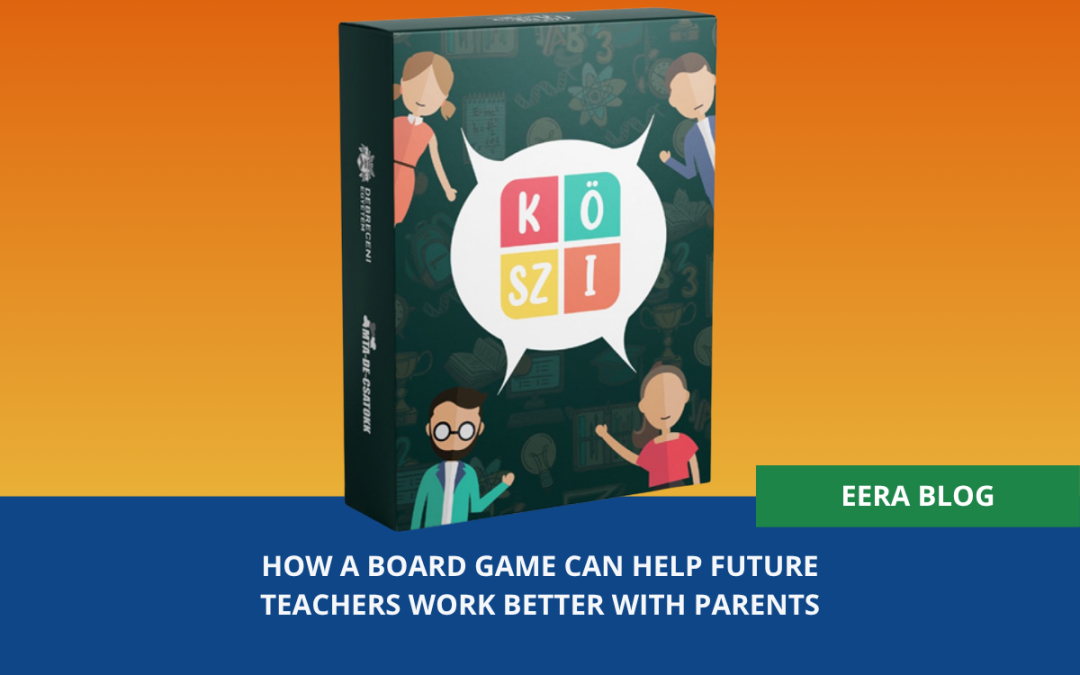
Our board game was designed by researchers and students together. The game presents realistic school scenarios. Players face communication challenges with parents, plan joint activities, and respond to unexpected events together as a team. Humour, cooperation, and decision-making are key elements of the gameplay (Kocsis et al. 2025).
The board game – set up
The board game invites players to step into the everyday reality of educators and explore the challenges of working with parents in a playful, collaborative way. The game is built on real-life situations, research findings, and educators’ experiences. While cooperation is key, luck also plays a role, occasionally helping or hindering progress. The game is designed for 4–7 players.
The game is fully cooperative: all players form one team representing the school staff. One player takes on the role of the school principal, while the others take on different staff roles. Cooperation means that players discuss each situation together and must agree on a shared solution. There are no individual winners or losers – the team either succeeds or fails collectively.
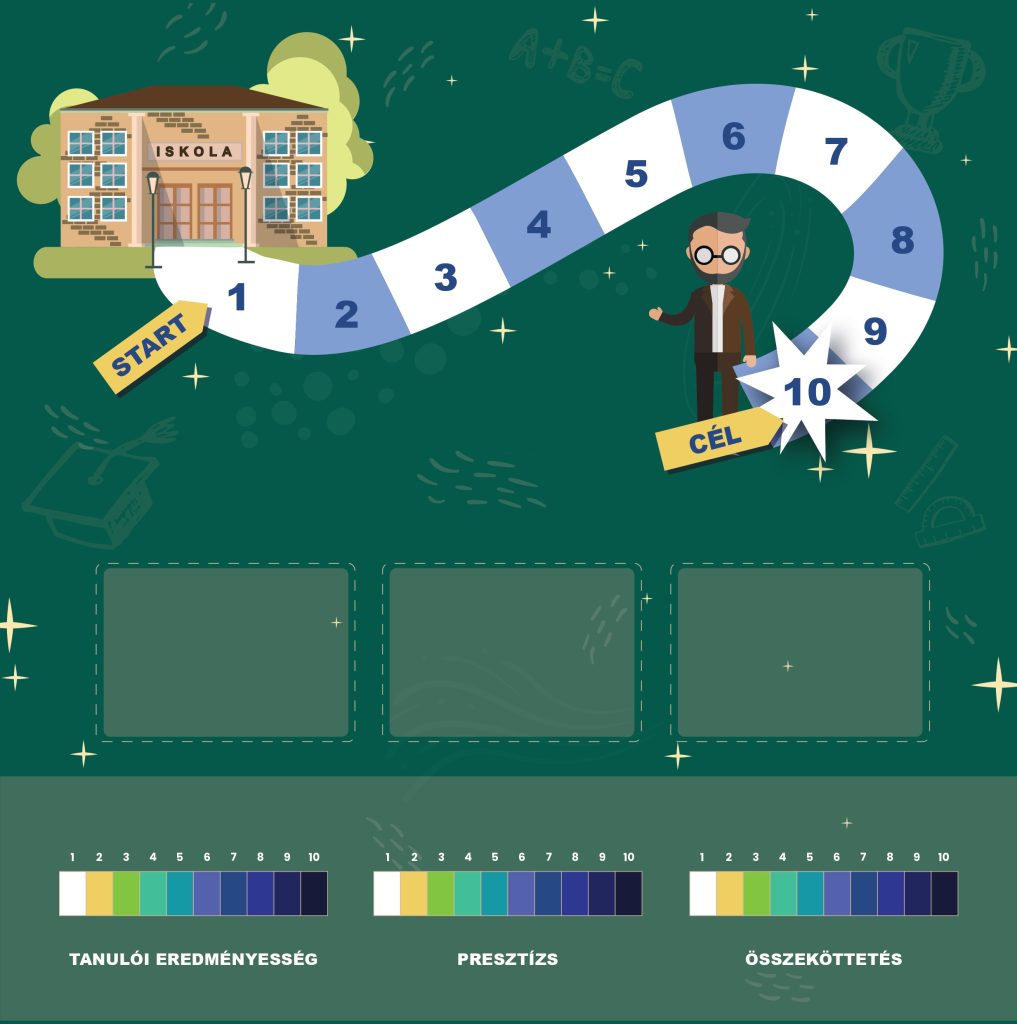
The game follows a school year, represented by a 10-space path, each space corresponding to one month. Each round represents one month in the school year, and players move forward together from one space to the next as the game progresses. Each month is associated with a specific challenge: at the beginning of every round, players draw and read aloud a new Challenge card that introduces the situation they must address as a team. In the centre, players find Parent, Action, and Quiz card decks.
At the bottom of the board, three scales track the school’s indicators in achievement, reputation, and community connectedness. These indicators, inspired by a previous theoretical framework, reflect what players must balance and improve by the end of the game. To keep the game replayable, different difficulty levels are available. The starting status of the school is based on data from the Hungarian 2019 National Assessment of Basic Competencies, resulting in four school profiles that combine levels of parental involvement and school effectiveness.
The cards
Character
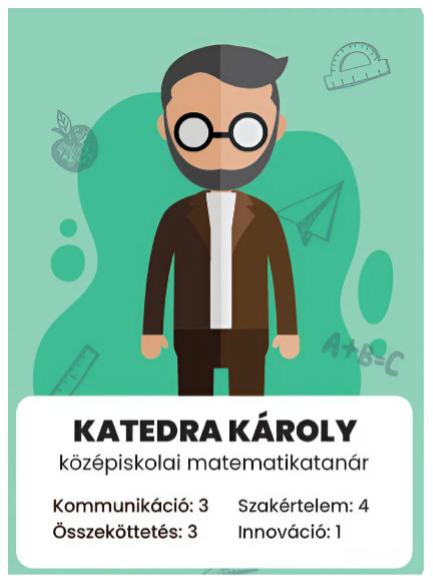
Players take on the roles of school staff members, each with a Character card showing their position and four key competencies: Communication, Connectedness, Expertise, and Innovation.
These form the K.Ö.SZ.I. index and determine how effectively players can handle challenges (The ‘K.Ö.SZ.I. Index’ was created through the combination of these skills. K.Ö.SZ.I. is an acronym made up by the initial letters of the skills’ Hungarian names, respectively). One player must always take on the role of the school principal; other roles can be freely chosen.
Note: A school professional character (high school math teacher). This character is a mature and respected teacher who has experienced a lot in his long career. He is respected for his great knowledge and fairness. However, he struggles to understand the problems of the modern school and does not know the latest and most effective solutions. The English translation of the text directly visible on the card reads: Charles Chair, high school mathematics teacher. Communication: 3, Connectivity: 3, Expertise: 4, and Innovation: 1.
Parent
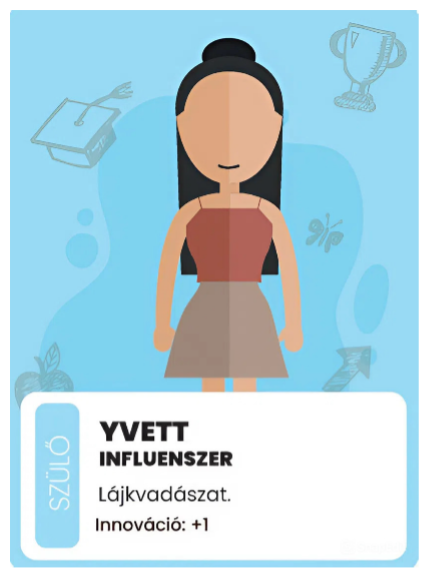
At the start of the game, each player draws a Parent card. These cards influence characters’ competencies in different ways:
- Blue cards represent actively involved parents and usually have positive effects.
- Red cards represent passive parents and typically have negative effects – though in some cases, the right school role can turn this into a positive.
- Orange cards represent caregivers such as grandparents or siblings, with mixed effects.
Note: Meet Yvette, the influencer mom. Her superpower? Hunting for likes! She is highly active on social media and brings a creative, trend-aware perspective to school life. Her presence boosts your team’s innovation skills by +1—showing how digital engagement can also contribute positively to the school community.
Challenge
Each round begins with a Challenge card that matches the current “month.” Players respond to the situation by choosing from a shared set of solution options. Once a solution is used, it cannot be selected again for the next two rounds, encouraging strategic thinking and variety.
Action
Action cards introduce unexpected events. Problem Action cards reduce one or more school indicators, while Good Practice Action cards increase a chosen indicator and showcase real-world examples worth reading aloud.
Quiz
At the end of each round, players draw a Quiz card and answer the question as a team. Correct answers allow the group to increase one school indicator by one point. The quizzes range from quick multiple-choice questions to short open-ended tasks, and QR codes link to further information for those who want to dive deeper.
The Solution Table
Players collaborate using a shared Solution Table that outlines possible actions for addressing each challenge. The table offers a range of evidence-informed options, such as home visits, workshops, communication tools, and community-based activities, each linked to different aspects of school–family–community partnerships.
The gameplay
Working as a team, players select and combine actions strategically, taking into account their competencies and the current situation, including the effects of Parent cards. Successful choices contribute to improving the school’s indicators, such as achievement, reputation, and community connectedness.
To summarise the game flow, the main steps of gameplay can be described as follows:
Start of game
- Select school Character (fixed role throughout game)
- Set initial school indicators (achievement, reputation, community connectedness)
Each round (1 month in the school year)
- Move forward on the 10-space school-year path
- Draw & read Challenge card (new situation)
- Collaborative decision-making and select a strategy from the Solution Table
- Apply outcome
- Draw an Action card
- Draw a Quiz card (team answers together, and possible further improvement of school indicators)
End of round
- Discard current Parent cards
- Draw new Parent cards (symbolising the continuously changing nature of school–family interaction)
- Next round begins
The game starts at the beginning of the school year (first month) and ends after completing all ten rounds. The team’s success depends on how well they manage and improve the school indicators by the end.
Our results
In our first project, 110 teacher education students played the cooperative, scenario‑based game. They appreciated its collaborative structure, realistic situations and humorous tone. Many reported new insights into parental roles and strategies for effective home‑school communication, suggesting deeper reflection and engagement than traditional theory alone could trigger.
The intervention was in spring 2024. Teachers and teacher trainees participated in separate groups. Based on anonymous identifiers, 31 matched responses were analysed, including 17 pre-service and 14 in-service teachers. The pre-test and post-test were conducted using the same self-developed questionnaire consisting of 70 items measured on a 10-point scale related to PI.
The results (analysed with Wilcoxon signed-rank test and effect-size calculations) showed:
- In‑service teachers demonstrated greater attitudinal change, particularly in commitment to parent engagement, compared with teacher trainees.
- Participants improved significantly across multiple indicators: partnership orientation, communication with parents, and social sensitivity.
- Attitudes toward parent involvement with adolescents remained low both before and after the intervention, underscoring a persistent belief that adolescent students require less parental engagement.
- Teacher trainees showed more limited change, likely due to lack of real-world experience to connect with the game’s scenarios.
These findings indicate the board game is a promising tool for reflexive learning, especially for teachers with some school experience, boosting both professional attitudes and social awareness in evidence‑based ways.
What we learned
What makes this approach valuable? Why it matters
In many teacher education systems, preparation for engaging with parents is still minimal and inconsistent (Willemse et al., 2018; Jones et al., 2025). Our board game offers one small but practical solution. It helps student teachers move beyond fear or assumptions and encourages them to reflect on how they can build meaningful relationships with families.
This approach is scalable. The game can be integrated into teacher education courses, adapted for different cultural contexts, or even used in in-service training. More broadly, it demonstrates the value of serious games in bridging the gap between academic learning and the everyday realities of teaching.
- Validated outcomes : two empirical studies, including statistical analysis, support claims of attitudinal change.
- Relevance across contexts: the game frames challenges that teachers worldwide face, such as collaborating with diverse families or negotiating partnerships for school events.
- Reflective, active learning: players explore dilemmas in a safe, teamwork‑based setting, bridging theory and practice.
- Versatile application: beyond initial teacher training, the game can be adapted for in‑service training, community workshops or multicultural contexts.
A call to educators and researchers
If we want future teachers to succeed, we must support them in learning how to work with families, especially in diverse and challenging environments. Tools like this board game are not replacements for direct experience, but they are a valuable bridge. We encourage colleagues worldwide to explore similar tools, contribute to evidence‑based evaluation, and advocate for experiential pedagogies in teacher education.

Key Messages
- Though research shows that parental involvement boosts student achievement, strengthens the school climate, and builds trust, many trainee teachers feel unprepared to work with parents.
- A new board game lets trainee teachers practice tricky parent conversations without real-life stress, simulating the everyday challenge of home-school collaboration in a fun, cooperative setting.
- In the study, over 110 student and in-service teachers played the game to improve school-family partnerships, leading to improved attitudes toward parent engagement, better communication skills, and insights that went beyond theoretical teaching.
- The evidence-based game sees players work as a team to tackle realistic challenges, balance school indicators, and navigate unexpected events.
- Fun games can have serious potential. The board game shows that playful, scenario-based learning can bridge the gap between theory and practice in teacher education.

Zsófia Kocsis
Institute of Educational and Cultural Studies, Faculty of Humanities, University of Debrecen
Zsófia Kocsis is an assistant lecturer at the Institute of Educational and Cultural Studies, Faculty of Humanities, University of Debrecen. Her research focuses on student work and the relationship between work and academic performance. In recent years, she has also expanded her research and teaching activities to include the use of board games in higher education. She led the development of two self-designed board games (K.Ö.SZ.I., Study hard, work hard!), which aim to develop students’ competencies and broaden their knowledge in the given field.
Other blog posts on similar topics:
Epstein, J. L. (2010). School/Family/Community partnerships: Caring for the children we share. Phi Delta Kappan, 92(3), 81–96 https://doi.org/10.1177/003172171009200326
Epstein, J. L. (2018). School, family, and community partnerships in teachers’ professional work. Journal of Education for Teaching, 44, 397–406. https://www.researchgate.net/publication/324721985_School_family_and_community_partnerships_in_teachers’_professional_work
Ezezika, O., Fusaro, M., Rebello, J., & Aslemand, A. (2023). The pedagogical impact of board games in public health biology education: The Bioracer board game. Journal of Biological Education, 57(2), 331–342 https://www.researchgate.net/publication/350860649_The_pedagogical_impact_of_board_games_in_public_health_biology_education_the_Bioracer_Board_Game
Goodall, J., & Vorhaus, J. (2011). Review of best practice in parental engagement. UK Department for Education. Available online: https://purehost.bath.ac.uk/ws/portalfiles/portal/146139638/DFE_RR156.pdf (accessed on 30 July 2025).
Graham-Clay, S. (2024). Communicating with parents 2.0: Strategies for teachers. School Community Journal, 34(1), 9–60. https://www.adi.org/journal/SS2024/Graham-Clay1.pdf
Jones, C., Sideropoulos, V., & Palikara, O. (2025). Do teachers have the knowledge and skills to facilitate effective parental engagement? Findings from a national survey in England. Educational Review, 1–24 https://www.tandfonline.com/doi/full/10.1080/00131911.2025.2506802
Kocsis, Z., Csák, Z., Bodnár, D., & Pusztai, G. (2025). Designing a Board Game to Expand Knowledge About Parental Involvement in Teacher Education. Education Sciences, 15(8), 986. https://doi.org/10.3390/educsci15080986
OECD. (2019). PISA 2018 results (volume III): What school life means for student’s lives. OECD Publishing.
OECD. (2020). Parental involvement in school activities. In PISA 2018 results (volume III): What school life means for students’ lives.
Pedditzi, M. L., Nonnis, M., & Nicotra, E. F. (2021). Teacher satisfaction in relationships with students and parents and burnout. Frontiers in Psychology, 12, 703130. https://pubmed.ncbi.nlm.nih.gov/34659016/
Pusztai, G., Bacskai, K., Ceglédi, T., Kocsis, Z., & Hine, M. G. (2025). Mission possible? Institutional family-school-community partnership practices and parental involvement in Hungarian majority and minority schools in three central and eastern European countries. Social Sciences, 14(2), 107. https://www.mdpi.com/2076-0760/14/2/107
Radzi, S. H. M., Ying, T. Y., Abidin, M. Z. Z., & Ahmad, P. A. (2020). The effectiveness of board game towards soft skills development for higher education. Ilkogretim Online—Elementary Education Online, 19(2), 94–106. https://www.researchgate.net/publication/348213416_The_effectiveness_of_board_game_towards_soft_skills_development_for_higher_education
Viray, J. S. (2016). Engaging students through board games: Measuring its effectiveness on academic performance. International Journal of Scientific and Research Publications, 6(10), 5–7. https://www.researchgate.net/publication/317032619_Engaging_Students_through_Board_Games_Measuring_Its_Effectiveness_on_Academic_Performance
Willemse, T. M., Thompson, I., Vanderlinde, R., & Mutton, T. (2018). Family-school partnerships: A challenge for teacher education. Journal of Education for Teaching, 44(3), 252–257. https://www.tandfonline.com/doi/full/10.1080/02607476.2018.1465545