
When rankings become norms: What school league tables reveal and conceal
Every year, many families face a familiar question: Which school is the best choice for their child? League tables seem to offer a clear answer by turning a complex educational landscape into a simple order. They are widely consulted precisely because families, students, journalists, and policymakers need accessible information (Leckie and Goldstein, 2009; Strickley et al., 2014; Wilson and Piebalga, 2008).
That simplicity is also their danger. Rankings do more than list schools: they signal which schools are desirable and which outcomes count as excellence. Repeated year after year, they can turn one selective definition of a good school into a public norm.
The key question, then, is not only which school is at the top, but whose idea of a “good school” is being measured?
Our argument is therefore clear: rankings can be useful sources of information, but conventional league tables should not be read as neutral or comprehensive measures of school quality. Evidence from Hungary shows why.
Rankings answer a real need – but only partially
School rankings reduce uncertainty and create a common reference point for public debate (Bhattacharji and Kingdon, 2016; Tse, 2019). That is a legitimate function. Yet rankings are never neutral mirrors of educational quality: what they reflect depends on what their designers choose to measure.
Every ranking is constructed from selected indicators – for example examination results, admission outcomes, competition results, or student performance measures – which are converted into points, weights, and positions. Those choices are technical, but they also express values.
If examination scores receive the greatest weight, schools with strong examination outcomes become the model. If competition success or admission demand is rewarded, competitive, popular, and selective schools become more visible (Wilson et al., 2006). The table does not merely record excellence; it helps define it.
What a ranking point can – and cannot – mean
Ranking points can make the measurement of educational quality appear more precise than it actually is. A Top 100 position looks objective, yet it summarises only what the ranking method has chosen and been able to count.
A high position may reflect committed staff and strong teaching. It may also reflect selective admissions, student composition, urban location, family resources, reputation, and the capacity to attract pupils who are already high achieving. These influences cannot be separated by a simple league-table position.
This matters especially in selective education systems. A school at the top of a league table may be excellent, but its position may also depend on who has access to it in the first place. If a school enrols pupils who already have strong academic, social, and family resources, high final results do not show by themselves how much the school contributed (Burger, 2016; Maaz et al., 2008). Ranking points are not school quality itself; they are indicators constructed to represent selected dimensions of it.
Lessons from Hungary: a stable elite, not open competition
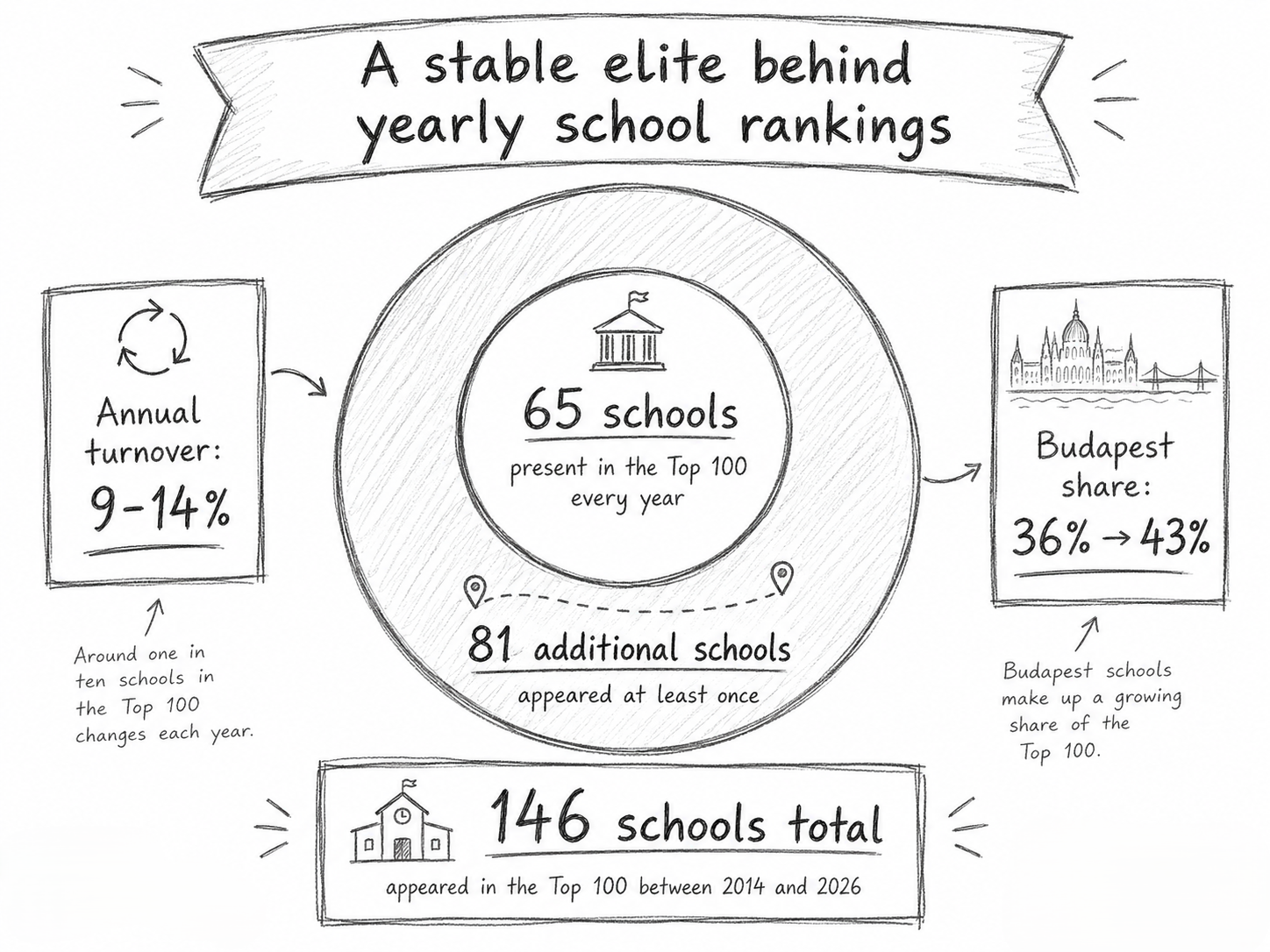
Figure 1. Stable core and moving margins in the HVG Top 100 ranking, 2014–2026
Our research in Hungary illustrates the problem. We analysed the 2014–2026 secondary school ranking published by HVG, a Hungarian weekly news magazine covering politics and economics (Béres, 2026b). Across those years, 146 schools appeared in the national Top 100 at least once, but 65 were present every year.
There was movement: annual turnover ranged from 9 to 14 percent. Yet this was not an open contest in which any school could readily rise to the top. The pattern was a stable elite surrounded by a more mobile outer zone.
The pattern was spatial as well as institutional. Budapest’s share increased from 36 to 43 percent, while schools with long-term visibility outside the capital tended to cluster in major urban centres.
Different methods, a similar elite
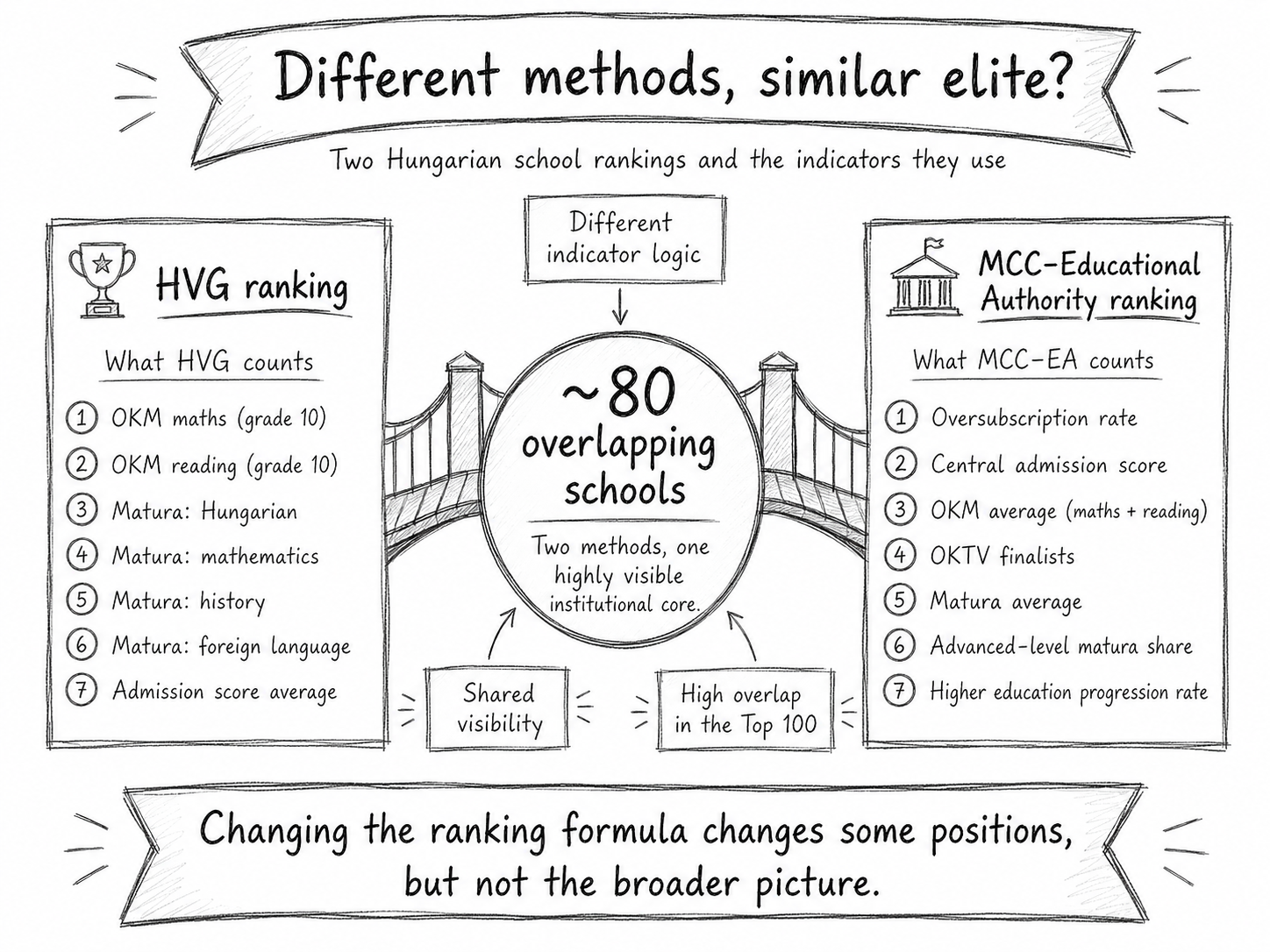
Figure 2. Different methods, similar elite? Comparing the HVG and MCC–Educational Authority rankings
Notes: OKM = Hungarian National Assessment of Basic Competencies; Matura = secondary school-leaving examination; OKTV = National Secondary School Academic Competition. Admission score average refers to higher education admission points, while central admission score refers to the written secondary school entrance examination. Higher education progression rate indicates continuation into higher education.
Could this stability be an artefact of one publisher’s method? A comparison of Hungary’s two main secondary school rankings suggests that methods matter, but they do not erase the broader pattern (Béres, 2026a).
Hungary has two main secondary school ranking systems: the weekly magazine mentioned above, HVG, and a ranking jointly produced by the Mathias Corvinus Collegium and the Hungarian Educational Authority (MCC-EA ranking). They draw on related national datasets but use different methods.
HVG combines competency-test results, school-leaving examinations, competition results, and higher education admission outcomes. MCC-EA also includes oversubscription and entrance scores. That emphasis makes MCC-EA an especially selective view of the academic secondary school (Gymnasium) sector.
Despite these differences, roughly 80 percent of the schools appeared in both Top 100 lists. Changing the indicators therefore changes some positions and determines which schools move into or out of visibility, confirming that ranks are constructed rather than natural facts.
At the same time, the high overlap reveals a durable institutional core. Different formulas repeatedly recognise many of the same academically strong, selective, urban, and already visible schools. Agreement between rankings can look like proof of quality even when both privilege similar forms of achievement.
This is the central lesson from Hungary: league tables do not simply compare schools within an open field. They can stabilise a particular model of excellence and give an established elite greater symbolic authority. That does not make the recognised schools undeserving, but it does narrow what the public is encouraged to see as success.
What rankings leave out
Most school league tables are better at displaying high final performance than educational compensation. They show where excellent results are concentrated, but usually say less about how far pupils have progressed from their starting points.
If we only recognise schools for high final outcomes, we may overlook schools doing difficult and socially valuable work. They can also overlook schools that create inclusive learning environments, support pupils from disadvantaged families, or expand opportunity in less advantaged regions. These are not secondary achievements; they are different dimensions of educational quality.
A fairer public conversation about schools would therefore report several dimensions side by side: final outcomes, value added, social inclusion, compensation for disadvantage, student wellbeing, and territorial access. No single position can represent all of them.
How should rankings be used?
Our position is straightforward. Rankings should not be ignored, because the demand for accessible information is real. But they should not be allowed to stand in for school quality as a whole.
Rankings should be treated as partial descriptions, never as final judgements of overall school quality.
Readers, journalists, and policymakers should ask three questions whenever a league table is published.
- What indicators were used? Examination results, competition success, admission demand, and student progress do not measure the same thing.
- Which definition of excellence is being reflected? Are we measuring educational quality in general, or the features of schools that are already socially and institutionally advantaged?
- What remains invisible? Are we also seeing schools that compensate for disadvantage, support diverse learners, and create opportunities where they are most needed?
These questions are not only relevant in Hungary. Across Europe, education systems are increasingly shaped by public data, performance indicators, and accountability tools. The challenge is not to reject measurement, but to interpret it responsibly.
Publishers and public agencies can make rankings more responsible by stating their limits prominently and presenting separate measures of attainment, progress, inclusion, and access instead of compressing them into one supposedly definitive score.
School rankings can be a useful starting point – but only if they open the conversation about educational quality rather than close it.
Key Messages
- Rankings are useful, but partial – While they provide accessible information, they reflect the indicators their designers choose.
- A high position reflects more than teaching quality – Admission, pupil intake, location, and family resources all influence results.
- Hungary shows a stable elite, not open competion – with many schools appearing year for year in the top 100.
- Different methods produced a similar elite cohort – despite different formulas, the same academically strong, selective, and often urban schools keep being recognised.
- Rankings should encourage debate – with readers aksing which indicators were used, which definition of excellence reflected, and which schools remain invisible.

András Béres
Institute of Geography and Earth Sciences, Faculty of Sciences, University of Pécs, Hungary
Other blog posts on similar topics:
Béres, A. (2026a). Schools in the mirror of rankings: Comparing the HVG and MCC grammar school rankings, 2025–2026. Új Pedagógiai Szemle, 76(7–8), 26–66. https://upszonline.hu/index.php?article=760708008&lang=en
Béres, A. (2026b). Stable elite or a revolving door? Spatial and dynamic patterns in the HVG TOP100 upper secondary school ranking (2014–2026). Iskolakultúra, 36(8), 35–63. https://doi.org/10.14232/iskkult.2026.8.35
Bhattacharji, P., Kingdon, G. G. (2016). School Education and the Lack of Parent Information. Contemporary Education Dialogue, 13(1), 57–92. https://doi.org/10.1177/0973184915603174
Burger, K. (2016). Intergenerational transmission of education in Europe: Do more comprehensive education systems reduce social gradients in student achievement? Research in Social Stratification and Mobility, 44, 54–67. https://doi.org/10.1016/j.rssm.2016.02.002
Leckie, G., Goldstein, H. (2009). The Limitations of using School League Tables to Inform School Choice. Journal of the Royal Statistical Society Series A: Statistics in Society, 172(4), 835–851. https://doi.org/10.1111/j.1467-985X.2009.00597.x
Maaz, K., Trautwein, U., Lüdtke, O., Baumert, J. (2008). Educational Transitions and Differential Learning Environments: How Explicit Between-School Tracking Contributes to Social Inequality in Educational Outcomes. Child Development Perspectives, 2(2), 99–106. https://doi.org/10.1111/j.1750-8606.2008.00048.x
Strickley, A., Bertram, J., Chapman, D., Hart, M., Hicks, R., Kennedy, D., Phillips, M. (2014). A National Single Indicator for Schools in England: Helping Parents Make Informed Decisions (pp. 331–345). https://doi.org/10.1007/978-3-662-45770-2_28
Tse, T. K. C. (2019). Fears and Tears of Transparency and Disclosure: Controversies and Politics of School Profiles in Hong Kong Since 2000. Education and Urban Society, 51(8), 1106–1126. https://doi.org/10.1177/0013124518785014
Wilson, D., Piebalga, A. (2008). Performance Measures, Ranking and Parental Choice: An Analysis of the English School League Tables. International Public Management Journal, 11(3), 344–366. https://doi.org/10.1080/10967490802301336
Wilson, D., Croxson, B., Atkinson, A. (2006). “WHAT GETS MEASURED GETS DONE.” Policy Studies, 27(2), 153–171. https://doi.org/10.1080/01442870600637995
AI disclosure: Illustrations were generated with ChatGPT, based on the author’s exact data, text, and stylistic instructions.