
Imagine two children at the end of elementary school. They have the same grades, the same achievements, and the same skills. When it comes to school track recommendations for lower secondary education, the similarity ends. One child is recommended for the path towards higher education, the other towards basic education. The difference? The latter has a migration background. Scenarios like this are not invented – they are an everyday reality.
Ethnic penalty – or disadvantage by default
The phenomenon of the ethnic penalty describes the disadvantages individuals experience because of their ethnic background, i.e., a background that differs from the majority population. Studies show that this effect is not only prominent in the labour market regarding chances to get job interviews and a higher salary, but also in education. It is well-documented across various national contexts.
Research consistently proves that the educational gap between students with and without a migration background is, to a large extent, a consequence of socio-economic disadvantages rather than ethnic background per se. Findings from international, representative large scale studies like TIMSS, PIRLS and PISA show that, when controlled for socio-economic background, negative associations between migration background and achievement mostly disappear (Rolfe & Yang Hanse, 2022). This finding is robust and important since it points to structural inequalities that demand structural responses.
Yet this is not the complete picture. Studies also find that even after controlling for socio-economic status, language skills, and measured achievement, a residual gap in educational outcomes and track placement persists in Western European countries (Heath & Birnbaum, 2014). Experimental evidence goes even further. An experimental study with Hungarian teachers shows that when teachers are presented with identical student profiles, perceived ethnic background influences their recommendations independently of performance (Kisfalusi, Hermann & Keller, 2025). A systematic review by Batruch et al. (2023) also highlights that tracking recommendations may be influenced by ethnic background. It is worth noting that the empirical evidence here is more mixed and inconsistent than the findings regarding socio-economic status.
Taken together, observational and experimental evidence suggests that ethnic background operates as an independent factor in educational sorting, even if its impact is smaller and less consistent than socio-economic effects.
Why then do equal grades lead to unequal recommendations?
The Pygmalion effect and implicit bias as key factors
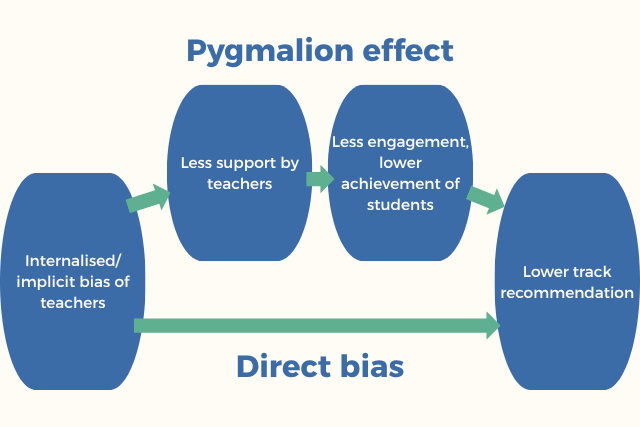
Teacher expectation effects (Pygmalion/Rosenthal effects) are one of the most robust findings in educational psychology. When teachers hold lower expectations of a student, e.g., based on family background, name, or perceived ethnicity, it shapes their interactions with that student. They give them less challenging tasks, show less encouragement and overall investment. In reponse, the student tends to perform in line with what is expected. This dynamic, first described by Rosenthal and Jacobson (1968) and replicated extensively since then, is not unique to any one country or school system.
Implicit bias adds a second layer. Even educators who explicitly reject ethnic stereotypes carry implicit associations that can influence their judgement. In the context of school track recommendations, which involve a degree of subjective assessment, these associations come into play. This bias can lead to an objectively inadequate track recommendation.
The result is a compounding effect: lower expectations reduce academic investment, implicit bias shapes the recommendation itself, and the child ends up on a lower track – not because of what they achieved or could achieve, but because of their teacher’s unconscious expections of what they could achieve. This does not make discrimination the primary driver of educational inequality. But it means that addressing socio-economic disadvantage alone is not sufficient because one part of the mechanism operates through an entirely different channel.
An international problem with varying intensity
This pattern holds across Europe, but its intensity varies. Countries with early, rigid tracking systems show larger residual gaps between students with and without a migration background than countries with more flexible systems. The earlier children are sorted into tracks, the less information teachers have available, and the more room remains for factors other than measured achievement to shape the decision.
Countries with later separation, such as Finland or Sweden, show smaller ethnic gaps in educational outcomes, even after controlling for socio-economic composition (Rolfe & Yang Hanse, 2022). Implicit bias nonetheless exists in these countries. But this finding suggests that structural design choices determine how much space cognitive biases have to develop.
What can be done to reduce the ethnic penalty?
Although these mechanisms are well-documented, their implicit nature makes them difficult to address through individual-level interventions alone. Awareness campaigns and diversity training have shown mixed results in changing actual recommendation behaviour. Structural approaches are more promising – standardised assessment criteria, anonymised recommendation processes, and mandatory second opinions reduce the space in which implicit bias can happen. Nevertheless, these approaches remain the exception rather than the rule across European school systems.
For educational researchers, this raises a slightly uncomfortable question: How much of what we measure as achievement gaps is a reflection of how schools sort children, rather than what those children actually know? And what would it take to build systems that are genuinely blind to the factors that should not matter?
Key Messages
- The educational gap between students with and without a migration background is largely explained by socioeconomic disadvantage – but this does not tell the whole story.
- Experimental studies show that perceived ethnic background influences teacher track recommendations independently of student performance.
- Two mechanisms are key: Pygmalion effects (lower expectations shape student outcomes) and implicit bias (ethnic background influences judgement at the moment of recommendation).
- Early tracking systems give implicit bias more room to operate and countries with later tracking show smaller ethnic gaps.
- Structural interventions show more promise than awareness training alone, but remain the exception across European school systems.

Marisa Urban
University of Hamburg, Germany
Marisa Urban, M.A., is a doctoral researcher at University of Hamburg, where she investigates environmental knowledge and education for sustainable development (ESD) using international large-scale assessment data. She also teaches a seminar on heterogeneity and inequality in schools for pre-service teachers and leads the third-party funded science communication project TIMSS Connect. Her research interests include educational inequality, multilingual education, and the measurement of competencies in international comparative contexts.
Other blog posts on similar topics:
Batruch, A., Geven,S., Kessenich, E., & van de Werfhorst, H.G. (2023). Are tracking recommendations biased? A review of teachers’ role in the creation of inequalities in tracking decisions. Teaching and Teacher Education (123).https://doi.org/10.1016/j.tate.2022.103985
Heath, A. & Brinbaum, Y. (2014). The Comparative Study of Ethnic Inequalities in Educational Careers’, in A.Heath & Y. Brinbaum (eds), Unequal Attainments: Ethnic educational inequalities in ten Western countries, Proceedings of the British Academy. https://doi.org/10.5871/bacad/9780197265741.003.0001
Kisfalusi, D., Hermann, Z. & Keller,T. (2025). Discrimination in track recommendation but not in grading: experimental evidence among primary school teachers in Hungary. European Sociological Review, 41(3), 411–425.https://doi.org/10.1093/esr/jcae044
Rolfe, V., & Yang Hansen, K. (2022). Family Socioeconomic and Migration Background Mitigating Educational-Relevant Inequalities. In: T. Nilsen, A. Stancel-Piątak & J.E. Gustafsson (eds), International Handbook of Comparative Large-Scale Studies in Education. Springer International Handbooks of Education. Springer, Cham. https://doi.org/10.1007/978-3-030-88178-8_50
Rosenthal, R. & Jacobson, L.(1968). Pygmalion in the Classroom: Teacher Expectation and Pupils’ Intellectual Development. Holt, Rinehart & Winston, New York. https://doi.org/10.1002/1520-6807(196904)6:2%3C212::AID-PITS2310060223%3E3.0.CO;2-U
Disclosure: Claude.ai was used for grammar, spelling, and style check of some parts of the blog post. Most of the corrections and suggestions were accepted.