
Caring for Those who Teach Online – Reflections from a Virtual Staffroom

Caring for Those who Teach Online – Reflections from a Virtual Staffroom

When schools and higher education institutions closed their doors in March 2020, some of the implicit and informal supports for teacher educators disappeared. As teacher educators migrated to new modes of teaching and learning, institutional supports such as IT upskilling, educational technologies, professional development, and assistance from HR were provided. However, many staff commented that the burden of the expectations placed on them often exceeded what they felt capable of responding to in a personal capacity. With this as the backdrop, I want to reflect on how staff in one institution developed more informal ways of supporting each other and building community in a time of isolation and fragmentation.

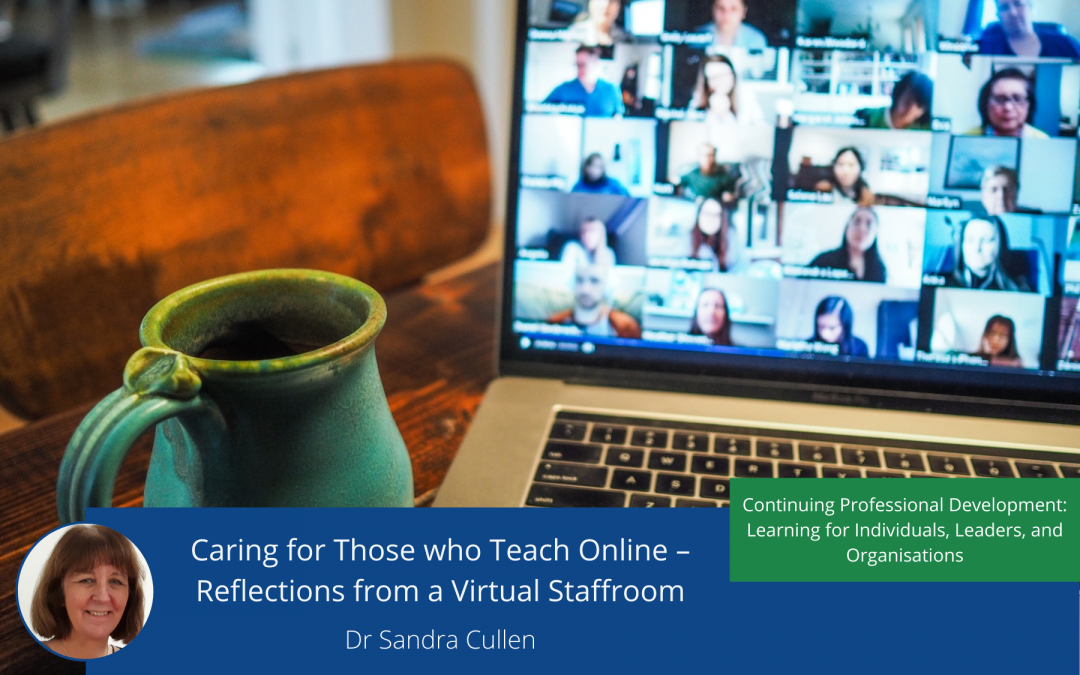
The imperative to create what Noddings calls ‘a climate in which caring relations can flourish’, and through which a sense of belonging can be maintained, led to us setting up a virtual staff room. The staff room doors opened for a coffee break from 11.00 to 12.00 every morning. To date, this has happened on over 120 occasions with more than 90 colleagues engaging in the staff room at different times. This casual drop-in space was hosted on Zoom with a reminder sent to all staff ten minutes before the room was opened. The live interaction was supported by emails, phone calls, and some shared photography and cooking projects.

As with any staff room, the tone was set by the people in the room at any given time.  Ultimately what emerged was a supportive conversational space which broke down barriers as people swapped the small details and intimacies of everyday living and allowed colleagues glimpses into one another’s lives. This online space was characterised by a framework of CARE: a space for free-flowing conversation on a range of topics from the sublime to the ridiculous, attention to each other, deepening relationships with colleagues, and an increasing empathy as we observed something of each other’s homes and family lives. What we learned from the virtual staff room is that each element of this framework of CARE has to be supported by a number of integrated principles for practice: presence, production, performance, persona, personal, pastoral, and peer-to-peer. 

Presence: Developing and maintaining a supportive space for conversation demands the fully engaged presence of the host in the virtual space. The host cannot dominate the conversation but will have to facilitate it. The continuity of having the same host, meeting at the same time, and sending a regular reminder, offered people a sense of assurance that some things stayed the same. As one colleague noted: ‘Just knowing that there are opportunities like this to connect goes a long way to help you feel more connected right away’.

Production: We learned that there should be no agenda or expectation of having to engage in quizzes or activities so that participants have the chance to ‘switch-off’ from having to do something. Participants wanted to ‘be’ with each other rather than to ‘do’.

Performance: Some personality types were comfortable adopting a virtual persona and spoke comfortably to the camera in the early stages of the virtual staff room, whereas it took others time to be comfortable in the space. Trying to ensure that all participants can be seen on one screen is vital for bringing quieter participants into the chat.

Persona: During the early weeks of meeting each other, there was a sense that participants were conscious of performing for the camera and projecting a positive persona. This mitigated against revealing what was really happening for them. Empathic conversations ensued when someone risked saying that things were not going so well for them.

Personal: The host has to ensure that people are introduced to each other as many colleagues may not have met in real-life. Deepening relationships in a CARE framework means that the virtual staffroom welcomed children, partners, and pets and provided glimpses of each other’s homes and gardens as part of caring for each other. In the words of one participant: ‘I like meeting people’s children and pets and seeing their homes and gardens – makes me feel more connected.’

Pastoral: Taking a CARE approach to hosting the virtual staff room will occasionally draw the host into providing pastoral support for some participants. CARE will sometimes call for actions that we might not have anticipated.

Peer-to-peer: CARE is ultimately a peer-to-peer activity based on the realisation, again in the words of a participant, ‘that we are in this together, I look forward to seeing the familiar faces.’ The virtual staff room extended people’s social network by creating new links and new modes of engagement between colleagues.


What began as an informal approach to caring for staff and keeping us connected with each other, the virtual staff room has become an example of how taking a CARE approach to an online space can provide a positive space for conversation, characterised by empathic attention to each other in our evolving relationships.

The door remains open, and the kettle is on.
Dr Sandra Cullen

Dr Sandra Cullen

Assistant Professor of Religious Education, Dublin City University

Dr. Sandra Cullen is Assistant Professor of Religious Education at Dublin City University where she specialises in second-level religious education. As Director of the ICRE (Irish Centre for Religious Education) she supports research and teaching in religious education in a variety of contexts. She is the APF (Area of Professional Focus) leader for Religious Education on the Doctor of Education Programme at DCU, and serves on the Executive of EFTRE (the European Forum for Teachers of Religious Education) and on the International Advisory Board of the Journal of Religious Education.

Multi-dimensional professional learning: a leadership perspective

Multi-dimensional professional learning: a leadership perspective

Life and learning rarely go forward in straight lines. The most stimulating and creative experiences often arise from unexpected and unintended interactions. It’s the same with professional learning. We need to master new knowledge and skills, but education is more than knowing and doing. That way lies repetition, comfort learning and stagnation as the future overtakes us. As professionals, we need to question our own contexts; explore and investigate outside our normal routines; look for opportunities to observe and experience different cultures of learning; then re-assess our own practice with fresh eyes.

We’ve moved on a long way since the realisation that formal ‘training’ is only a small part of the professional learning process. We now understand the implications of working and learning in complex environments and appreciate that learning is active, not passive. We can’t develop professionals, but as leaders and colleagues, we can support their development. So, the first dimension of professional learning we need to appreciate is the centrality of the individual professional.


Dimension 1: Centrality of the Individual Professional

As a leader, I need to understand that while I have my priorities, and we as collaborative professionals need to work together to achieve them, it is each of you, my colleagues, who will bring the motivation, the experience, the questions, the ideas and the critical challenge to achieve what we want for ourselves and for our students. I need to understand how, as a classroom teacher or teacher leader, you have identified your own priorities.


I need to be aware of how your priorities are shaped by your own career path and whether there are barriers to your professional learning that I can help to remove.


There are five key elements to this first dimension:

  • Re-positioning: are you ready for a new challenge such as teaching a different part of the curriculum or age range? Or even experiencing teaching in a different school or with aspiring professionals in Initial Teacher Education? Can I open doors for you to do this?
  • Re-visioning: This involves looking more deeply at things you may be taking for granted. It involves asking critical, challenging questions and seeing day-to-day processes with new eyes. In some cases, professional learning should be ‘edgy’ – challenging our existing values and ways of working. It may involve small-scale research, and it may require you to ask me to justify my own values and actions, so I must not be defensive when responding to your questions.
  • Extending: in the same way that we support the development of a young person’s knowledge and understanding as they move through school, so we need to encourage stimulation through deep professional learning. Intellectual challenge is important (and a requirement for some professions). How best can I encourage colleagues to engage in further study, wider reading and critical questioning?
  • Co-creating: active learning is best undertaken when one or more co-learners can ask constructively-critical questions to move thinking and acting forward. This requires trust and an element of professional security so that confidence is not undermined. As a leader with an overview of the professional environment within my organisation and, through networks, beyond it, I can suggest who might form suitable co-learners for my colleagues.
  • Consolidating: It’s a mistake to think that professional learning must be continuous. That means unbroken. It must, however, be continuing so that we revisit our learning and, at times, cruise a little to enjoy what we do well. Constantly questioning and looking critically at our work may prove psychologically challenging. As a leader, I need to be aware of this in myself and others and be careful not to apply pressure to change when well-being is at risk.


Dimension 2: Engagement

The second dimension of professional learning is engagement. This is the ‘doing’ part. Thankfully, we now understand that attending a professional development event does not necessarily enhance learning in planned and determined ways. The recent pandemic has made us realise that formal teaching has to be supplemented with other approaches to learning. The term ‘blended learning’ is often used to describe a mixture of online learning and face-to-face teaching, but this suggests a two-part approach when our engagement with learning is multi-faceted.

The term ‘professional learning blend’ has been used in Wales (Jones et al., 2019) to indicate that professional learning engagement takes many forms throughout a person’s career. It may involve:

  • mentoring (as a mentor or mentee)
  • presenting ideas and experiences to colleagues in one’s institution or at a conference (virtual or in-person)
  • being part of a professional learning network
  • studying for a Master’s or Doctoral award
  • attending a training event
  • observing others, being observed or simply talking about professional experiences with different colleagues.

Or all of these at different points in a person’s career path.

These different experiences will not be treated as separate events; they will merge in many ways to develop more rounded, informed and aware professionals. As a leader, I should not attempt to create a learning blend for others. The blending will be done by the individual professionals themselves. My role will be to help create the space and opportunity for colleagues to engage in these different professional learning experiences and, where appropriate, to prompt individuals to blend the learning into coherent ways of working. 


Dimension 3: Application

The third dimension is Application, sometimes called ‘impact’, or effectiveness, or follow-up (or follow-through). It is the understanding that although the professional learning process should be satisfying, much like reading a good book or being in enjoyable company, our purpose as education professionals is to support the learning of others and we must keep these others in mind when we engage in our own professional learning.

As a leader, this is something I need to be most aware of. I am accountable for the quality of teaching and learning in my institution (staff and students), and more than one type of indicator will be used to judge this. So, I need to ensure that the application of professional learning processes is maximised. At times, this means reverting to a performative approach with defined outcome criteria. Often, it is allowing the creative professional to emerge and giving space for the creation of new approaches inside and outside the formal learning environment.

We seem to know what works best in professional learning. Or do we? Stepping back and looking at well-researched and established models of professional learning (see, for example, Boylan (2018), and Kennedy (2014)) allows us to revisit our professional learning programmes as providers and as participants. Beware of claims that “this course will transform your teaching”. Don’t generalise from the findings of evaluations of funded professional learning programmes which show, usually immediately after the event, that participants were highly motivated to change their practice.

Learn from, but don’t emulate, others. Sherlock Holmes, in a rare mentoring moment, said to Dr Watson: “You know my methods: apply them”. But Watson could no more emulate the deductive brilliance of his companion any more than the fictional Holmes could have related the stories as well as their author. So, it’s a little more complex than copying what works in one instance and transferring it into your own context.


Dimension 4: Space

The final two dimensions are space and time. Leaders with responsibility for equitable resource allocation will be familiar with the challenges these bring. Space relates to where the learning takes place. Opportunities to learn outside one’s classroom, beyond the school and even in different countries and cultures are invaluable. Leaders must think laterally to enable learning mobility (ensuring that students aren’t disadvantaged by substitutions in teaching by enabling continuity of learning) and we must protect the ability to experience locational flexibility so that we do not become prisoners of school-based learning.


Dimension 5: Time

The final dimension is time. We could see this in terms of ‘learning hours’ (a dubious criterion to determine the quality of education provision) but it’s more fundamental: it’s about what we are learning and the ways we learn and whether they are set in the past, present or future. The rapid growth in online learning during the COVID-19 pandemic exposed the out-of-date approaches we previously used to structure our education. To what extent do we equip our students for the future and are we ahead of them in our own learning? And are we clear about the ethical issues that this will inevitably involve? Harari (p463) refers to this as the Human Enhancement question: “what do we want to become?”


It would be easier if we could simply manage staff development to ensure that all our teachers perform effectively. At least now we have acknowledged that it’s much more complex than this. We are responsible for leading rather than managing, and we engage in professional learning rather than staff development.   Leaders should embrace and celebrate this complexity.


The views expressed in this blog post are from Professor Jones and not necessarily representative of Network 1.


Professor Ken Joes

Professor Ken Joes

Chair of the Editorial Board, Professional Development in Education

Ken taught in London before returning to Wales to work as Head of the School of Education and Dean of the Faculty of Humanities in Swansea Metropolitan University. He was Senior Consultant for Professional Learning and Development at UWTSD and is now Professor Emeritus.

His international work has included leading symposia on Professional Learning and Leadership in many European countries, in the USA and in India. He is co-convenor of Network 1 (Professional Learning and Development) of the European Education Research Association.

He has been Managing Editor of the journal Professional Development in Education and is now Chair of the Editorial Board. He was one of the founding members of the International Professional Development Association (IPDA) and of IPDA Cymru.

He now works as an independent education consultant.

References

Boylan, M., Coldwell, M., Maxwell, B. and Jordan, J. (2018) Rethinking models of professional learning as tools: a conceptual analysis to inform research and practice Professional Development in Education 44.1 120-139 https://www.researchgate.net/publication/317126034_Rethinking_models_of_professional_learning_as_tools_a_conceptual_analysis_to_inform_research_and_practice 

Harari, Y.V. (2015) Sapiens. A brief history of humankind. London: Vintage https://www.ynharari.com/book/sapiens-2/ 

Jones, K., Humphreys, R., Lester, B. and Stacey, B. (2019) National Approach to Professional Learning: Research Report The Professional Learning Blend 2.0 Cardiff: Education Workforce Council https://www.ewc.wales/site/index.php/en/?option=com_fileman&view=file&routed=1&name=Professional%20Learning%20Blend%202.0.pdf&folder=&container=fileman-files

Kennedy, A. (2014) Understanding continuing professional development: the need for theory to impact on policy and practice Professional Development in Education 40.5 688-697 https://www.tandfonline.com/doi/abs/10.1080/19415257.2014.955122