We Are the Storytellers: Co-Creating Counternarratives with Black Caribbean Boys

We Are the Storytellers: Co-Creating Counternarratives with Black Caribbean Boys

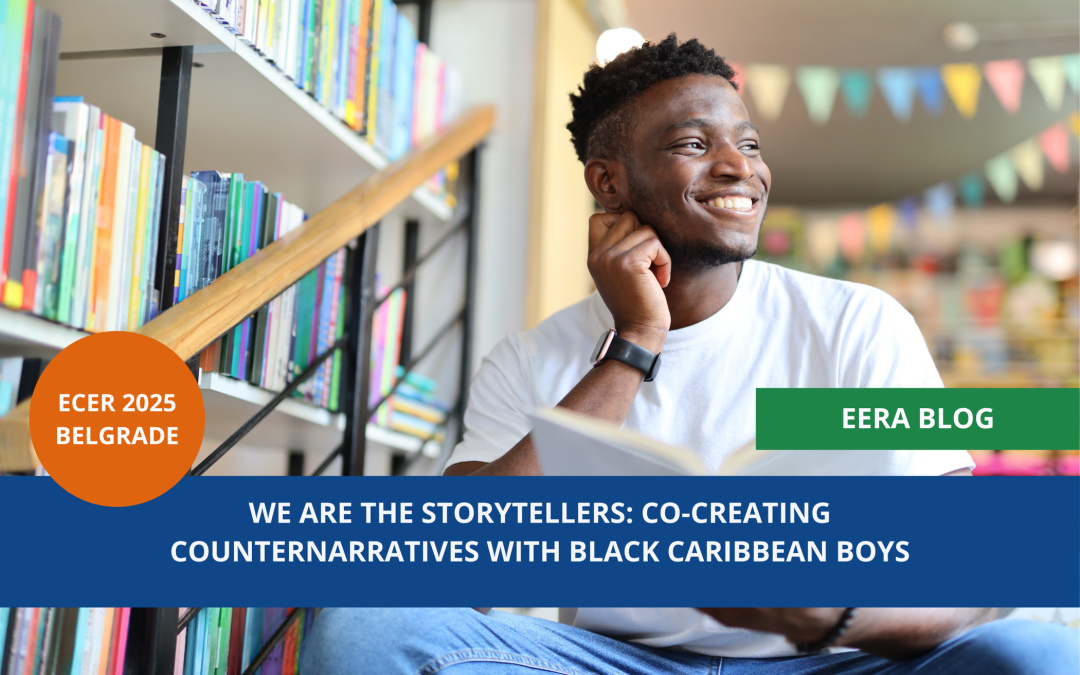
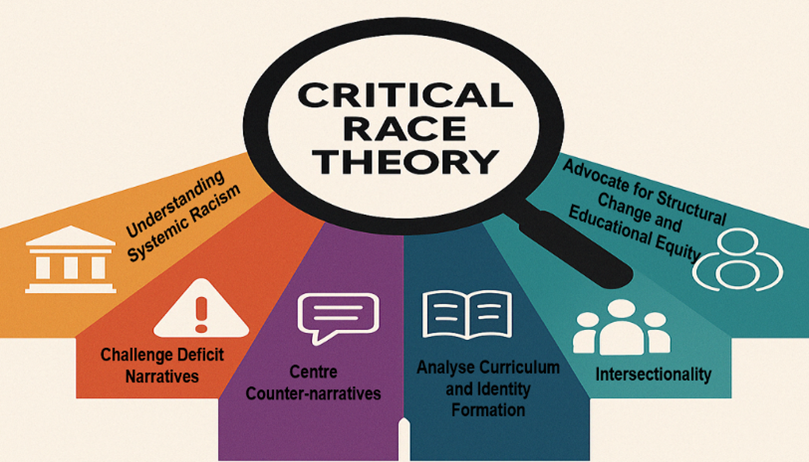
This blog previews the project I will present at ECER 2025, titled ‘Literature as Identity Work: Exploring Self-Discovery Through Texts’. It examines Black Caribbean male students’ experiences with the GCSE English literature curriculum in the UK, positioning literature as a space where identities are negotiated, challenged and reshaped. Through participants’ encounters with canonical texts, the study highlights literature’s dual role as a platform for personal growth, and a mechanism through which cultural exclusion is perpetuated. Rooted in Critical Race Theory (CRT) (Delgado, R. and Stefancic, J., 2023; Gillborn, 2024; Ladson-Billings, 2021) and narrative inquiry (Frank, 2012), the project uses storytelling – both textual and sonic – as a method for disseminating research, amplifying representation and showcasing resistance.
Representation, identity, and the limits of the literature curriculum

Although literature is often hailed as a window or door into other worlds and a mirror reflecting the self (Bishop, 1990), these metaphors take on new significance when curriculum texts fail to reflect the identities, cultures or lived experiences of its readers. For many Black Caribbean male students in England, the GCSE literature curriculum offers few mirrors since the reforms implemented by then Education Secretary, Michael Gove (Institute for Government, 2022; Chandler-Grevatt, 2021) have cemented a syllabus dominated by Eurocentric canonical texts, largely written by White men from the sixteenth to twentieth centuries. Despite their historical and literary value, the stories and contexts frequently fail to reflect the identities, realities and voices of Black Caribbean male students, leaving many to experience the literature curriculum as something to be gazed at from the outside rather than lived from within (Elliott et al., 2021). As one participant observes, “There are other people as good as Shakespeare, with different skin colours but no one knows about them”. Such reflections reveal that, for the participants, literature transcends its status as an academic subject to become an opaque mirror, a battleground and a site for self-definition, resistance and critical identity work.

Heterotopic spaces enable open reflection on race, masculinity and belonging
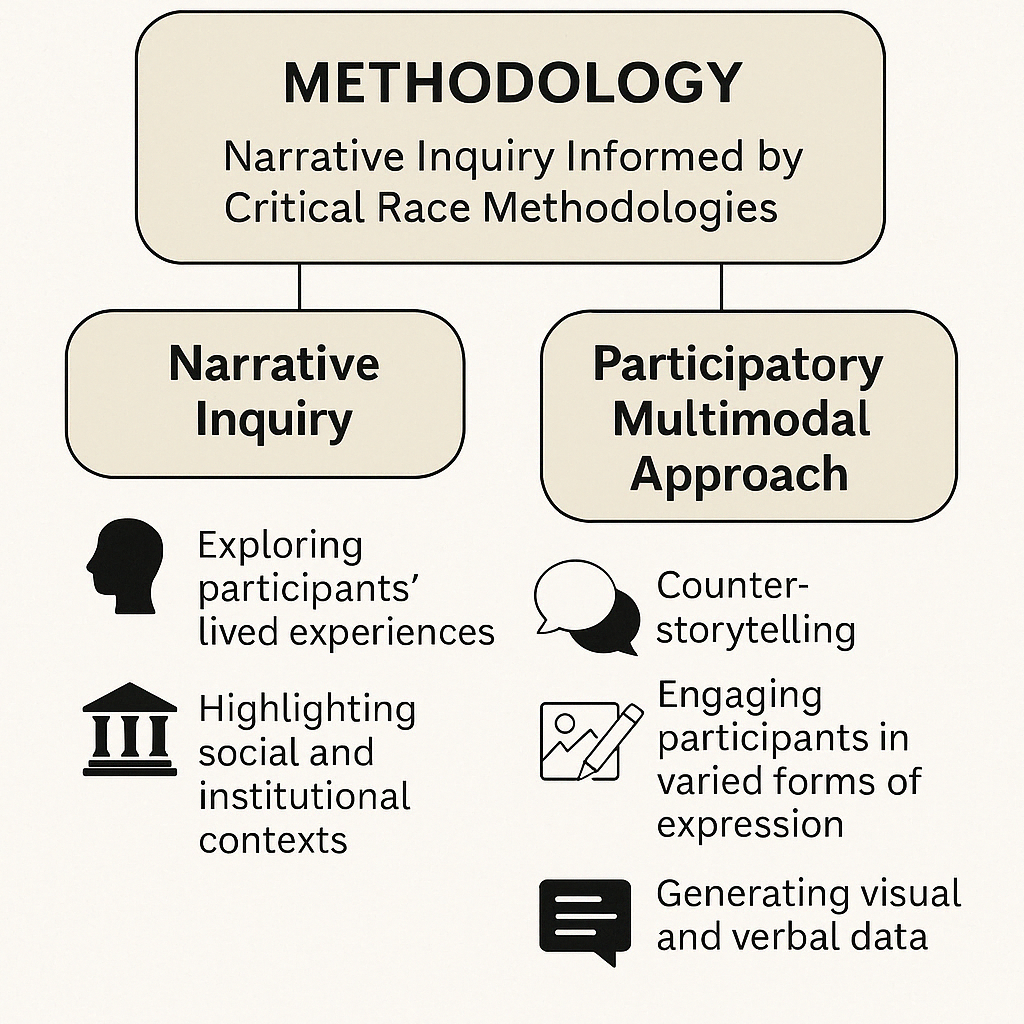
Viewed through the lenses of CRT and narrative inquiry, the participants’ counter-narratives uncover the personal stakes of curriculum design suggesting that questions of literature and identity are inseparable from questions of method. In this light, my research explores how participants’ engagement with canonical works and selected twentieth- and twenty-first-century texts shapes their navigation of masculinity, race, emotion and belonging.

The study facilitates one-to-one participatory narrative interviews, situated within Foucault’s (1986) conceptualisation of heterotopic spaces — cultural, dialogic environments designed to foster open, identity-affirming reflection. In these spaces, participants are empowered to move beyond the constraints of school-based discussions to critically engage with both the texts and their evolving sense of self.

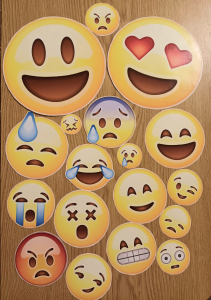
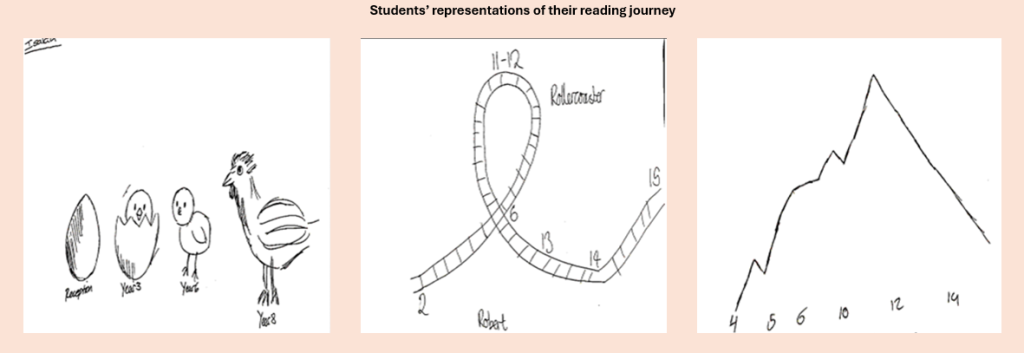
To support emotional processing and deepen participant engagement, I employ a range of multimodal activities including text rating, visual mapping and character reflection (Kress, 2010; Woolhouse, 2017).

One notable strategy involves employing emojis to enable students’ articulation of their emotional responses to texts and characters.

These methodological tools prove effective because they provide a familiar and accessible medium through which to explore affective interpretation.
Sonic dissemination invites audiences to listen and engage with counter-narratives

Most significantly, the power of this study lies in the dissemination of research data. Rather than summarising student responses in researcher-authored prose, narratives are co-created using the boys’ own words as dialogue. Their speech — unpolished, reflective and often emotionally charged — remains intact. This approach allows for narrative framing without distorting the participants’ words, tone or rhythm. Also, by giving sonic life to the participants’ counter-narratives through AI voice simulation, audiences are invited not only to read the data but to listen – to hear counter-narratives in voices that echo their resonance and resistance.

Through this method of dissemination, audiences encounter young Black men speaking on their own terms, articulating nuanced understandings of masculinity, justice, diasporic belonging and the politics of hope (Freire, 2021). Sonic dissemination preserves the emotional texture of participants’ words, enacts the ethics of co-creation (Cohen, Manion and Morrison, 2017), and disrupts normative expectations of data sharing. It also reimagines dissemination as relational listening, a mode that centres empathy, embodiment and presence.

Serving as a commentary to remind us that voice is not only a methodological tool but also a political act — one that challenges the silences imposed by dominant narratives and affirms lived experience as legitimate knowledge — John, a participant, states: ‘I don’t mind people hearing what I said. I just want them to actually listen”. Consequently, my methodological choices do not merely generate data; they open space for new stories to emerge, stories that resonate within academia but also hold the potential to connect with wider audiences through accessible forms of storytelling and voice.

A co-created composite counter-narrative

In this co-created composite counter-narrative, ‘Unmasking Dr Jekyll and Mr Hyde’, the boys reflect on themes of identity, duality and the pressures of navigating stereotypes, connecting The Strange Case of Dr Jekyll and Mr Hyde to their social reality. Co-created using the participant’s direct quotes from interviews this voiced composite counter-narrative brings their perspectives and experiences to life.

Students’ counter-narratives explore masculinity, identity and belonging

The composite counternarratives co-created through my research illustrate the students’ reflections on masculinity, identity, justice, racism and diasporic belonging, articulated through their negotiations with literature and wider society. The participants construct masculinity as a fluid, often contested identity, shaped by social context, cultural pressure and lived experience.

While several boys reject emotional vulnerability, critiquing characters such as Romeo (Shakespeare, 1993) as “simpish” and “unstable”, others value traits such as loyalty, self-awareness and quiet strength. Tybalt and Mercutio (Shakespeare, 1993) emerge as models of decisiveness and honour, even when their actions are rooted in violence. By contrast, texts such as Boys Don’t Cry (Blackman, 2024) enable a redefinition of masculinity grounded in emotional growth, caregiving and moral accountability.

Crucially, the students do not engage with masculinity in one uniform way; they actively interrogate what it means to be a man across diverse social and literary contexts (Connell, 1995). Through their counter-storytelling, the boys challenge hegemonic masculine norms (Connell, 1995) which positions certain performances of manhood — particularly those marked by dominance, emotional restraint and heterosexuality as ideal. Their counter-narratives (Solórzano and Yosso, 2002) therefore resist static, deficit-laden constructions of Black masculinity, providing instead complex and situated accounts of identity.

In a system that frequently frames Black Caribbean boys as disengaged or underachieving, this work foregrounds their criticality, emotional intelligence, cultural literacy and capacity for reflective resistance. The participants demonstrate cultural awareness, an understanding of their position in society as well as how they navigate and negotiate its demands. They are not disengaged; they are resisting performance of the self that feels untrue.

 At its heart, this project asks educators and researchers to do something very simple but radical: listen. Because when we truly listen to marginalised students, they do more than answer our questions.

They tell us a story.

And sometimes, they rewrite it.

Key Messages

  • The GCSE English literature curriculum, shaped by Govian reforms, offers few mirrors for Black Caribbean boys as it prioritises Eurocentric canonical texts.
  •  The participant’s counter-narratives reveal how literature becomes a site of struggle, identity work, and resistance against deficit views of Black masculinity.
  • Using multimodal and narrative methods, the study creates heterotopic spaces for boys to reflect on masculinity, race, belonging and justice.
  • Data is disseminated through AI-voiced sonic counter-narratives which preserve emotional texture and extend conventional research outputs by introducing new possibilities for sharing and experiencing participant voices. This approach offers a relational and participatory approach to dissemination.
  • The project foregrounds students’ voices as acts of resistance and hope, creating spaces where marginalised young people exercise their agency and transform narrative sites into spaces for reimagining justice, education, identity and belonging.

ECER 2025 – 

As part of my ECER 2025 presentation, I will be sharing the composite counter-narrative “We Weren’t Just Reading: Reflection, Resistance, Becoming”, a co-created narrative built from the boys’ direct quotes voiced during interviews. The story explores how literature functions as a critical space for young Black men to reflect on masculinity, identity, representation and belonging whilst developing critical consciousness about the systems that shape their lives.

Through their reflections on texts such as Boys Don’t Cry, Othello, Romeo and Juliet, Macbeth, and An Inspector Calls, the participants interrogate stereotypes, power and exclusion — questioning whose stories are centred and whose are silenced. Their voices challenge dominant narratives of disinterest and underachievement, foregrounding themes that are central to CRT.  The composite counter-narrative ‘We Weren’t Just Reading: Reflection, Resistance, Becoming’ reveals that the Black Caribbean male students in my research are not merely analysing literature; they, instead, use it as a tool for self-discovery, resistance and critical reflection to create new understandings of identity, power and belonging. 

  • Network: 07. Social Justice and Intercultural Education
  • Contribution ID: 1195
  • Title: Literature as Identity Work: Exploring Self-Discovery Through Texts
  • Session Title: 07 SES 02 A: Engaging Families and Alternative Educational Practices
  • Date & Time: 09 September 2025, 15:15 – 16:45 (CET)
  • Location: Room 001 | Eduka College | Ground Floor
Keisha-Ann Stewart

Keisha-Ann Stewart

Edge Hill University

Keisha-Ann Stewart is a PhD researcher at Edge Hill University. Her doctoral research explores Black Caribbean male students’ experiences of literature texts studied at Key Stage 4, examining how these experiences shape their engagement, interpretation and academic responses within English classrooms in England. With a multidisciplinary background in applied linguistics, literature, publishing studies and education, Keisha-Ann’s academic interests include literacy development, anti-racist education, decolonising the curriculum, teacher education, the ethical use of artificial intelligence in education, and the integration of technology to enhance learning and pedagogy. Her work is grounded in a strong commitment to equity, inclusion and culturally responsive teaching.

ECER Belgrade 2025

Since the first ECER in 1992, the conference has grown into one of the largest annual educational research conferences in Europe. In 2025, the EERA family heads to Serbia for ECER and ERC.

08 - 09 September 2025 - Emerging Researchers' Conference
09 - 12 September 2025 - European Conference on Educational Research

Find out about fees and registration here.

Since the first ECER in 1992, the conference has grown into one of the largest annual educational research conferences in Europe. In 2025, the EERA family heads to Serbia for ECER and ERC.

In Belgrade, the conference theme is Charting the Way Forward: Education, Research, Potentials and Perspectives

No doubt that education has a central role in society, but what it is destined to do is contested politically as well as scientifically. Yet more debate is had concerning the question of the way in which educational research should shape the future of educational practice. The important, but sensitive role educational research occupies in that regard should be the promotion of a better understanding of the contemporary and future world of education, as is expressed in EERA’s aim.

Emerging Researchers' Conference - Belgrade 2025

The Emerging Researchers' Conference (ERC) precedes ECER and is organised by EERA's Emerging Researchers' Group. Emerging researchers are uniquely supported to discuss and debate topical and thought-provoking research projects in relation to the ECER themes, trends and current practices in educational research year after year. The high-quality academic presentations during the ERC are evidence of the significant participation and contributions of emerging researchers to the European educational research community.

By participating in the ERC, emerging researchers have the opportunity to engage with world class educational research and to learn the priorities and developments from notable regional and international researchers and academics. The ERC is purposefully organised to include special activities and workshops that provide emerging researchers varied opportunities for networking, creating global connections and knowledge exchange, sharing the latest groundbreaking insights on topics of their interest. Submissions to the ERC are handed in via the standard submission procedure.

Prepare yourself to be challenged, excited and inspired.

Other blog posts on similar topics:

References

Bishop, R.S. 1990. ‘Mirrors, windows, and sliding glass doors’, Perspectives: Choosing and Using Books for the Classroom, 6(3), pp. ix–xi.
Available at: https://scenicregional.org/wp-content/uploads/2017/08/Mirrors-Windows-and-Sliding-Glass-Doors.pdf (Accessed: 20 August 2025).

Blackman, M. 2024. Boys don’t cry. London: Penguin

Chandler-Grevatt, A. 2021. ‘The wilderness years: An analysis of Gove’s education reforms on teacher assessment literacy’, The Buckingham Journal of Education, 2(2), pp. 149–164.
Available at: https://doi.org/10.5750/tbje.v2i1.1935 (Accessed: 18 August 2025).

Cohen, L., Manion, L. and Morrison, K. 2017. Research methods in education. 8th edn. Abingdon: Routledge.

Connell, R.W. 1995. Masculinities. Berkeley: University of California Press.

Delgado, R. and Stefancic, J. 2023. Critical race theory: An introduction. 4th edn. New York: New York University Press.

Elliott, V., Nelson-Addy, L., Chantiluke, R. and Courtney, M. 2021. Lit in Colour: Diversity in Literature in English Schools. London: Penguin Books UK and The Runnymede Trust.
Available at: https://litincolour.penguin.co.uk/assets/Lit-in-Colour-research-report.pdf (Accessed: 20 August 2025).

Foucault, M. 1986. ‘Of other spaces’, Diacritics, 16(1), pp. 22–27.

Freire, P. 2021. Pedagogy of hope: Reliving pedagogy of the oppressed. Bloomsbury Academic.

Frank, A. 2012. “Practicing Dialogical Narrative Analysis,” in Varieties of Narrative Analysis, pp. 33–52. Available at: https://doi.org/10.4135/9781506335117.n3 (Accessed: 20 August 2025).

Gillborn, D. 2024. White lies: Racism, education and critical race theory. London: Routledge.

Institute for Government. 2022. The Gove reforms a decade on. London: Institute for Government. Available at: https://www.instituteforgovernment.org.uk/sites/default/files/publications/gove-reforms-decade-on.pdf (Accessed: 18 August 2025).

Kress, G. 2010. Multimodality: A social semiotic approach to contemporary communication. London: Routledge.

Ladson-Billings, G. 2021. A scholar’s journey: Critical race theory and education. New York: Teachers College Press.

Shakespeare, W. 1993. The tragedy of Romeo and Juliet. Champaign, Ill.: Project Gutenberg. Available at: http://www.gutenberg.org/etext/1777

(Accessed: August 20, 2025).

Solórzano, D.G. and Yosso, T.J. 2002. ‘Critical race methodology: Counter-storytelling as an analytical framework for education research’, Qualitative Inquiry, 8(1), pp. 23–44.
Available at: https://journals.sagepub.com/doi/full/10.1177/107780040200800103 (Accessed: 20 August 2025).

Stewart, K. 2025. Beyond the page: Literature as a catalyst for identity and resistance. Edge Hill University. Poster.
Available at: https://doi.org/10.25416/edgehill.29616704.v1.

Woolhouse, C. 2017. ‘Multimodal life history narrative: Embodied identity, discursive transitions and uncomfortable silences’, Narrative Inquiry, 27(1), pp. 109–131.
Available at: https://research.edgehill.ac.uk/en/publications/multimodal-life-history-narrative-embodied-identity-discursive-tr (Accessed: 20 August 2025).

 

Researching education in troubled times: Reflections ahead of ECER 2025 in Belgrade

Researching education in troubled times: Reflections ahead of ECER 2025 in Belgrade

As we prepare to gather in Belgrade for ECER 2025, I find myself reflecting on what it means today to be a researcher in education. ECER has always been a powerful space of convergence — a moment when ideas circulate freely across borders, when educational issues are discussed in their complexity, and when we are reminded that research is, in essence, a public act.

This year’s theme, “Charting the Way Forward: Education, Research, Potentials and Perspectives”, resonates deeply in the moment in which we are living. Across Europe and beyond, we are witnessing social and political tensions that question not only the role of education, but also the very conditions under which we produce knowledge. In Serbia, where the conference is taking place, students are rising — peacefully and courageously — to demand accountability, transparency, and the respect for democratic values. Their actions, which have earned them a nomination for the 2025 Nobel Peace Prize, have been acknowledged in an open letter published by EERA in June, expressing solidarity with their commitment to democratic ideals and civic engagement. Their mobilisation has been exemplary, and it reminds us that the university can still be a place of critical hope and civic engagement.

In such a context, our research in education cannot remain indifferent. Whether we are exploring how students learn, how teachers adapt, or how systems evolve, we are also implicitly — and sometimes explicitly — questioning how education contributes to democracy, justice, and human dignity.

My own work, focused on educators’ professional development and digital literacy, has been shaped by this conviction. For instance, I have been involved in the development and implementation of the French national certification platform écri+, which supports students’ academic writing skills across universities. I also contributed to the organisation and facilitation of a hackathon held in Lyon in early July 2025. This event brought together researchers, students, and digital practitioners to explore how generative AI is reshaping scientific writing and academic literacies. These initiatives reflect a core belief: writing is not merely a technical skill, but a deeply reflexive and formative practice. It is a way of thinking, of situating oneself, and of constructing meaning in a changing world. At ECER, I will be presenting research that links writing practices to reflexivity and social engagement — drawing on collaborative work conducted in France and beyond.

I look forward to sharing this work and, more importantly, to engaging in the conversations that will undoubtedly emerge in Belgrade — with fellow researchers, students, and all those who believe that education is more than a field of study — it is a force for transformation.

Dr Philippe Gabriel

Dr Philippe Gabriel

Université d’Avignon

Philippe Gabriel is Associate Professor (Maître de conférences hors classe) in Educational Sciences at Avignon Université, and researcher at LIRDEF (Laboratoire Interdisciplinaire de Recherche en Didactique, Éducation et Formation), jointly supported by the universities of Montpellier and Montpellier Paul-Valéry. His research focuses on academic literacies, digital learning environments, AI in education, and adult education. He has coordinated several national and European projects and co-leads the EERA Network 16 on ICT in Education and Training.

ORCID: 0000-0002-9337-572X

Research Lab: https://lirdef.edu.umontpellier.fr

OpenEdition (editorial role): Éducation et Socialisation (https://journals.openedition.org/edso/)

ECER Belgrade 2025

Since the first ECER in 1992, the conference has grown into one of the largest annual educational research conferences in Europe. In 2025, the EERA family heads to Serbia for ECER and ERC.

08 - 09 September 2025 - Emerging Researchers' Conference
09 - 12 September 2025 - European Conference on Educational Research

Find out about fees and registration here.

Since the first ECER in 1992, the conference has grown into one of the largest annual educational research conferences in Europe. In 2025, the EERA family heads to Serbia for ECER and ERC.

In Belgrade, the conference theme is Charting the Way Forward: Education, Research, Potentials and Perspectives

No doubt that education has a central role in society, but what it is destined to do is contested politically as well as scientifically. Yet more debate is had concerning the question of the way in which educational research should shape the future of educational practice. The important, but sensitive role educational research occupies in that regard should be the promotion of a better understanding of the contemporary and future world of education, as is expressed in EERA’s aim.

Emerging Researchers' Conference - Belgrade 2025

The Emerging Researchers' Conference (ERC) precedes ECER and is organised by EERA's Emerging Researchers' Group. Emerging researchers are uniquely supported to discuss and debate topical and thought-provoking research projects in relation to the ECER themes, trends and current practices in educational research year after year. The high-quality academic presentations during the ERC are evidence of the significant participation and contributions of emerging researchers to the European educational research community.

By participating in the ERC, emerging researchers have the opportunity to engage with world class educational research and to learn the priorities and developments from notable regional and international researchers and academics. The ERC is purposefully organised to include special activities and workshops that provide emerging researchers varied opportunities for networking, creating global connections and knowledge exchange, sharing the latest groundbreaking insights on topics of their interest. Submissions to the ERC are handed in via the standard submission procedure.

Prepare yourself to be challenged, excited and inspired.

Other blog posts on similar topics:

Should genetics play a role in education?

Should genetics play a role in education?

A startup company promising to test embryos for intelligence has made headlines recently. Nucleus Genomics, a Silicon Valley-based organization backed by millions of dollars from technology investors, claims its platform will enable “genetic optimization” of embryos, with IQ one of many traits and medical conditions it can measure and assess. The educational implications of such a technology are significant, raising the prospect of students entering schools with genetically-optimised advantages over others. That is, if the technology works as the company claims.

The problem with Nucleus Genomics, as the bioethicists Arthur Caplan and James Tabery have argued in Scientific American, is that its promises are false and are not supported by scientific evidence. Nucleus is “what happens when you Silicon Valley-ify diagnostic genetics”: it has cast professional scientific consensus aside and instead sought rapid income from wooing venture capital investors and making sales pitches to wealthy customers. Parents are now being marketed expensive embryo testing, as well as other Nucleus services, with misleading promises about “investing” in their family’s future through genetic tweaks.

Genetically-optimised learning

Although the Nucleus platform is clearly “snake oil”, it highlights how genetic testing and diagnosis of traits such as intelligence has become of growing interest—not only in the medical domain, but with implications for education. On the Nucleus website, one listed “collaborator” is Professor Robert Plomin, a behavioural genetics specialist who has published extensively on the potential uses of genetic testing data in the educational context.

Plomin’s controversial 2018 book Blueprint: How DNA makes us who we are, proposed that genetic data from consumer tests could in the near future be used to inform decisions about schooling. Parents could use genetic data to decide which school would suit them best, or genetic information could even be deployed in a pedagogic model that Plomin termed “precision education”.

Precision education would involve testing children for probable future outcomes, and adjusting or personalising teaching practices to maximise their achievements. In a more recent co-authored article, Plomin and colleagues proposed that commercial genetic testing platforms could be used for precisely this purpose, particularly for the “genetic prediction of academic underachievement and overachievement” and to customise education on that basis. While the scientific validity of the Nucleus tests is highly questionable, it fits neatly with the vision of precision education that some scientists now promote. It’s a vision of genetically-optimised learning based on DNA testing.

Educational genomics

In a project funded by The Leverhulme Trust, my colleagues and I have been examining the emergence of novel data-intensive forms of biological science and their implications for educational practice and policy. This includes the growing area of “educational genomics”. We mapped out the scientific networks that are conducting educational genomics research, the scientific claims they are making, and the methods and technologies that underpin their knowledge-making practices in a recent paper.

Educational genomics is a fast-growing area of research, with scientists, research centres, networks and international associations that span Europe, the US, southeast Asia and Australia. The scientific knowledge being produced is presented as being highly relevant to educational practitioners and policymakers. Not all scientists conducting such research view the precision education model as a viable or desirable prospect. However, there does seem to be a converging consensus on the possibility of early years genetic testing for learning difficulties, as a report for the Early Intervention Foundation indicates.

A recent report from the Nuffield Council on Bioethics shows that educational genomics research also raises sharp ethical challenges. In particular, it pinpoints the risks associated with the use of commercial genetic testing technologies like those launched by Nucleus, and of precision education models proposed by Plomin and others. Genetic information collected in the early years, at birth, or even before, could lead to forms of genetic stigmatization, discrimination or fatalism, and to the fallacious belief that one’s DNA determines their educational prospects.

Genetically-scored students

Educational genomics is clearly risky science, and the “geneticization of education” it represents demands ongoing bioethical scrutiny. An additional question, however, is whether it is even valid science. Can scientists really detect traces of educational outcomes, or biological indicators of underachievement, from data-mining DNA?

Underpinning educational genomics research is a very specific method, called polygenic scoring. It involves collecting masses of genetic data from huge samples, analysing it with sophisticated computational technologies, and then producing statistical scores that are said to predict educational outcomes.

It is on the basis of these polygenic scores that various proposals have been made to incorporate genetic data into educational practice or policy. In addition to the precision education model, these include proposals for early years ability screening for purposes of genetically-based differentiation in classrooms. Genetically scoring students could, according to others, be the basis for educational decision-making at the policy level. In the popular 2021 book The Genetic Lottery, for instance, behavioural geneticist KP Harden proposed using student polygenic scores as additional information to assess “what works” in policy intervention evaluations.

But there are significant problems with using polygenic scores in education, which extend beyond ethical risks and controversies to questions of scientific accuracy. In a recent in-depth analysis of polygenic scoring methods, Callie Burt argued that the scores give the impression that genetics plays a significant role in educational outcomes, when those outcomes are primarily influenced by social factors. The underlying scientific evidence associating genetic biomarkers with educational outcomes remains too weak and confounded by non-genetic factors to support any form of translation into policy or practice whatsoever.


Controversial science

Others agree. The behavioural geneticist Eric Turkheimer recently pointed out that a new polygenic scoring study undermined the confident claims of previous educational genomics research. The results from the study, in Turkheimer’s analysis, show that “unconfounded direct genetic effects” make almost no contribution at all to complex outcomes like educational achievement.

“This is what Plomin referred to as the ‘game changer’, the fortune teller that was going to reveal to us who we really are”, Turkheimer argued, describing polygenic scores as “the basis for all the crazy, unethical enthusiasm for commercial genomic information and embryo selection” and “the big hopes for precision education”.

But if DNA plays an almost negligible role in influencing an individual’s outcomes, it would be nonsensical to base educational practices or policies on it. If this is the case, it remains highly questionable whether genetics should play any role in education at all — regardless of the rapid growth in published educational genomics research, and the rise of commercial genetic testing companies that promise parents they can optimise their children.

Now that educational genomics has established itself as a scientific domain, and commercial genetic testing is growing rapidly, educators and educational researchers will need to remain highly vigilant about how new genetic explanations are asserted for highly complex educational processes and outcomes. Far from being a settled scientific matter, as some advocates insist, the role of data-intensive biological science in education remains fraught with scientific and ethical controversies.

ECER 2025 – Keynote 

At ECER 2025 in Belgrade, Dr Williamson will expand on this topic during his keynote:

The birth of the bio-edu-data-sciences: biology, data, and the consequences for educational research, policy and practice

“As the bio-edu-data-sciences continue to develop evidence of the genetic and neural aspects of learning and educational outcomes, will they complement and advance, or displace and marginalize existing practices of educational research? What futures of educational research do the bio-edu-data sciences suggest lay ahead in the next decade, and what should be done about it?”

Dr Ben Williamson

Dr Ben Williamson

Moray House School of Education and Sports, University of Edinburgh

Dr Ben Williamson is a Senior Lecturer and Co-Director of the Centre for Research in Digital Education at the Moray House School of Education and Sport, University of Edinburgh. His research examines the connections between digital technologies, data practices, and education policy, practice and governance. Recent and current research projects explore data-intensive biology in education and sociodigital learning futures.

Ben is the author of Big Data in Education: The digital future of learning, policy and practice, an editor of the World Yearbook of Education 2024: Digitalisation of Education in the Era of Algorithms, Automation and Artificial Intelligence, and a co-editor of the journal Learning, Media and Technology.

ECER Belgrade 2025

Since the first ECER in 1992, the conference has grown into one of the largest annual educational research conferences in Europe. In 2025, the EERA family heads to Serbia for ECER and ERC.

08 - 09 September 2025 - Emerging Researchers' Conference
09 - 12 September 2025 - European Conference on Educational Research

Find out about fees and registration here.

Since the first ECER in 1992, the conference has grown into one of the largest annual educational research conferences in Europe. In 2025, the EERA family heads to Serbia for ECER and ERC.

In Belgrade, the conference theme is Charting the Way Forward: Education, Research, Potentials and Perspectives

No doubt that education has a central role in society, but what it is destined to do is contested politically as well as scientifically. Yet more debate is had concerning the question of the way in which educational research should shape the future of educational practice. The important, but sensitive role educational research occupies in that regard should be the promotion of a better understanding of the contemporary and future world of education, as is expressed in EERA’s aim.

Emerging Researchers' Conference - Belgrade 2025

The Emerging Researchers' Conference (ERC) precedes ECER and is organised by EERA's Emerging Researchers' Group. Emerging researchers are uniquely supported to discuss and debate topical and thought-provoking research projects in relation to the ECER themes, trends and current practices in educational research year after year. The high-quality academic presentations during the ERC are evidence of the significant participation and contributions of emerging researchers to the European educational research community.

By participating in the ERC, emerging researchers have the opportunity to engage with world class educational research and to learn the priorities and developments from notable regional and international researchers and academics. The ERC is purposefully organised to include special activities and workshops that provide emerging researchers varied opportunities for networking, creating global connections and knowledge exchange, sharing the latest groundbreaking insights on topics of their interest. Submissions to the ERC are handed in via the standard submission procedure.

Prepare yourself to be challenged, excited and inspired.

Other blog posts on similar topics: