
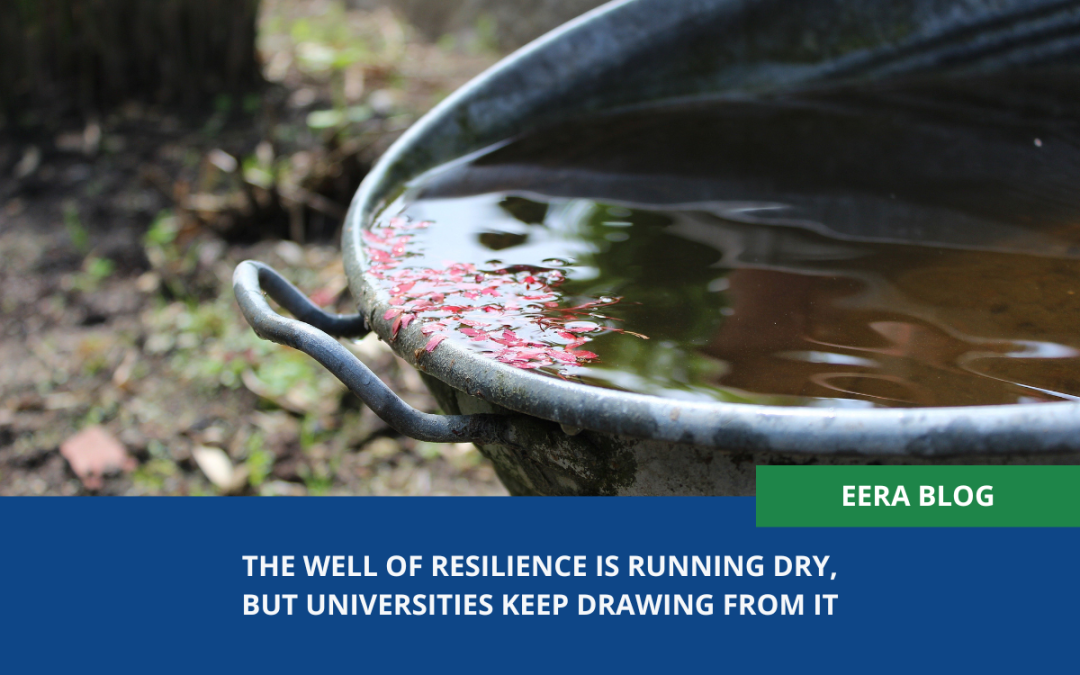
The well of resilience is running dry, but universities keep drawing from it
Resilience is usually treated as a good thing. It is the quality we admire in people who keep going when work becomes difficult. The people who adapt under pressure, put their heads down and carry on when demands keep growing. In universities, as in many other professions and sectors, resilience is often treated as part of being professional.
What doesn’t kill you makes you stronger
However, there is a point at which resilience stops being a personal strength and becomes something the job quietly depends on. My recent research with teacher educators in Ireland and the UK suggests that this is increasingly the case in higher education. Teacher educators are not simply academics who ‘just’ teach and research. They also mentor student teachers, support them during school placement, respond to pastoral issues, and manage the effects of repeated policy, accreditation, and inspection demands (for example, Ofsted inspections in England). Much of this work is time-consuming, emotionally demanding, and only partly visible in the ways universities usually account for academic labour.
Keep calm and carry on
One participant in my study captured the culture in a single phrase: “Just plough on and pretend it’s not happening.” The phrase points to something beyond individual frustration; in work built around care and public service, people often keep things going by absorbing pressures that should not really be carried by individuals alone. They answer emails late into the evening, take on extra work, manage other people’s distress, and fill gaps when formal support is missing. Over time, what is praised as resilience can become one of the ways chronic strain is normalised.
Participants in my study described their academic roles as feeling like “three separate jobs” at once:
“No matter how hard or how efficiently we work, there is always a mountain of endless tasks to be completed.”
Another described how work had spread into every corner of their life:
“I never have true rest periods, working on annual leave, weekends and evenings. Never being ‘finished’, no matter how many hours or how little rest time, you are never on top of everything.”
None of this is to say that resilience has no value. It clearly does; it can help people deal with uncertainty and see them through periods of pressure. But it has limits. Namely, it cannot make an excessive workload reasonable, nor can it make an unsupported role more sustainable.
Soldier On
Yet public discussion of workplace pressure often slips too quickly into the language of coping. Are you setting boundaries? How are you managing your stress? Are you looking after yourself properly? Are you being adaptable enough? Have you attended the wellbeing workshop on offer? The problem is that those questions often obscure a harder one: why is so much of this strain being dealt with at the level of the individual in the first place?
Resilience as scar tissue
This is where Suslovic and Lett’s critique of resilience is useful. They argue that resilience is too often treated as “an individual-level solution to a structural toxin”. More strikingly, they suggest that resilience may be better understood as “scar tissue”. It is a powerful metaphor because it shifts resilience away from the reassuring language of inner strength and towards something else: the mark left by repeated injury.
The idea of scar tissue helps make sense of what many academics in my study described. Their accounts were not simply about the ordinary demands of their work. They were about prolonged accommodation to conditions that had become excessive and normalised. They repeatedly pointed to pressures that were structural rather than personal: competing demands across teaching, research, service, mentoring and placement work; administrative burdens linked to accountability systems; and a sense that the most demanding parts of their role were poorly understood, or indeed invisible.
As one participant put it:
“All of this work is pretty much irrelevant (under a performance metrics lens), so while I’m trusted to do my job, there isn’t really anyone who understands the stress involved in these elements.”
Moving beyond ‘Chin Up’
In recent years, work-related stress has increasingly been recognised not just as a private issue but also as an organisational one. For example, in December 2025, Britain’s Health and Safety Executive (HSE) found that the University of Birmingham did not have appropriate arrangements in place to manage work-related stress and could not demonstrate that it was managing the risks associated with excessive workload. The significance of that case lies in the framing. The question was not whether staff were coping well enough. It was whether the institution was identifying and effectively managing foreseeable risk, as is an employer’s legal responsibility.
There is a similar legal imperative in Ireland. The Health and Safety Authority (HSA) treats work-related stress as a workplace hazard to be assessed and prevented by employers. That matters because it shifts the focus from systems of work that generate stress to whether workers can keep adapting indefinitely.
This is significant since wellbeing language now circulates widely across universities in Ireland and the UK. That veneer of well-being can sit easily alongside overload if the organisation of work itself does not change. Workshops and wellbeing campaigns may have some value, but if academic staff do not have the time or energy to benefit from them, they can feel more like another way of returning responsibility to the individual. The real question, then, is not how much more resilience university staff can produce, but why universities have built conditions that depend so heavily on it.
Key Messages
Resilience needs to be viewed as a structural requirement, not a personal strength. Universities increasingly depend on academics’ abilitiy to absorb excessive workloads rather than addressing unsustainable working conditions
Teacher educators face invisible, emotionally demanding labour. Beyond teaching and research, they mentor students, manage pastoral care, and navigate constant policy changes – work that is time-consuming yet largely unrecognised.
Resilience may be better understood as ‘scar tissue’. Rather than inner strength, resilience can represent the accumulated damage from repeated exposure to structural workplace toxins.
Wellbeing initiatives can obscure systemic problems. Workshops and self-care campaigns place the responsibility on the individual, while leaving the organisation of work unchanged.

Dr Sabrina Fitzsimons
DCU CREATE—The Centre for Collaborative Research Across Teacher Education at Dublin City University, Ireland.
Sabrina Fitzsimons is a lecturer in Initial Teacher Education and Co-Director of DCU CREATE—The Centre for Collaborative Research Across Teacher Education at Dublin City University, Ireland. Her research focuses on the occupational well-being and flourishing of educators, including higher education-based teacher educators, academics, school-based teachers, student teachers and other educators. She is a graduate member of the Psychological Society of Ireland and a Senior Fellow of the Advance HE.
Other blog posts on similar topics:
Birmingham UCU. (2025, December 13). HSE confirms material breaches at the University of Birmingham following union safety concerns. https://birminghamucu.org/2025/12/13/hse-confirms-material-breaches-at-university-of-birmingham-following-union-safety-concerns/
British Safety Council. (n.d.). The Health and Safety at Work Act explained. Retrieved April 29, 2026, from https://www.britsafe.org/training-and-learning/informational-resources/the-health-and-safety-at-work-act-explained
Fitzsimons, S., & Smith, D. S. (2025). “Just plough on and pretend it’s not happening”: Understanding burnout in teacher educators in Ireland and the United Kingdom. International Journal of Educational Research Open, 9, 100491. https://doi.org/10.1016/j.ijedro.2025.100491
Fitzsimons, S., Boag, L. & Smith, D.S. (2025) Understanding Teacher Educators’ Quality of Life: Insights from the PERMA Model. Applied Research Quality Life. https://doi.org/10.1007/s11482-025-10435-z
Fitzsimons, S., & Smith, D. S. (2025). ‘Don’t do anything special for us coming’: the mental health impact of Ofsted inspections on teacher educators in England. Cambridge Journal of Education, 1–19. https://doi.org/10.1080/0305764X.2025.2451280
Furlong, C., Fitzsimons, S., & O’Farrell, P. (2026). Protective factors for teacher wellbeing in Ireland through the PERMA lens. Pastoral Care in Education, 1–18. https://doi.org/10.1080/02643944.2026.2646149
Health and Safety Authority. (n.d.). Safety, Health and Welfare at Work Act 2005. Retrieved April 29, 2026, from h https://www.hsa.ie/eng/topics/managing_health_and_safety/safety-_health_and_welfare_at_work_act_2005/
Health and Safety Authority. (n.d.). Causes of work-related stress. Retrieved April 29, 2026, from https://www.hsa.ie/eng/workplace_health/workplace_stress/workplace-stress-overview/causes-of-work-related-stress/
Suslovic, B., & Lett, E. (2024). Resilience is an Adverse Event: A Critical Discussion of Resilience Theory in Health Services Research and Public Health. Community health equity research & policy, 44(3), 339–343. https://doi.org/10.1177/2752535X231159721