
Who gets to collaborate? Diversity and inclusion in a decade of research into higher education at ECER
At the annual European Conference for Education Research (ECER), the symposia format is one that requires participants from a minimum of three countries. Thus, preparing and participating in a symposium is a promising way to foster both international cooperation in research and deepen knowledge about various educational systems, justifying the prominence of symposia in the annual ECER programme. Typically, symposia enable researchers from different countries to interchange ideas over a certain topic, encouraging inclusiveness by fostering “cooperation and communication between the various educational research communities in Europe” (Deleye et al., 2025), in line with EERA’s goals.
Examining a decade of research – what we studied and how
EERA Network 22 Research into Higher Education recently developed a project to contribute to deepen knowledge about international collaboration within this field of research. We examined research and researchers involved in NW22 symposia held at ECER from 2014 to 2024. It should be highlighted that ECER symposia are self-organised by one or more researchers that invite other colleagues and propose who is presenting as well as a discussant.
The dataset for this study was compiled from publicly available conference program materials on the EERA’s website. The data gathered included details of the institutional and country affiliations of symposia chairs, discussants and presenters. The team also identified key topics, theoretical frameworks, methods, and national contexts being researched in each paper presented within symposia. Data was explored throughout thematic analysis and social network analysis, aimed at characterizing collaboration patterns within the NW22 symposia.
What the data revealed
The project revealed that Network 22 ECER program between 2014 and 2024 included 33 symposia in total and, except for ECER 2022, there were symposia held every year. This exception is likely related to the fact that ECER 2022 was an unusual conference, i.e., the first after the outbreak of the COVID-19 pandemic. ECER 2022 was attended by a smaller number of participants – both in person in Yerevan and online – than the yearly conferences before the pandemic and since 2023.
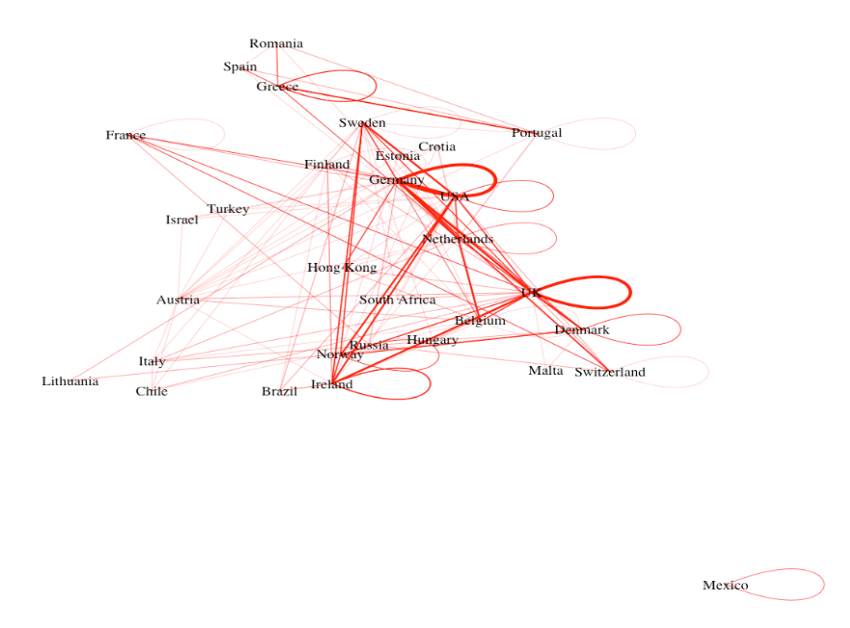
The project results (see figure 1) suggest that :
The UK seems to be a central hub: It serves as an important bridge in the network, with other major actors in the NW22 symposia being the Netherlands and Germany. Despite its geographical distance, the USA also demonstrates a central position in the network, as it collaborates with a wide number of countries, and does so frequently. This pattern aligns with the results of various overviews of the higher education research field (Fu et al., 2022; Akbaritabar & Barbato, 2021; Tight, 2019).
It also highlights the role of linguistic similarity more than of geographical distance in fostering international collaboration in research. However, the Netherlands and Germany also emerged as major actors in the NW22 symposia network, due to their connections to the most influential countries in the network and to other countries. Moreover, the social network analysis results show that Nordic countries tend to collaborate frequently with each other, but much less with other countries and this could serve as another example of the silos tendency described by Tight (2019).
Greece as a bridge: An unexpected finding in the network analysis was Greece’s high betweenness centrality, which highlights that the country acts as bridge between otherwise weakly connected parts of the network (Landherr et al., 2010). Results show that it is part of a tightly-knit group with Portugal, Romania, and Spain, somewhat isolated from the rest of the network. As Fishberg (2022) notes, the production of knowledge rarely stems from a level playing field and this seems to be reflected in symposia as well as within collaborative research projects. Nevertheless, in this case, Greece participated in only one symposium in 2024, leading to infer that despite a limited participation, a country can take a structurally significant position if it links separate clusters or sparsely connected regions.
The periphery: Additionally, social network analysis results suggest that countries such as Croatia, Estonia, France, Hungary, Israel, Italy, Malta, Romania, Spain, and Turkey occupy peripheral positions in the network. Their limited participation in symposia and their tendency to connect primarily with each other rather than with more centralized actors creates a network structure in which a densely interconnected core is surrounded by a periphery of countries. This might echo the claim that research terrain tends to reflect the hierarchical ordering of global higher education, since studies are disproportionately located in the global centres of higher education (Warren et al., 2021).
An isolated entry: Until 2019 the network expanded in a cohesive way: each new country that appeared in the symposia became integrated into the existing collaboration structure, adding to the same interconnected group of countries. In 2019, however, Mexico appeared in the data through a symposium on graduate employability that included three studies written by authors affiliated with the same Mexican institution. Because this symposium involved only Mexican researchers and no co-participation with authors from other countries, Mexico did not connect to the existing collaboration network. Instead, it appeared as a separate, isolated part of the graph.
What the data reveals – patterns of inclusion and exclusion
Although the limitedness of the data analysed in this project, it is possible to highlight the following key messages:
- The idea of international collaboration being framed by inequalities and asymmetries is confirmed by our results, even if there are also signs of openness to the emergence of more peripherical countries and establishment of new links between countries.
- There is room for international collaboration within symposia, but more diversity can be ensured reinforcing ECER NW22 as a collaborative environment with researchers from diverse backgrounds and including more critical matters in higher education research within the organization of symposia.
- The challenge of ensuring equal value to the diversity of linguistic and epistemological traditions and practices within the research field in HE is reinforced. This stresses the need to think about strategies to face this challenge within ECER NW22.
- Symposia can be an even more effective tool to present and foster a diverse and inclusive perspective on higher education research in terms of international contexts, topics, issues, and methodologies which inspire NW22 participants and especially early career researchers.
Would you like to find out more about our research, or would you like to get more involved in higher education research? Get in touch with Network 22 directly, or come along to the Network 22 sessions at the upcoming ECER in Tampere.
The Authors

Mariana Gaio Alves
Instituto de Educação, Universidade de Lisboa Lisboa, Portugal

Jani Ursin
University of Jyväskylä Finnish Institute for Educational Research
Serap Emil
Middle East Technical University (METU)

Kaisa Silvennoinen
Finnish Institute for Educational Research

Anil Ersoz
Middle East Technical University (METU)

Andreia Veiga
Instituto de Educação da Universidade de Lisboa

Christine Teelken
VU University Amsterdam, Netherlands

Rosemary Deem
Royal Holloway, University of London, UK

Liudvika Leysite
TU University Dortmund, Germany
Other blog posts on similar topics:
Akbaritabar A, Barbato G. An internationalised Europe and regionally focused Americas: A network analysis of higher education studies. Eur J Educ. 2021; 56: 219–234.https://doi.org/10.1111/ejed.12446
Deleye, M., Carmona, C., Ciolan, L., Dovigo, F., Figueiredo, M., Grell, P., Schindler, C., &Hoveid, M. H. (2025). Mapping European Educational Research: Insights from topic modelling of ECER abstracts. European Educational Research Journal, 24(5), 614-638. https://doi.org/10.1177/14749041251346817
Fishberg, R. (2022 ). EU Social Science Collaborations as unequal Europeanisation: an ethnographic study of people and practices in EU funded research Roskilde]. Denmark ISSN 0909-9174
Fu, Y.C., Marques, M., Tseng, YH. et al. An evolving international research collaboration network: spatial and thematic developments in co-authored higher education research, 1998–2018. Scientometrics 127, 1403–1429 (2022). https://doi.org/10.1007/s11192-021-04200-w
Landherr, A., Friedl, B., & Heidemann, J. (2010). A critical review of centrality measures in social networks. Business & Information Systems Engineering, 2(6), 371-385. https://doi.org/10.1007/s12599-010-0127-3
Tight, M. (2019). Higher Education Research – the developing field, Bloomsbury Academic.
Warren, S.; Starnawski, M.; Tsatsaroni, A.; Vogopoulou, A.; Zgaga, P. (2021).How does research performativity and selectivity impact on the non-core regions of Europe? The case for a new research agenda, Higher Education (2021) 81:607–622, https://doi.org/10.1007/s10734-020-00559-6