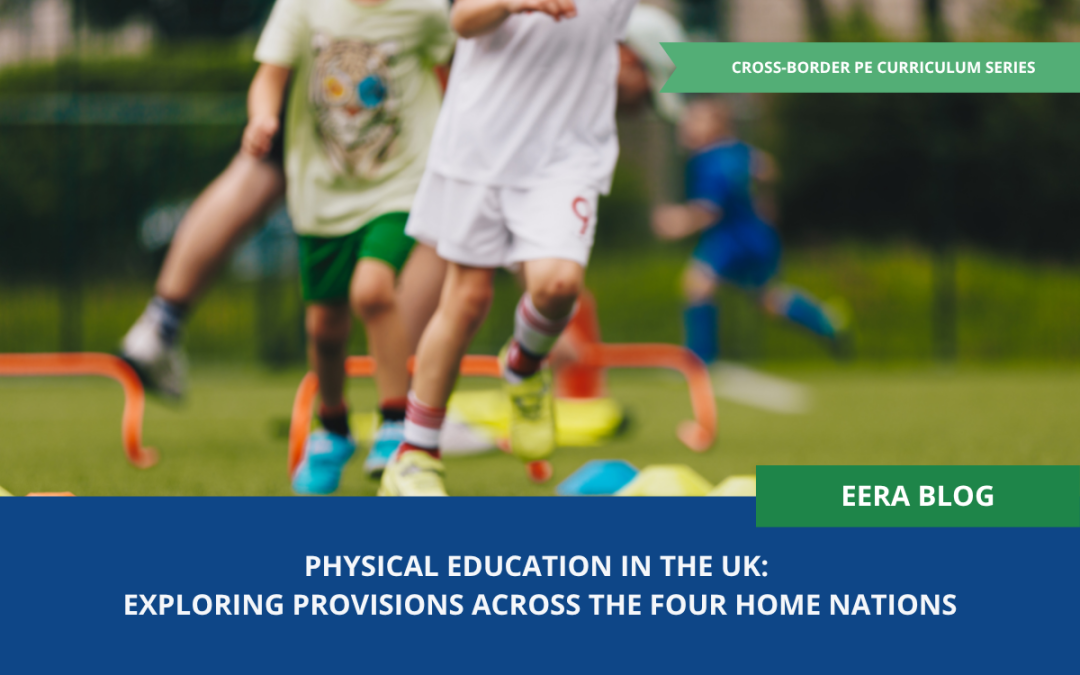
Physical Education in the UK: Exploring provisions across the four home nations
This blog is the first installment of the EERA-funded seminar series on ‘Physical Education Curriculum Learning across European Borders’ and focuses on the curricula of the United Kingdom (UK), with the four home nations of Scotland, England, Wales and Northern Ireland.
The UK presents an interesting context, with a devolved system of government, meaning each nation has responsibility for the development and delivery of its own localised education policy. As such, there are significant differences in the structure and content of national curricula across the UK, driven by varying political agendas as well as a desire for countries to forge a distinct path and educational identity. For example, in both Scotland and Wales, PE is positioned within the curricular area of Health and Wellbeing and, as such, has an explicit role to play in this regard (more detail on this below). As noted in the opening blog in this series, our recent cross-border curriculum analysis work as the UKPE Collaborative has evidenced this, with a specific focus on the context of physical education (PE) and Health and Wellbeing (see Gray et al., 2022a; Gray et al., 2022b).
This blog seeks to provide an overview of some key findings in relation to our cross-curricula analysis. What follows is a brief overview of the curricula landscape in each country context, with a focus on the relevance for PE and Health and Wellbeing. Subsequently, we offer a brief analysis of similarities and differences across the home nations and reflections on the implications for curriculum development/reform.
PE curriculum in Scotland
In Scotland, the current curriculum is the Curriculum for Excellence (CfE), introduced in 2010 for learners aged from 3 to 18. Within CfE, PE sits within the curriculum area of Health and Wellbeing (HWB). Here, PE teachers are guided by Experiences and Outcomes, statements which describe what children and young people should experience and achieve as they progress through school. Alongside physical objectives, they focus on social, emotional and mental objectives, written as ‘I can’ statements that position the learner as central to the planning, teaching and learning processes.
A key feature of the Scottish PE curriculum is this strong alignment with wider HWB outcomes. PE teachers are responsible not only for young people’s physical learning and development, but also for supporting, for example, their confidence, motivation, resilience and relationships. Interestingly, although the curriculum provides details on whatlearners should achieve (I can recognise improvements and achievements), it offers only limited guidance on how this learning should be achieved. Despite this, through collaboration, professional learning and engagement with research, many PE teachers in Scotland have developed pedagogical approaches that meaningfully embed personal development and wellbeing, positioning PE as a subject that supports the whole child (e.g., Lamb et al., 2021; Teraoka & Kirk, 2022).
PE curriculum in England
In the English context, the National Curriculum sets out programmes of study and attainment targets for all subjects across 4 Key Stages (KS1/2 – primary, KS3/4 – secondary), comprising learners from 5-16 years. More specifically, the PE offer is shaped by the National Curriculum for Physical Education (NCPE), last revised in 2014 (and currently undergoing a review). The four overarching aims of the NCPE are to ensure that all pupils:
- develop competence to excel in a broad range of physical activities
- are physically active for sustained periods of time
- engage in competitive sports and activities
- lead healthy, active lives.
The purpose across all stages is to inspire pupils to succeed and excel in competitive sport and other physically demanding activities, thus helping them to build character and embed values such as fairness and respect. Across all stages of learning, pupils should also be provided with opportunities to become physically confident in ways that support their health and fitness. The current NCPE is a brief document and has been described as ‘traditionalist and minimalist’ (Herold, 2020). However, the brevity of the NCPE can also be seen to afford teachers autonomy and support the use of professional judgement in shaping practice to meet the needs of diverse learners.
PE curriculum in Wales
The Curriculum for Wales (introduced in 2022) is the national framework guiding education for learners aged 3–16. It is underpinned by the Four Purposes, which act as the starting point for all learning, and places strong emphasis on pedagogy, teacher agency, and subsidiarity, enabling schools to design curricula that reflect their learners and local contexts. Learning is organised into six Areas of Learning and Experience: Expressive Arts; Health and Wellbeing; Humanities; Languages, Literacy and Communication; Mathematics and Numeracy; and Science and Technology.
For PE, one of the main implications of this new curriculum is that it is not considered a separate subject but is embedded within the holistic Area of Health and Wellbeing. This Area is structured around five Statements of What Matters, which recognise the interconnected physical, social, emotional, cognitive, affective, and psychological aspects of wellbeing. These emphasise lifelong physical health, mental and emotional responses to experiences, informed decision-making, the influence of social factors on wellbeing, and the importance of healthy relationships. Together with the Principles of Progression and Descriptions of Learning, these statements support teachers in designing locally responsive curricula that develop in complexity as learners progress.
PE curriculum in Northern Ireland
Following its revision in 2007, the Northern Ireland curriculum (NIC) underwent a significant shift towards a more skills-based, flexible curriculum with greater emphasis on Thinking Skills and Personal Capabilities and the introduction of cross-curricular skills (Communication, Using Maths, Using ICT). Specifically, the NIC was designed to help young people develop as:
- Individuals
- Contributors to society
- Contributors to the economy and environment
Across all stages of the curriculum – Foundations (4 – 6 years); KS1 and KS2 (6-11 years); KS3 (11-14 years) and KS4 (14 – 16 years) – PE is a compulsory area of learning.
Within the NIC, PE aims to develop learners’ physical skills and fitness, knowledge of movement, and health and personal and social skills (e.g. teamwork, confidence, resilience) though the focus varies across stages. In Foundation and KS1 and KS2, the emphasis is on children’s physical development, health and wellbeing, though there is a somewhat narrow focus on sport and physical skills here. In contrast, KS3 concentrates more on holistic development, with the skills-based element focusing not only on performance but also on thinking skills and personal capabilities. KS4 then continues the holistic development focus, but with an increased recognition of health, wellbeing and lifelong participation, reflecting the wider aims of the NIC.
Cross-border curriculum analysis
Examining and comparing the messages conveyed across each national curriculum in the UK has highlighted both similarities and differences in how health is conceptualised within PE. Across all four nations, we found references to a public health discourse, positioning PE as a response to concerns such as low physical activity levels and sedentary lifestyles – although the strength of this message varies across contexts.
In England, public health is the dominant narrative, but this is less so in Scotland, Wales and Northern Ireland, where health is framed more holistically – as ‘health and wellbeing’, encompassing social, emotional and mental health. This is perhaps unsurprising, given the position of PE in Scotland and Wales (aligned with Health and Wellbeing), and the emphasis on cross-curricular learning in Northern Ireland.
Our analysis also revealed that performance remains a strong curriculum discourse for PE across the UK, except for in Wales where recent reform has encouraged a more holistic approach. This offers useful comparative insights, encouraging us to consider what PE might look like if it moved beyond performance discourses focused on sport, skills and competition. There are implications here for future curriculum development and reform (see Gray et al., 2024 for further reflections).
Conclusion
By generating comparative insights about PE curricula from across the UK, we hope to reveal different perspectives on what PE is for and could become. Alongside the subsequent blogs detailing PE curricula from across Europe, this discussion contributes to a cross‑border learning journey that opens spaces for dialogue, critical reflection and new ideas for future curriculum development.
Key Messages
The devolved system of government in the UK makes for significant differences in the structure and content of the four national physical education (PE) curricula.
While there are some similarities across the four nations, there are also some interesting differences.
Comparing PE curricula from across the UK offers insights and different perspectives on what PE is for and what it could become.
Cross-border conversations like this are useful for future curriculum learning and reform.
Explore all blog posts from the cross-border PE curriculum seminar series

Dr Rachel Sandford
Loughborough University, UK
Dr Rachel Sandford is a Reader in the School of Sport, Exercise and Health Sciences at Loughborough University, UK. She is also the Co-Lead of the UNESCO Chair in Sport, Physical Activity and Education for Development. Her research centres on young people’s attitudes towards, experiences of and development in/through sport and physical activity. She has a particular interest in issues around popular culture, embodied identity and positive youth development. Dr Rachel Sandford | Loughborough University

Dr Shirley Gray
University of Edinburgh, UK
Dr Shirley Gray is a Senior Lecturer in Physical Education at the University of Edinburgh. Her research focuses on issues relating to gender and equality, social and emotional learning, pupil motivation and the professional learning of teachers. Dr Shirley Gray | University of Edinburgh

Dr Anna Bryant
Cardiff School of Education and Social Policy, Cardiff Metropolitan University
Dr Anna Bryant is Director of Teacher Education and Professional Learning and Reader in Physical Health Education at the Cardiff School of Education and Social Policy, Cardiff Metropolitan University. Her research focuses on physical health education, the health and wellbeing curriculum, and physical literacy. She co-leads the Teacher Education and Physical Health Education for Lifelong Learning (PHELL) Research and Innovation Group. Dr Anna Bryant | Cardiff Metropolitan University

Dr Julie Stirrup
School of Sport, Exercise and Health Sciences at Loughborough University, UK
Dr Julie Stirrup is a Senior Lecturer in Physical Education and Sport Pedagogy in the School of Sport, Exercise and Health Sciences at Loughborough University. Julie’s research focuses on policy and curriculum enactment across formal and informal physical education. Specifically exploring how teachers enact policy/curriculum and how this impacts learners across a range of social and cultural contexts. Julie Stirrup | School of Sport, Exercise and Health Sciences | Loughborough University
Other blog posts on similar topics:
Gray, S., Hooper, O., Hardley, S., Sandford, R., Aldous, D., Stirrup, J., Carse, N., & Bryant, A. S. (2022). A health(y) subject? Examining discourses of health in physical education curricula across the UK. British Educational Research Journal, 48(6), 1161–1182. https://doi.org/10.1002/berj.3820
Gray, S., Sandford, R., Stirrup, J., Aldous, D., Hardley, S., Carse, N. R., Hooper, O., & Bryant, A. S. (2022). A comparative analysis of discourses shaping physical education provision within and across the UK. European Physical Education Review, 28(3), 575–593. https://doi.org/10.1177/1356336X211059440
Gray, S., Sandford, R., Hooper, O., Hardley, S., Bryant, A.S. & Carse, N. R. (2024). Exploring the re-legitimisation of messages for health and physical education within contemporary English and Welsh curricula reform. Sport, Education and Society, 29(8), 939–951. https://doi.org/10.1080/13573322.2023.2240822
Herold, F. (2020). ‘There is new wording, but there is no real change in what we deliver’: Implementing the new National Curriculum for Physical Education in England. European Physical Education Review, 26(4), 920–937. https://doi.org/10.1177/1356336X19892649
Lamb, C. A., Teraoka, E., Oliver, K. L., & Kirk, D. (2021). Pupils’ motivational and emotional responses to pedagogies of affect in physical education in Scottish secondary schools. International Journal of Environmental Research and Public Health, 18(10), Article 5183. https://doi.org/10.3390/ijerph18105183
Teraoka, E., & Kirk, D. (2022). Exploring pupils’ and physical education teachers’ views on the contribution of physical education to health and wellbeing in the affective domain. Sport, Education and Society, 27(8), 935-945. https://doi.org/10.1080/13573322.2021.1940917