The importance of diversity training for educators in predominately white places

The importance of diversity training for educators in predominately white places

The state of future education as a discipline will be possibly influenced by the importance it places on a conceptual, curricular, and pedagogical need to shift the emphasis toward transformative classrooms working for positive change through cultural diversity (Banks, 2020). Awareness of issues around race equality, inclusive growth, and community cohesion has heightened following George Floyd’s killing in the USA in 2020, and the Black Lives Matter Movement. This increasing awareness is particularly pertinent in Britain in areas of historically low ethnic diversity which have lately experienced a rise in ethnic minority populations, and where inclusive growth is a challenge.

The Research

My research explores the understanding and experiences of multiculturalism of students, parents and educators in four mainstream primary schools situated in the predominantly White South-West England. I adopted a qualitative case study methodology framed by a sociocultural theoretical framework (Vygotsky, 1978). Data were collected through semi-structured interviews with adult participants, observation of students’ classroom activities, and documentary analysis of classroom and corridor displays.

The interviews had questions around books and topics reflecting multiculturalism. In the height of COVID-19, the classroom and corridor displays were photographed to see whether the school ethos and atmosphere reflect multiculturalism.

Background – Diversity, Curriculum and Education Inspectorate

Although 33.5% of the school population includes ethnically diverse children, out of 6478 children’s books published in Britain in 2019, 10.5% featured characters belonging to Black, Asian and Minority Ethnic communities; of these, only 5% had a main character who belonged to the communities mentioned (Wood, 2019). The education inspectorate, Office for Standards in Education, Children’s Services and Skills or in short, Ofsted (2019:11,12) is vocal about ensuring “inclusive education and training to all”, and extending the Curriculum beyond the academic and technical domains for students’ broader development, and creation of understanding, and appreciation of cultural diversity. However, race equality and community cohesion, which could help in the students’ broader development, do not constitute Ofsted’s school inspection criteria (Rhamie, 2014).  

Findings

My research findings suggest participants’ eagerness for more ethnically diverse content incorporated in teaching and learning. However, schools are considerably dependent on, and somewhat confined by, the knowledge-focused Primary National Curriculum in England for which efforts towards a multicultural reflection are less noticeable. The absence of culturally diverse content in the school Curriculum highlighted by the 1985 Swann Report and the 2007 Ajegbo Report makes England’s primary National Curriculum look like a “Brexit policy three decades before Brexit”  (Moncrieffe et al., 2020:20). The situation emphasizes the need to start afresh. The starting point may be to get thinking and acting while doing Curriculum making (Priestley et al., 2021). This is because Curriculum thinking  is at the heart of education practice today (Poutney and Yang, 2021).

Implications – Curriculum thinking and teacher training

The educators as Curriculum framers play a significant part in Curriculum thinking and delivery where the task design is crucial, and where the educators can place equal importance on the interwoven elements of “how”, “what” and “why” the task is taught (Moncrieffe et al., 2020:16-17). The educators need to build confidence in encouraging difficult conversations around racism, fear, indifference, and ignorance breaking the stereotypical barriers. This would help equip the students with the necessary creative skills so that they learn, grow and foster as responsible citizens in this changing complex world (Deng, 2022) with an apt cognition of a multicultural Britain. But how can they train students without the required training in the specific area?

Lander’s research (2014) showed that trainee educators in predominantly White areas often run the risk of sharing confined perspectives while educating children. I agree with Lander that no matter the geographical location, school educators can be equipped with the necessary culturally responsive initial training, and continuous professional development, with a focus on race-centric and multiculturally responsive education (ibid).   This may aid in the reduction of employees’ unconscious bias for which the CRE (2021)  recommended training and routine skills assistance. This becomes distinctly pertinent to avoid horrific cases of racism in the future like the one in Hackney, London where a Black teenager referred to as Child Q was wrongly suspected of cannabis possession, and strip-searched during her period, risking deep serious consequences for the child (FordRojas, 2022 ).

Having competent culturally responsive educators in 21st century classrooms may have important positive effects like boosted self-esteem, improved academic achievement, and greater engagement and well-being of students from ethnically diverse communities, which, in turn, have implications for fostering nurturing inclusive classrooms and school environments.

Key Messages

  • There is often a misconception that only schools with high ethnic minority populations or those situated in multicultural places need multicultural awareness.
  • Race equality and cultural awareness are essential topics amidst racist incidents in multicultural schools at the heart of London
  • These topics are equally important in predominantly White places in Britain, especially in the aftermath of George Floyd’s murder, the BLM movement, and post-Brexit rises in racist and xenophobic attacks.
  • School curriculum and atmosphere need to offer race sensitive multicultural reflection in these places.
  • Practitioners need training and preparedness to equip them with relevant knowledge, skills, and confidence.

Suparna Bagchi

Suparna Bagchi

Final year doctoral student in Plymouth Institute of Education, University of Plymouth, UK

Suparna Bagchi is a final-year doctoral student at the Plymouth Institute of Education, University of Plymouth. She worked there as a Doctoral Teaching Assistant from 2019 to 2022. Suparna’s doctoral research explores perceptions of multiculturalism in mainstream primary schools in South West England. With a research interest in race, equity and social justice, Suparna is a member of various race equality associations both inside and outside the University.

Suparna is a dignity and respect ambassador and student representative of Equality, Diversity and Inclusion (EDI) at Plymouth University. In 2022, Suparna received EDI Award from Plymouth University coming among the top three students. Suparna is a trained Compassionate Community Ambassador, mentor of the UNO-recognised Virtues Project, a certified Community Champion and trained Hinduism Faith Speaker. Suparna appears regularly on BBC Radio Devon as a guest speaker. Suparna has made academic presentations nationally and internationally.

Twitter handle: https://twitter.com/suparnabagchi2?lang=en-GB

Orcid: https://orcid.org/0000-0002-2498-2892

ResearchGate: https://www.researchgate.net/profile/Suparna-Bagchi

Other blog posts on similar topics:

References and Further Reading

Banks, J. A. (2020). Diversity, transformative knowledge, and civic education: Selected essays. Routledge. https://doi.org/10.4324/9781003018360

Deng, Z. (2022). Powerful knowledge, educational potential and knowledge-rich curriculum: pushing the boundaries. Journal of Curriculum Studies, 54(5), 599-617. https://doi.org/10.1080/00220272.2022.2089538

FordRojas, J.P. (2022). Child Q report: Met Police culture ‘under scrutiny again’ after case of schoolgirl strip-searched by officers, says policing minister. Sky News. 13 April. https://news.sky.com/story/child-q-report-met-police-culture-under-scrutiny-again-after-case-of-schoolgirl-strip-searched-by-officers-says-policing-minister-12572253

Lander, V. (2014). Initial teacher education: The practice of whiteness. In R. Race. and V. Lander (Eds.), Advancing race and ethnicity in education, (pp. 93-110). Palgrave Macmillan.http://www.palgrave.com/us/book/9781137274755

Moncrieffe, M., Race, R., Harris, R., Chetty, D., Riaz, N., Ayling, P., Arphattananon, T., Nasilbullov, K., Kopylova, N. and Steinburg, S. (2020). Decolonising the curriculum. Research Intelligence, 142, 9-27. British Educational Research Association. https://www.researchgate.net/publication/340870420_Decolonising_the_Curriculum_-_Transnational_Perspectives_Research_Intelligence_Issue_142Spring_2020

Ofsted. (2019). The education inspection framework. Draft for Consultation–January 2019.

https://www.gov.uk/government/publications/education-inspection-framework-draft-for-consultation

Plymouth Report. (2019). Plymouth: Plymouth City Council.https://www.plymouth.gov.uk/publichealth/factsandfiguresjointstrategicneedsassessment/plymouthreport

Pountney, R. and Yang, W. (2021). International perspectives on the curriculum Implications for teachers & schools. BERA Research Intelligence, 148, pp. 15 https://www.bera.ac.uk/publication/autumn-2021

Priestley, M., Alvunger, D., Philippou, S., and Soini, T. (2021). Curriculum making across European nations. BERA Research Intelligence,148, 16-17. http://hdl.handle.net/1893/33293

Rhamie, J. (2014). Resilience, the black child and the Coalition Government. In .R Race, and V. Lander (Eds.), Advancing Race and Ethnicity in Education (pp. 230-249. Palgrave Macmillan. https://doi.org/1057/9781137274762_15

Sewell, T., Aderin-Pocock, M., Chughtai, A., Fraser, K., Khalid, N., Moyo, D., … and  Shah, S. (2021). Commission on race and ethnic disparities: The report. Commission on Race, Ethnic Disparities. https://assets.publishing.service.gov.uk/government/uploads/system/uploads/attachment_data/file/974507/20210331_-_CRED_Report_-_FINAL_-_Web_Accessible.pdf

Vygotsky, L. S., and Cole, M. (1978). Mind in society: Development of higher psychological processes. Harvard university press.https://doi.org/10.2307/j.ctvjf9vz4

Wood, H. (2019). New CLPE report into kids books warns over simplified depictions of BAME characters. The Bookseller. https://www.thebookseller.com/news/clpe-reveals-increase-bame-representation-urges-against-jasmine-default-1085896
Reimagining Teacher Education Pedagogies and Policies in the Context of Mass Global Migration

Reimagining Teacher Education Pedagogies and Policies in the Context of Mass Global Migration

Diversity across the world is hardly new, but its nature is changing given the growing number of refugee and migrant children, placing increasing stress on schools to meet their learning needs [1] These increases in transnational mobility have teachers struggling to reconsider their everyday practices to accommodate many more newcomers in their classrooms, even while immigrant and refugee students lag behind their nonimmigrant peers academically. [2] [3] [4]

In 2019, the number of international migrants reached 272 million; 33 million of them were children. Among the world’s migrants are nearly 29 million refugees and asylum seekers who have been forcibly displaced from their own countries. An additional 41 million people in 2018 were internally displaced due to conflict and violence, an estimated 17 million of whom were children. [5]

The need for teachers to become more responsive to changing social conditions and student populations is gaining urgency [6][7][3][8] as recent reports [9] emphasize the support of children from low socio-economic, migrant, or “disadvantaged” minority backgrounds. This highlights teacher supply and preparation as an urgent issue affecting immigrant and refugee education globally. [10]

Reimagining Teacher Education Pedagogies and Policies Across Turkey, United States, and Hong Kong

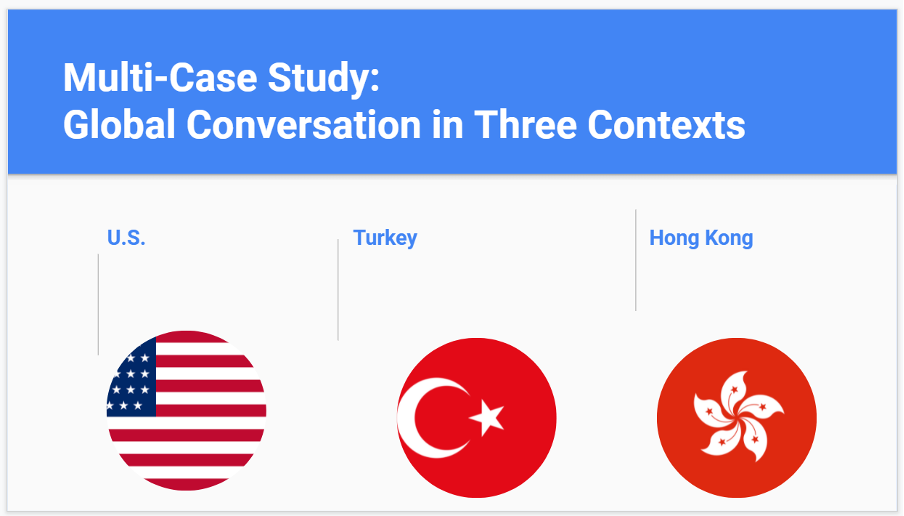
Our purpose in this study was to gain insight into quality teachers for immigrant students. Using social justice as a lens, we focused on teacher educators, whose research and experience center on preparing teachers to teach immigrant students and considered their perspectives on teaching immigrant students for educational equity. To this end, in a multiple case study, we examined teacher educators in Turkey, the United States (US), and Hong Kong (HK), as each context presents a distinct case of immigration.

In Turkey, immigrants have recently consisted largely of refugees displaced by war. The US has, historically, long received immigrants, motivated by push factors such as political conflicts, as well as pull factors such as economic opportunities. HK’s colonial past and subsequent re-integration with greater China has meant minimal “traditional” immigration, but rather ethnic minorities who are non-Chinese residents, imported workers, and migrants from mainland China.

We acknowledge the essentializing nature of these characterizations of immigrant, which simplifies the complexity of the phenomenon as it unfolds in each context. Our intention was not to mask the multilayeredness of immigration generally, or in each of these contexts, but to illuminate the varied ways in which the concept of immigrant manifests internationally, and to forward our cases as three specific examples.

Theoretical Framework

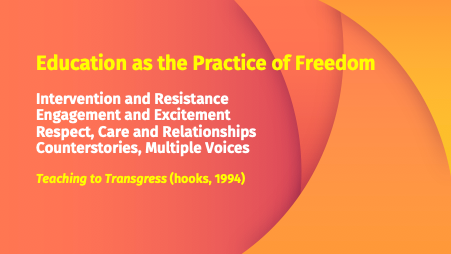
We conceptualized the perspectives of teacher educators for teachers of immigrant students using theoretical frameworks articulated by two scholars of social justice teaching and teacher education. First, we used bell hooks’ notion of teaching to transgress [11] to illuminate teacher practice and preparation that can “enables transgressions” needed to dismantle entrenched educational hegemonies experienced by immigrant youth and “[make] education the practice of freedom” [11]. Second, we used Cochran-Smith’s theory of teacher education for social justice which “is intended to challenge the educational status quo and be transformative” [12] by interrogating the central issues of teacher education: teachers, curriculum, teaching contexts, and outcomes. Our study offers insight into what seems to be emphasized (or absent) in pre- and in-service teacher education to support immigrant learners, both within the confines of each unique context and also through collaborative global dialogue across three cultural boundaries.

Teacher Educators’ Perspectives on Preparing Teachers to Teach Immigrant Students

Through our study, we aimed to gain insight into educating immigrant students and what seems to be emphasized (or absent) in pre- and in-service teacher development and practice to support immigrant learners in these three contexts, based on the perspectives of teacher educators who do the work of preparing teachers to teach immigrant students. In doing so, we asked the following question: “Using social justice as a lens, what insights do teacher educators in Turkey, the US, and HK, offer on preparing teachers to teach immigrant students?”

We framed each context as an individual case and examined the perspectives of practicing teacher educators from the US, Turkey, and HK, given the unique insights professionals from each context can offer for teacher preparation/development for educating immigrant students. Our study included 22 teacher educators from Turkey, the US, and Hong Kong, whose research interests and experiences center on preparing teachers to teach immigrant students.

We present the findings from our preliminary analysis of our interview data under three themes of teacher educators’ identity, their work, and implications for teacher education, policy, and research. 

Findings

Teacher Educators and Who They Are

Our analysis revealed that the topic of educating immigrant children was personal to many teacher educators whom we interviewed. They either had a first-hand experience of being an immigrant child or had generational family histories of immigration. Other teacher educators also mentioned that in addition to their personal histories, their professional and educational histories mattered when engaging persistently in topics of research and teaching related to educating immigrant children.


Teacher Educators and The Work That They Do

The teacher educators intentionally integrated their research on issues around immigrants and immigration and the elements of social justice with their teaching. For example, they discussed including specific pedagogies on how to teach immigrant students in their teacher education courses and bringing their research into teaching to provide evidence from the field. In addition, many teacher educators elaborated on building partnerships and collaboration as key to teaching immigrant students. Some were involved in family-community partnerships and others were in collaboration with colleagues who have direct immigrant backgrounds or are close to immigrant communities because they believed that such collaboration and partnerships can offer important perspectives on how to teach and partner with immigrant students and families.


Teacher Educators and the Work That Needs to be Done

The narratives of the teacher educators across the three national contexts pointed toward what further work needs to be done to ensure education that is equitable and socially just for immigrant students around the globe. The first is a radical reform in teacher education programs; second is learning about and navigating policies that are often against immigrants; third is the need for research that is context specific but also cross-cultural and transnational as one way to respond to the mass global migration. 


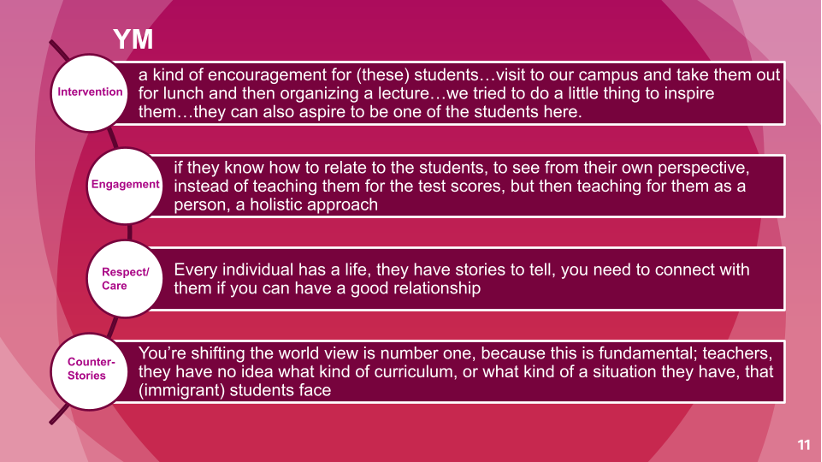
Within these themes, we also drew upon bell hooks conception as “education as the practice of freedom,” and used bell hooks’ concepts to illustrate teachers’ enactments. An example of our participant, YM, is here. 

Findings

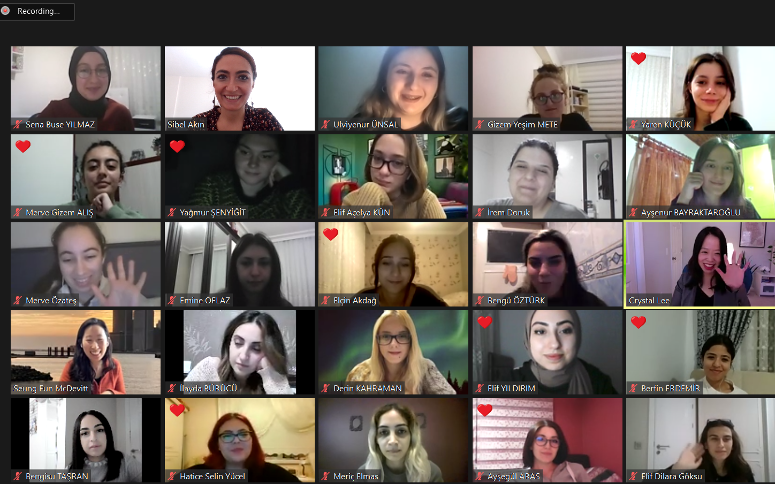
Example of a Webinar: Pre-service Teachers in Dr. Akin-Sabuncu’s Life Studies Education class at TED University

The theoretical lenses afforded by hooks and Cochran-Smith enabled us to discern connections between teacher educator identities and work, and teacher preparation for educating immigrant students. Our findings showed: 1) the relationship between identity and commitments to teaching marginalized populations as each respondent articulated a clear connection to immigrant students as key to their work, an insight into “which teachers are recruited” for social justice teaching [12]; and 2) inserting “a counter-narrative account” that “insist[s] that everyone’s presence is acknowledged” [11] by building bridges between immigrant communities and families and teacher preparation curricula, and enabling the capacities of immigrant students contained in everyday, ordinary actions to be instructive to new and experienced teachers and researchers.


Our study illuminates the need for teacher educators to design preparation programs that explicitly address immigrant students, enable novice teachers to make professional connections to immigrant communities through personal, authentic experiences, stretch the curriculum beyond the confines of the university to engage local communities and make full use of the rich resources and partners they represent. Through this study, we present a broader, more global view on teaching and teacher education for (im)migrant students, provide a window into the knowledge and skills teacher educators need to emphasize in their preparation, and offer lessons for and across different national settings.


Their narratives across the three jurisdictions highlighted what further work needs to be done to ensure socially just education for immigrant students around the globe. First is radical reform in teacher education programs; second is learning about and navigating policies that are often hostile to immigrants; third is the need for research that is context-specific but also cross-cultural and transnational as one way to respond to mass global migration. 

We are looking forward to sharing our findings at the annual meetings of the ECER-2022 and WERA-2022!


Other blog posts on similar topics:

Dr Sibel Akin-Sabuncu

Dr Sibel Akin-Sabuncu

Assistant Professor of curriculum and instruction at the Faculty of Education at TED University.

Sibel Akin-Sabuncu, Ph.D., is an assistant professor of curriculum and instruction at the Faculty of Education at TED University. She obtained her Ph.D. degree in the Curriculum and Instruction Program at Middle East Technical University. Dr. Akin-Sabuncu was a visiting scholar at Teachers College, Columbia University during her doctoral studies, and is also currently a postdoctoral researcher and a visiting assistant professor at Teachers College, Columbia University. Her research focuses on preservice and in-service teacher education; elementary teacher education; teacher/teacher educator beliefs; teaching and teacher education for social justice/immigrant and refugee students/disadvantaged students; educational equity; critical pedagogy; and culturally responsive pedagogy.

LinkedIn: www.linkedin.com/in/sibel-akin-sabuncu-77034643

Instagram @sibel_akin_sabuncu

Dr Crystal Chen Lee

Dr Crystal Chen Lee

Assistant professor of English language arts and literacy at North Carolina State University in Raleigh, NC

Crystal Chen Lee, Ed.D., is an assistant professor of English language arts and literacy at North Carolina State University in Raleigh, NC. Her research lies at the nexus of literacy, teacher education, community engagement, and marginalized populations. She received her Ed.D. in Curriculum and Teaching from Teachers College, Columbia University. 

Twitter: @CrystalChenLee1

Dr Seung Eun (Sunny) McDevitt

Dr Seung Eun (Sunny) McDevitt

Assistant professor of special education at St. John’s University in Queens, New York, USA.

Seung Eun (Sunny) McDevitt, Ed.D., is an assistant professor of special education at St. John’s University in Queens, New York, USA. Her research interests include diverse teachers and their inclusive practice for marginalized children in early childhood education and care contexts. Prior to entering academia, Dr. McDevitt was an early childhood/special education teacher and a learning specialist in New York City.

Twitter: @SunnyMcDevitt

Dr A Lin Goodwin

Dr A Lin Goodwin

Dean and Professor of the Faculty of Education at the University of Hong Kong

Lin Goodwin (葛文林) is Dean and Professor of the Faculty of Education at the University of Hong Kong. Professor Goodwin’s research focuses on teacher/teacher educator beliefs, identities and development; equitable education and powerful teaching for immigrant and minoritized youth; international analyses and comparisons of teacher education practice and policy.

Twitter: @algoodwin_TC

GENE Awards

EERA is delighted and honoured to be partnering with the Global Educational Network in Europe (GENE) to make significant research funds available to our members to further research in the area of global education.

These research awards are funded by Global Education Network Europe (GENE), the European network of Ministries and Agencies with national responsibility for policymaking, funding, and support in the field of Global Education. For this reason, the subject area for research projects undertaken is that of Global Education.

The purpose of the award is to support quality research around the themes outlined here  – which have been identified as of interest to policymakers. Gathering of existing research, application of existing research from other areas of education to Global Education, follow-up studies, all are perfectly acceptable. It is not expected that the research has to draw policy conclusions – but to make available up-to-date, policy-relevant research from which policymaker can draw their own conclusions.

References and Further Reading

[2] American Psychological Association (APA), Presidential Task Force on Educational Disparities. (2012). Ethnic and racial disparities in education: Psychology’s contributions to understanding and reducing disparities. Retrieved from
http://www.apa.org/ed/resources/racial-disparities.aspx

[12] Cochran-Smith, M. (2010). Toward a theory of teacher education for social justice. In A. Hargreaves (Eds.), Second international handbook of educational change (pp. 445–467). Dordrecht, The Netherlands: Springer. https://www.academia.edu/4346572/Toward_a_Theory_of_Teacher_Education_for_Social_Justice

[9] European Commission. (2013a). Education and training in Europe 2020: Responses from the EU member states. Brussels: Eurydice. https://eacea.ec.europa.eu/national-policies/eurydice/content/education-and-training-europe-2020-responses-eu-member-states_en

[6] European Commission. (2013b). Supporting teacher competence development for better learning outcomes. Retrieved from http://ec.europa.eu/dgs/education_culture/repository/education/policy/school/doc/teachercomp_en.pdf

[11] hooks, b. (1994). Teaching to transgress. New York, NY: Routledge. https://www.routledge.com/Teaching-to-Transgress-Education-as-the-Practice-of-Freedom/hooks/p/book/9780415908085

[7] Organisation for Economic Co-operation and Development (OECD). (2010). Educating teachers for diversity: Meeting the challenge. Retrieved from
http://dx.doi.org/10.1787/9789264079731-en

[3] Organisation for Economic Co-operation and Development (OECD). (2016). Supporting teacher professionalism: Insights from TALIS 2013. Retrieved from
http://dx.doi.org/10.1787/9789264248601-en

[8] Organisation for Economic Co-operation and Development (OECD). (2019). TALIS 2018
results (Volume I): Teachers and school leaders as lifelong learners.
Paris: OECD
Publishing. https://www.oecd.org/education/talis-2018-results-volume-i-1d0bc92a-en.htm

[10] Paine, L., Blòmeke, S., & Aydarova, O. (2016). Teachers and teaching in the context of
globalization. In D. Gitomer & C. Bell, (Eds.), Handbook of research on teaching (pp.
717-786). Washington, DC: AERA. https://www.academia.edu/27448289/Paine_L._Blomeke_S._and_Aydarova_O._2016_._Teachers_and_Teaching_in_the_Context_of_Globalization._AERA_Handbook_of_Research_on_Teaching

[1] Public Policy & Management Institute. (2017). Preparing teachers for diversity: The role of initial teacher education.Brussels: European Commission.

[4] Sugarman, J. (2017). Beyond teaching English: Supporting high school completion by immigrant and refugee students. Washington, DC: Migration Policy Institute. https://www.migrationpolicy.org/research/beyond-teaching-english-supporting-high-school-completion-immigrant-and-refugee-students

[5] UNICEF. (2020). Child migration. Retrieved from https://data.unicef.org/topic/child-migration-and-displacement/migration