The well of resilience is running dry, but universities keep drawing from it

The well of resilience is running dry, but universities keep drawing from it

Resilience is usually treated as a good thing. It is the quality we admire in people who keep going when work becomes difficult. The people who adapt under pressure, put their heads down and carry on when demands keep growing. In universities, as in many other professions and sectors, resilience is often treated as part of being professional.

What doesn’t kill you makes you stronger

However, there is a point at which resilience stops being a personal strength and becomes something the job quietly depends on. My recent research with teacher educators in Ireland and the UK suggests that this is increasingly the case in higher education. Teacher educators are not simply academics who ‘just’ teach and research. They also mentor student teachers, support them during school placement, respond to pastoral issues, and manage the effects of repeated policy, accreditation, and inspection demands (for example, Ofsted inspections in England). Much of this work is time-consuming, emotionally demanding, and only partly visible in the ways universities usually account for academic labour.

Keep calm and carry on

One participant in my study captured the culture in a single phrase: “Just plough on and pretend it’s not happening.” The phrase points to something beyond individual frustration; in work built around care and public service, people often keep things going by absorbing pressures that should not really be carried by individuals alone. They answer emails late into the evening, take on extra work, manage other people’s distress, and fill gaps when formal support is missing. Over time, what is praised as resilience can become one of the ways chronic strain is normalised.

Participants in my study described their academic roles as feeling like “three separate jobs” at once:

“No matter how hard or how efficiently we work, there is always a mountain of endless tasks to be completed.”

Another described how work had spread into every corner of their life:

“I never have true rest periods, working on annual leave, weekends and evenings. Never being ‘finished’, no matter how many hours or how little rest time, you are never on top of everything.”

None of this is to say that resilience has no value. It clearly does; it can help people deal with uncertainty and see them through periods of pressure. But it has limits. Namely, it cannot make an excessive workload reasonable, nor can it make an unsupported role more sustainable.

Soldier On

Yet public discussion of workplace pressure often slips too quickly into the language of coping. Are you setting boundaries? How are you managing your stress? Are you looking after yourself properly? Are you being adaptable enough? Have you attended the wellbeing workshop on offer? The problem is that those questions often obscure a harder one: why is so much of this strain being dealt with at the level of the individual in the first place?

Resilience as scar tissue

This is where Suslovic and Lett’s critique of resilience is useful. They argue that resilience is too often treated as “an individual-level solution to a structural toxin”. More strikingly, they suggest that resilience may be better understood as “scar tissue”. It is a powerful metaphor because it shifts resilience away from the reassuring language of inner strength and towards something else: the mark left by repeated injury.

The idea of scar tissue helps make sense of what many academics in my study described. Their accounts were not simply about the ordinary demands of their work. They were about prolonged accommodation to conditions that had become excessive and normalised. They repeatedly pointed to pressures that were structural rather than personal: competing demands across teaching, research, service, mentoring and placement work; administrative burdens linked to accountability systems; and a sense that the most demanding parts of their role were poorly understood, or indeed invisible.

As one participant put it:

“All of this work is pretty much irrelevant (under a performance metrics lens), so while I’m trusted to do my job, there isn’t really anyone who understands the stress involved in these elements.”

Moving beyond ‘Chin Up’

In recent years, work-related stress has increasingly been recognised not just as a private issue but also as an organisational one. For example, in December 2025, Britain’s Health and Safety Executive (HSE) found that the University of Birmingham did not have appropriate arrangements in place to manage work-related stress and could not demonstrate that it was managing the risks associated with excessive workload. The significance of that case lies in the framing. The question was not whether staff were coping well enough. It was whether the institution was identifying and effectively managing foreseeable risk, as is an employer’s legal responsibility.

There is a similar legal imperative in Ireland. The Health and Safety Authority (HSA) treats work-related stress as a workplace hazard to be assessed and prevented by employers. That matters because it shifts the focus from systems of work that generate stress to whether workers can keep adapting indefinitely.

This is significant since wellbeing language now circulates widely across universities in Ireland and the UK. That veneer of well-being can sit easily alongside overload if the organisation of work itself does not change. Workshops and wellbeing campaigns may have some value, but if academic staff do not have the time or energy to benefit from them, they can feel more like another way of returning responsibility to the individual. The real question, then, is not how much more resilience university staff can produce, but why universities have built conditions that depend so heavily on it.

Key Messages

Resilience needs to be viewed as a structural requirement, not a personal strength. Universities increasingly depend on academics’ abilitiy to absorb excessive workloads rather than addressing unsustainable working conditions

Teacher educators face invisible, emotionally demanding labour. Beyond teaching and research, they mentor students, manage pastoral care, and navigate constant policy changes – work that is time-consuming yet largely unrecognised.

Resilience may be better understood as ‘scar tissue’. Rather than inner strength, resilience can represent the accumulated damage from repeated exposure to structural workplace toxins.

Wellbeing initiatives can obscure systemic problems. Workshops and self-care campaigns place the responsibility on the individual, while leaving the organisation of work unchanged.

Dr Sabrina Fitzsimons

Dr Sabrina Fitzsimons

DCU CREATE—The Centre for Collaborative Research Across Teacher Education at Dublin City University, Ireland.

Sabrina Fitzsimons is a lecturer in Initial Teacher Education and Co-Director of DCU CREATE—The Centre for Collaborative Research Across Teacher Education at Dublin City University, Ireland. Her research focuses on the occupational well-being and flourishing of educators, including higher education-based teacher educators, academics, school-based teachers, student teachers and other educators. She is a graduate member of the Psychological Society of Ireland and a Senior Fellow of the Advance HE.

Other blog posts on similar topics:

References and Further Reading

Birmingham UCU. (2025, December 13). HSE confirms material breaches at the University of Birmingham following union safety concerns. https://birminghamucu.org/2025/12/13/hse-confirms-material-breaches-at-university-of-birmingham-following-union-safety-concerns/

British Safety Council. (n.d.). The Health and Safety at Work Act explained. Retrieved April 29, 2026, from https://www.britsafe.org/training-and-learning/informational-resources/the-health-and-safety-at-work-act-explained

 Fitzsimons, S., & Smith, D. S. (2025). “Just plough on and pretend it’s not happening”: Understanding burnout in teacher educators in Ireland and the United Kingdom. International Journal of Educational Research Open9, 100491. https://doi.org/10.1016/j.ijedro.2025.100491

Fitzsimons, S., Boag, L. & Smith, D.S. (2025) Understanding Teacher Educators’ Quality of Life: Insights from the PERMA Model. Applied Research Quality Lifehttps://doi.org/10.1007/s11482-025-10435-z

Fitzsimons, S., & Smith, D. S. (2025). ‘Don’t do anything special for us coming’: the mental health impact of Ofsted inspections on teacher educators in England. Cambridge Journal of Education, 1–19. https://doi.org/10.1080/0305764X.2025.2451280

Furlong, C., Fitzsimons, S., & O’Farrell, P. (2026). Protective factors for teacher wellbeing in Ireland through the PERMA lens. Pastoral Care in Education, 1–18. https://doi.org/10.1080/02643944.2026.2646149

Health and Safety Authority. (n.d.). Safety, Health and Welfare at Work Act 2005. Retrieved April 29, 2026, from h https://www.hsa.ie/eng/topics/managing_health_and_safety/safety-_health_and_welfare_at_work_act_2005/

 Health and Safety Authority. (n.d.). Causes of work-related stress. Retrieved April 29, 2026, from https://www.hsa.ie/eng/workplace_health/workplace_stress/workplace-stress-overview/causes-of-work-related-stress/ 

Suslovic, B., & Lett, E. (2024). Resilience is an Adverse Event: A Critical Discussion of Resilience Theory in Health Services Research and Public Health. Community health equity research & policy44(3), 339–343. https://doi.org/10.1177/2752535X231159721 
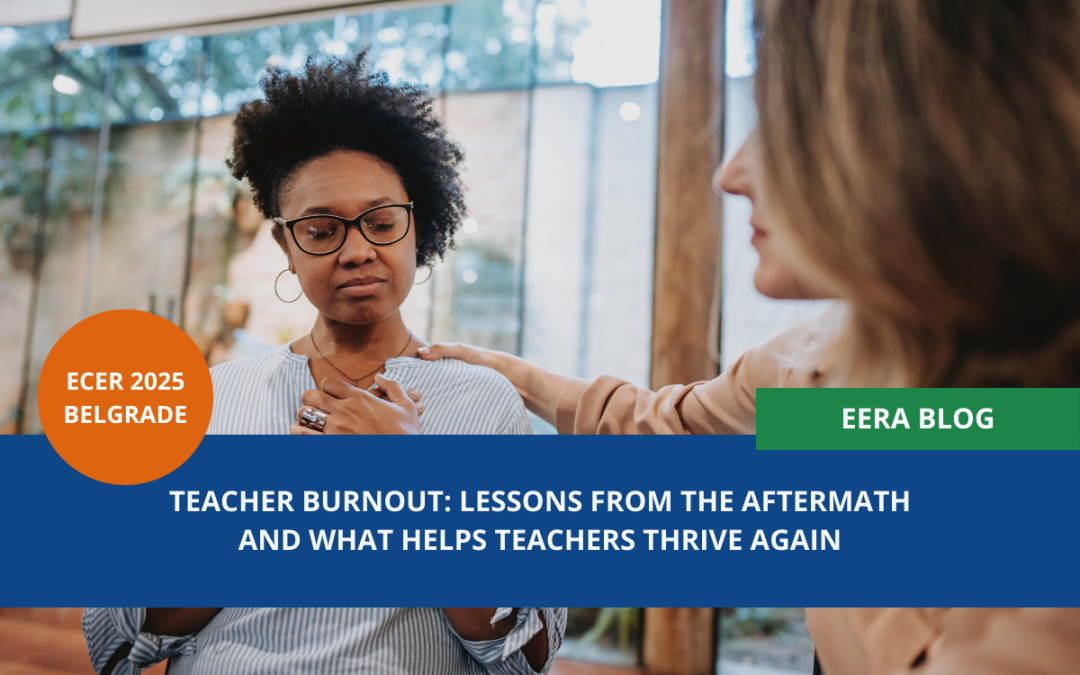
Teacher burnout: Lessons from the aftermath and what helps teachers thrive again

Teacher burnout: Lessons from the aftermath and what helps teachers thrive again

Teaching is one of the most rewarding professions, but also one of the most demanding. Across Europe, nearly half of teachers report experiencing high levels of work-related stress (European Commission, 2021). For some, this stress escalates into teacher burnout, a psychological syndrome marked by exhaustion, emotional detachment, and a reduced sense of personal accomplishment (Schaufeli et al., 2020).

Much of the existing research has focused on the causes of burnout before teachers leave the classroom, and on its consequences once they have dropped out (Ahola et al., 2017). But what happens after burnout, when teachers return to work? Too often, the story ends at the point of absence. Yet the period of reintegration can be just as challenging. Understanding this ‘teacher burnout aftermath’ is essential if schools want not only to support teachers effectively but also to retain them in the profession.

Our study into reintegration after teacher burnout

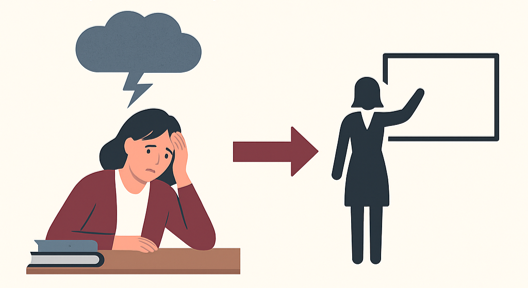
An illustration of a woman under a stormy cloud. She looks worried. An arrow points to a woman in front of a white board, indicating that this image references teacher burnout.

To address this gap, our study explored the experiences of ten teachers who returned to the classroom after burnout. Using semi-structured interviews, we investigated the challenges they faced and the factors that helped them reintegrate successfully. Although the teachers’ experiences varied, several recurring themes emerged.

Barriers teachers encounter

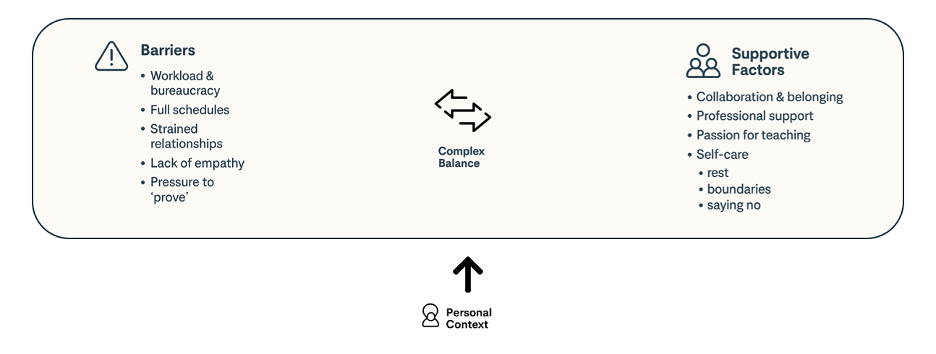
Many participants described workload as the most pressing obstacle to recovery. Administrative and bureaucratic tasks consumed precious energy that could otherwise have been invested in teaching. In some cases, schools placed teachers straight back into full schedules, leaving little room to rebuild their confidence.

Relationships also proved decisive. Strained interactions with colleagues or a lack of understanding from school leaders created additional stress. Some teachers reported feeling they had to “prove” themselves all over again, rather than being welcomed back with empathy. This sense of scrutiny often made the return heavier than expected.

Supportive factors that made a difference

Despite these barriers, teachers also pointed to a range of supportive factors that facilitated their reintegration after teacher burnout.

Positive collaboration with colleagues and school leaders created a sense of safety and belonging. Teachers highlighted the importance of professional support, such as therapy, counselling, or coaching, to help them process their experiences. As one participant explained, counselling helped her set clearer boundaries and avoid slipping back into old patterns.

For many, a genuine passion for teaching was a crucial source of motivation: the classroom itself gave them energy and meaning, even if it sometimes carried the risk of overcommitment. Finally, self-care practices such as adjusting workloads, saying “no” more often, or prioritising rest were described as essential in maintaining balance.

Together, these elements created the conditions for teachers to regain stability and gradually rebuild confidence in the classroom.

A complex balance

One of the most striking findings was the dual role of certain factors. Passion for teaching, for instance, could be both a protective resource and a risk. While it inspired teachers to return, it also tempted some to take on too much too soon, undermining recovery.

This highlights the complexity of teacher burnout aftermath: resources and risks are not separate, but deeply intertwined. A factor that enables reintegration in one context can easily become constraining in another. Successful support, therefore, requires continuous adjustment and awareness, rather than one-off measures.

Personal context matters

The barriers and supportive factors of teacher burnout. Barriers include workload and bureaucracy, full schedules, strained relationships, lack of empathy, and pressure to 'prove'. Supportive factors include collaboration and belonging, professional support, passion for teaching, and self-care – including rest, boundaries, and saying no. A set of arrows is between the columns of Barriers and Supportive Factors, pointing in both directions, to denote the complex balance between these.

The study also revealed the decisive role of personal circumstances. Teachers with supportive families or flexible private responsibilities generally found reintegration smoother. Those facing additional stressors, such as caring duties or financial pressures, often experienced a heavier burden.

This underlines that reintegration after burnout is not a one-size-fits-all process but highly context-dependent. Any support strategy must take account of both the professional and personal dimensions of teachers’ lives.

What schools can do

Our findings point to the critical role of school leadership in enabling successful reintegration. Support cannot rely on individual goodwill alone; it requires both organisation-wide frameworks and tailored measures.

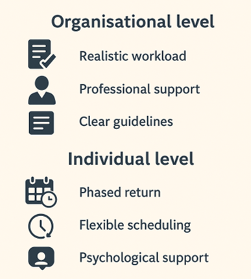
At the organisational level, schools should:

  • Ensure a realistic workload for returning teachers.
  • Provide accessible professional support such as counselling.
  • Develop clear reintegration guidelines across the institution, so teachers know what to expect.

At the individual level, reintegration must move beyond a one-size-fits-all approach. Effective measures include:

  • Phased returns, where responsibilities are built up gradually.
  • Flexible scheduling and the reduction of non-core tasks.
  • Access to psychological support.

According to the teachers we spoke to, these personalised adjustments often made the difference between a sustainable return and a renewed risk of burnout.

Moving forward

Reintegration after burnout should not be seen as a private matter for the teacher to “manage better”.

It is a shared responsibility between the individual, the school, and the wider education system.

Addressing both structural and personal dimensions of the burnout aftermath is essential to protect teachers’ well-being and ensure their long-term retention in the profession.

A graphic showing the support needed on an organisational level vs individual level for a reintegration after teacher burnout. On an organisational level: Realistic workload, professional support, and clear guidelines. On an individual level: phased return, flexible scheduling, and psychological support.

Conclusion

Teacher burnout does not end when a teacher leaves the classroom; in many ways, the story begins there. Returning to work presents its own set of challenges, requiring careful attention, supportive structures, and flexibility. By acknowledging the complexity of the “burnout aftermath” and implementing tailored strategies, schools can help teachers return stronger, healthier, and ready to thrive.

During the ECER conference in Belgrade, we had the chance to connect with fellow researchers and discuss the pressing challenges of teacher burnout. In particular, we explored the gaps in both research and practical strategies for supporting teachers as they return to work after burnout. Hearing their perspectives was incredibly enlightening and highlighted a shared commitment to promoting teacher well-being across diverse educational contexts

Key Messages

  • Returning to the classroom after burnout is just as challenging as the burnout itself; it’s a critical but often overlooked phase.
  • Workload, strained relationships, and lack of leadership support are major barriers to reintegration.
  • Supportive colleagues, counselling, and self-care practices help teachers to return.
  • Passion for teaching is both a motivator and a risk, highlighting the complexity of recovery.
  • Successful reintegration requires tailored, school-wide strategies that address both personal and professional contexts.
Aron Decuyper

Aron Decuyper

Department of Educational Studies, Ghent University, Belgium

Aron Decuyper is a doctoral researcher at the Department of Educational Studies, Ghent University (Belgium). In his PhD, he focuses on effective teaching behaviour in the context of team teaching. Furthermore, he conducts research on teacher educators and teacher well-being

Laura Thomas

Laura Thomas

Department of Educational Studies, Ghent University, Belgium

Laura Thomas is a postdoctoral researcher at the Department of Educational Studies, Ghent University (Belgium). Her research focuses on social networks and teacher wellbeing, spanning student teachers, early career teachers, and experienced teachers.

Maxime Moens

Maxime Moens

Department of Educational Studies, Ghent University, Belgium

Maxime Moens is a doctoral researcher at the Department of Educational Studies, Ghent University (Belgium). Her research focuses on school wellbeing policies, with a particular emphasis on teacher wellbeing.

Melissa Tuytens

Melissa Tuytens

Department of Educational Studies, Ghent University, Belgium

Melissa Tuytens is a professor at the Department of Educational Studies, Ghent University (Belgium). Her research and teaching focuses on policy, leadership, and people management in education.

Ruben Vanderlinde

Ruben Vanderlinde

Department of Educational Studies, Ghent University, Belgium

Ruben Vanderlinde is a professor at the Department of Educational Studies, Ghent University (Belgium). He focuses on educational innovation, teacher training and professionalisation and the integration of Information and Communication Technologies in education.

Other blog posts on similar topics:

References and Further Reading

European Commission/EACEA/Eurydice (2021). Teachers in Europe: Careers, Development and Well-being. Eurydice report. Luxembourg: Publications Office of the European Union. https://eurydice.eacea.ec.europa.eu/sites/default/files/teachers_in_europe_2020_chapter_1.pdf

Schaufeli, W., Desart, S., & De Witte, H. (2020). The Burnout Assessment Tool (BAT) – Development, validity and reliability. International Journal of Environmental Research and Public Health, 17(24), 9495. https://doi.org/10.3390/ijerph17249495

Ahola, K., Toppinen-Tanner, S., & Seppänen, J. (2017). Interventions to alleviate burnout symptoms and to support return to work among employees with burnout: Systematic review and meta-analysis. Burnout Research, 4, 1–11. https://doi.org/10.1016/j.burn.2017.02.001